Top Stories
Building Bridges Through Words Understanding Militant Ideologies in Modern Contexts Security: Beyond Walls and Weapons Upcoming Events: Connecting Ideas and People Previous Milestones: Reflecting on Our Journey Fatwas: Reclaiming the Spirit of Ethical Guidance Role of NATO in Conflict Resolution Washington Peace Deal Between Congo and Rwanda Social Justice and Equality in the Qur’ān: Implications for Global Peace The Qurʾānic Concept of Human Equality: An Analysis against Racism and Ethnic Discrimination in Contemporary Societies Reinterpreting Dhimmitude: A Reconsideration of Its Social and Political Functions in the Modern Context How China Is Playing the Long Economic War Ukraine Peace Efforts Advance Cautiously Despite Partial Alignment Among Parties How Pakistan-Libya Military Relations Strategic Outreach, Economic Stakes and Geopolitical Implications Aleppo Clashes as Syria and Kurdish-Led SDF Agree to Ceasefire Across the Border, Pakistani Ulema Stand Against Afghan Girls\' Education Ban Pakistan announce 500 fully-funded scholarships for Bangladeshi students in 8 programs How theTaliban regime threat for reginal peace Women Left Behind in Khyber Pakhtunkhwa’s Education System Sudan’s Civil War: Anatomy of the World’s Largest Humanitarian Crisis Changing Security Architecture in Central Asia Pakistan Leads India on Economic and Peace Indicators in 2026 : Gallup Survey Submerged Classrooms, Long-Term Learning Loss Pakistan Security Report 2025: Terrorism Trends and the Peace Deficit HEC’s MAKTAB Initiative Signals a New Era for Higher Education Southern Yemen Faces Tensions and Urgent Need for Peace IUT Strengthens Education Integrity in Bangladesh Pakistan’s Arms Sales Contracts (2024–25) and the Peace Dimension Pakistan\'s Contribution to UN Peacekeeping Operations for Global Peace Pakistan Enhances Educational Cooperation with Sri Lanka through Scholarship The Growing Defense and Economic Nexus of the Muslim World Charter of Trump’s Board of Peace Pakistan & Myanmar Prioritize Education Strategic Saudi defense agreements are redefining the Middle East\'s security architecture What would be the consequences of the U.S.–Iran Conflict on Pakistan? How Indian Cricket Politics Affect Regional Peace The Kashmir issue remains a central peace and stability in South Asia American Weapons in Afghanistan Are Destabilizing Pakistan Global Education Coalition sixth annual meeting A New Chapter for Pakistan’s Universities: Leadership, Stability, and Vision under the New HEC Chairman The Evolution of the IMCTC into a Global Security Pillar Reintegration Initiative: Analyzing the 2026 IMCTC Engagement in Pakistan Psychosocial Warfare and the IMCTC Peace Journalists Initiative (2026) The Concept of ‘Ummah’ in the Qurʾān: Transcending Race, Tribe, and Ethnicity HEC Reforms Regulation, Defends Academic Freedom Pakistan’s Evolving Role in Fostering Peace and Security on the African Continent Recontextualizing Pakistan’s Role in the Board of Peace War in the Middle East: Measuring the Cost The Silent Bridge: Pakistan’s Strategic Neutrality and the Quest for Middle Eastern Stability The Geography of Escalation: Living in an Age of Permanent Crisis Mapping the Educational Crisis in the Middle East Conflict The Blind Alley of “Epic Fury”; A War with no End game A Pakistani Voice Against Digital Islamophobia: A Landmark Academic Contribution World Eye on Pakistan for Middle East Peace Leading with Truth, ICEP’s Analysis Outlasted the Skeptics on Middle East Crisis World Powers Push for Deal U.S. Presents 15-Point Plan and Iran Responds with 5 Conditions Pakistan and Türkiye Open New Chapter in Academic Cooperation with Strategic Initiatives Pakistan at the Crossroads of Global Trade as a Logistics Revolution Unfolds Why Ethical Dialogue necessary in a Diverse Pakistan for a Peacebuilding Initiative Pakistan\\\'s Game-Changer Role for World Peace Entrepreneurship Education Is Shaping Pakistan\\\'s Economic Future Dr. Jamil Akhtar Featured in Prestigious Brill Encyclopaedia (2026) A Milestone in Global Interfaith Scholarship Peace Light in a Dark Night WAR RESHAPES PAKISTAN’S ECONOMY AND OPEN DOORS FOR INTERPRENEURS From Gaza to Lebanon: ICC, UN, and the Unanswered Duty to Prosecute Can Pakistan turn a temporary ceasefire into lasting middle east peace? Bridging the Gap: Confronting Education Inequality in Pakistan Hierarchical Culture In Pakistani Organizations \"How It Kills Innovation — and What Leaders Can Do About It\" Can Diplomacy Survive the Iran Crisis? Peace Efforts in an Age of Permanent Escalation Why are Peace Talks a US strategic priority? Features of Intellectual Property in the Age of Artificial Intelligence (In the Context of World Intellectual Property Day) A Global Forum for Peace, Governance, and a Better World (France\'s Landmark Contribution to International Dialogue) IS UAE WANT A \\\'CURRENCY SWAP\\\' WITH THE USA Energy War by Sea: The Hormuz Blockade Proves Oil is Still a Weapon The End of Strategic Dependence In Europe? Pakistan\'s Strategic and Structural Evolution from Crisis to Consolidated World Peace Silent Deterrence: Hangor-Class SSP-2800 and Undersea Strategy of Pakistan Inside the $9 Billion Prediction Market Revolution Pakistan at the Crossroads: Between Fragile Stability and the Weight of Structural Crisis WHY DIALOGUE FAILS IN CONFLICT ZONES; A LESSON FOR POLICY MAKERS The Crisis of American Legitimacy in the Post-Unipolar Era THE OIL CLUB UAE JUST QUIT Inside OPEC’s Biggest Defection in Decades — and What It Means for the World The Kashmir Dispute: International Institutional Failure and Humanitarian Consequences The $100 Billion Event the World Refuses to Understand How is Eid-ul-Adha A School of Peace? 250 Million Children Classrooms Zero Learning Ethical Dialogue: The Art of Speaking with Intention Ethical Dialogue: The Moral Weight of an Honest Word Skills in Their Hands, Books in Their Bags Ethical Dialogue : Honoring the Voice of the Other HEC Honors Top Pakistani Scientists and NRPU Grant Recipients at Punjab University What\'s the 14 Point of Peace deal that will be signed in Geneva When Words Carry Power: The Unequal Conversation Why Humanitarian Crises Gain Attention Only When Politicized : An International Law Perspective The Ethics of Saying Nothing The Strait of Hormuz Crisis: Energy Security in an Era of Regional War Ethical Dialogue: The Forgotten Half of Every Conversation Why is Homework Still a Thing In Modern Education Peace Beneath the Red Lines Ethical Dialogue: The Wisdom of Not Being Certain HEC\'s 47th Commission Meeting Charts Reform Path for Higher Education Sector PERIDOT: Franco-Pakistani Research Collaboration Program WINDS OF CHANGE Ethical Dialogue: Persuading Without Deceiving HEC Conducts Scholarship Test Across Bangladesh The significance of the \"same DNA\" statement Phone-free campuses could become the next step in education reform Ethical Dialogue: When Dialogue Becomes a Weapon HEC hosted a Quality Leadership Session in Faisalabad Women\'s Role in Peace-building in Somalia Modernizing the Indus Waters Treaty for the Climate Change Era How Will Pakistan Prevent Another \"Ever Given\" at Bab al-Mandab? HEC Chairman Leads Strategic Higher Education Engagements in Lahore and Karachi A Nation Cannot Prosper While Its Children Suffer NIPIS\'26 Welcomes Largest-Ever International Cohort of 50 Interns from 15 Countries The Bermuda Triangle of Promises: U.S. and Iran in Negotiations Pakistan\'s New Strategic Architecture in the Gulf Pakistan Unveils First International Defense Technology Incubation and Investment Platform Selective Justice Under the UN: India\'s Record in a Disputed Territory Married Off Instead of Educated: How Child Marriage Quietly Empties Pakistan\'s Classrooms Between Unemployment and Extremism: Can Vocational Training Break the Cycle for Pakistan\'s Youth? Winning Battles, Losing Peace: Why Military Force Has Failed in Sudan Kashmir Seven Years After Article 370: Development, Rights, and Regional Challenges HEC-NAHE Launches Strategic Planning & Leadership Excellence Workshop for University Leaders Could the Iran-US Conflict Escalate Into a NATO Crisis? Quality Education - Dawn of Tomorrow Beyond the Indus Water Treaty : Re thinking Pakistan’s water security after India’s suspension Can Justice truly exist without Morality? Climate Change as a Non-Traditional Security Threat in Pakistan HOW DOES SOCIAL MEDIA INFLUENCE STUDENTS’ ACADEMIC PERFORMANCE? How Article 370 Pushed the Kashmir Dispute Out of Delhi\'s Courts and Into International Arbitration Digital Literacy as Pakistan’s Best Armour Against Online Extremism Beyond direct talks: why backchannel mediators are crucial for modern crisis de-escalation? How Medical Education Can Promote Peace and Reduce Conflict in Pakistan? The Age of Narrative Warfare The Role of Youth in Community-Level Peacebuilding Digital Islamophobia in India after 2024 Election Article 140-A: The Constitutional Solution Pakistan Keeps Ignoring HEC Pushes AI Revolution in Pakistan’s Higher Education Sector If Iran Joins the Makkah Pact, Pakistan\'s Balancing Act Gets Harder Why Trump Refused Saudi Arabia’s Call for Direct Action Against the Houthis Is India’s BRICS Achievement Really a Diplomatic Victory? Makkah Defence Alliance Is Defensive, Says DG ISPR Ethics of Dialogue: The Courage to Speak When It Costs Something Can Kashmir’s Ecological Crisis Become a Regional Climate Security Threat? Pakistan-Türkiye Higher Education Ties Strengthened Through NUST Engagement Kohat Attack and the Fragile Path to Pakistan-Afghanistan Talks From Insurgents to Stakeholders: The Transformation of the Houthis in Yemen Stitches of Struggle: Why Kashmir’s Home-Based Women Artisans Are Left Behind in the Global Luxury Economy Soft Power without Hollywood: How China Is Making Culture a Strategic Asset The Rise of Ittehad-ul-Mujahideen Pakistan: A new challenge to Pakistan’s militant landscape The New U.S- Iran Maritime Standoff - Who Controls Hormuz
Education

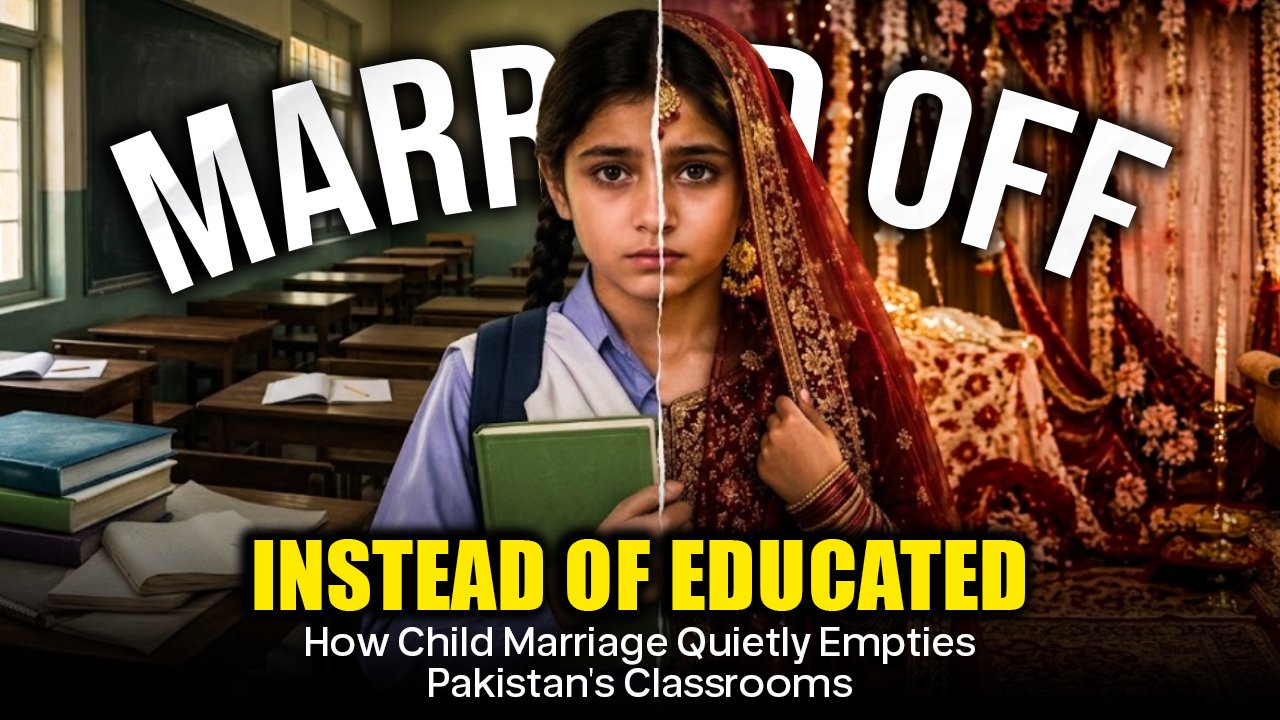
Married Off Instead of Educated: How Child Marriage Quietly Empties Pakistan\'s Classrooms

In many government girls' schools across rural Pakistan, the ninth-grade classroom tells a quieter story than any dropout statistic. The rows that were full in sixth grade begin to thin out, not because the girls who are missing have failed their exams, but because many of them are already wives, and some are already mothers. Child marriage in Pakistan is often discussed as a health issue or a human rights violation, and it is both. But it is also, just as urgently, an education crisis, one that empties classrooms one signature on a nikah nama at a time.

For a student of international relations, the issue is best understood through the lens of human security: a framework that looks beyond the state and asks whether individuals, especially the most vulnerable, are protected from the everyday threats that shape their lives. Seen this way, child marriage is not simply a private family decision. It is a structural failure that intersects with poverty, weak enforcement of existing laws, and gaps in access to schooling, and it directly undermines a girl's right to education long before she has any say in the matter.

The scale of the problem is significant. National estimates suggest that roughly eighteen percent of girls in Pakistan marry before the age of eighteen, though the figure varies sharply by income and geography. Among the poorest households, the share of girls married as children is nearly five times higher than among the wealthiest, a gap that points less to culture alone and more to economic desperation. Families facing poverty, displacement after floods or other disasters, or a lack of nearby schools often see early marriage as a form of security, one less mouth to feed, one daughter settled. Education, meanwhile, remains one of the few proven protections against this practice; girls with no schooling are far more likely to be married as children than those who complete secondary education. The relationship, however, runs both ways. Just as a lack of schooling leaves girls more vulnerable to early marriage, marriage itself is one of the leading reasons girls leave school in the first place.

The dropout figures make this connection difficult to ignore. Girls drop out of school at notably higher rates than boys, and by the end of sixth grade, well over half of girls enrolled have already left the system entirely, a steeper decline than their male classmates experience. At the secondary level, the gender gap widens further, particularly in rural districts where middle and high schools are located far from home. Once a girl is married, continuing her education is rarely treated as a priority. Domestic responsibilities, early pregnancy, and social expectations about a married woman's role combine to push schooling to the margins, even in cases where the family might otherwise have supported her studies. In this way, child marriage does not merely coincide with low female literacy; it actively produces it, generation after generation.

 Beyond the immediate loss of education, the long-term consequences are profound. Girls who leave school early are more likely to remain economically dependent, limiting their participation in the workforce and narrowing their life choices. Lower levels of female education are closely linked to poorer health outcomes, reduced civic participation, and slower economic growth. When a girl is married off before completing her education, the cost is not borne by her alone. It is absorbed by communities and, ultimately, by the country’s development trajectory.

The picture also differs by province, which matters for anyone thinking about solutions. Sindh moved early, raising the minimum marriage age to eighteen for both genders in 2014 and making violations a punishable offence. Balochistan, where surveys suggest close to two-thirds of marriages occur before girls turn eighteen, has more recently introduced its own criminalising legislation, following years of advocacy from civil society groups and reporting on the province's education gaps. These legal steps are meaningful, but critics have argued that legislation alone has limited reach in regions where enforcement is weak, courts are distant, and marriage registration itself is informal or unrecorded. Difficult terrain, understaffed schools, and long-standing gender norms that expect girls to remain at home compound the challenge in these areas, meaning a law on paper does not automatically change a decision made inside a household under economic pressure.

 Punjab and Khyber Pakhtunkhwa have also debated reforms, yet disparities between urban and rural districts remain stark. In remote communities, the absence of girls’ secondary schools within safe travelling distance effectively narrows choices for families. Where schools exist but lack boundary walls, sanitation facilities, or female teachers, parents may withdraw daughters at puberty, fearing for their safety or reputation. In such contexts, marriage can appear as the socially acceptable alternative to uncertainty.

 None of this is to suggest that the problem is unsolvable. Programs that combine community awareness sessions with tangible support, such as stipends for keeping girls in school or investment in nearby secondary schools, have shown that families do respond when the incentives around a daughter's future shift. Conditional cash transfer initiatives in particular have demonstrated measurable improvements in girls’ enrollment and retention. What the evidence consistently shows is that education and child marriage are locked in a cycle: each additional year a girl stays in school lowers her risk of early marriage, and each marriage prevented keeps a girl in the classroom a little longer.

 Religious scholars, local leaders, and teachers also have a critical role to play in reshaping community narratives. Where sermons, village meetings, and school outreach programs emphasise the compatibility of girls’ education with cultural and religious values, resistance often softens. When communities see educated women contributing as teachers, health workers, and entrepreneurs, the perceived return on educating daughters becomes more tangible.

In sum, child marriage in Pakistan functions as both a cause and a consequence of girls' exclusion from education. National data shows a clear link between poverty, low school access, and early marriage, while dropout figures confirm that marriage itself is a leading reason girls leave the classroom before completing their schooling. Provincial legislation in Sindh and Balochistan represents genuine progress, but the persistence of the practice across income groups and regions suggests that legal reform alone cannot fill classrooms' empty seats. Addressing the economic pressures that push families toward early marriage, expanding girls' access to secondary schools, improving school infrastructure, and strengthening enforcement of existing laws together offer a more complete path toward keeping Pakistan's daughters in school rather than married off before they have the chance to finish their education.