International law is based
on a basic principal rules are enforced in the same way whether powerful or
wealthy. But there is otherwise the dispute over Jammu and Kashmir that has
been ongoing for 7 decades. India which has been touting itself as the
"world's largest democracy," has for decades been opposing the very
framework of the United Nations it had formally acceded to in order to address
the Kashmir issue. Under three different heads of international law its actions
in the region it administers give rise to serious concerns: regarding the right
to self-determination as enshrined in UN Security Council resolutions on
Kashmir international human rights law, as detailed in UN's own human rights
office and since its constitutional changes in 2019 the rules for occupying
powers duties in relation to an area's demographic character. All of these
infractions would be significant on their own. Together they create a pattern a
rules-based international order would not allow a weaker state to follow what
critics of the current system complain of: that under UN law the weak suffer
while the strong go free.
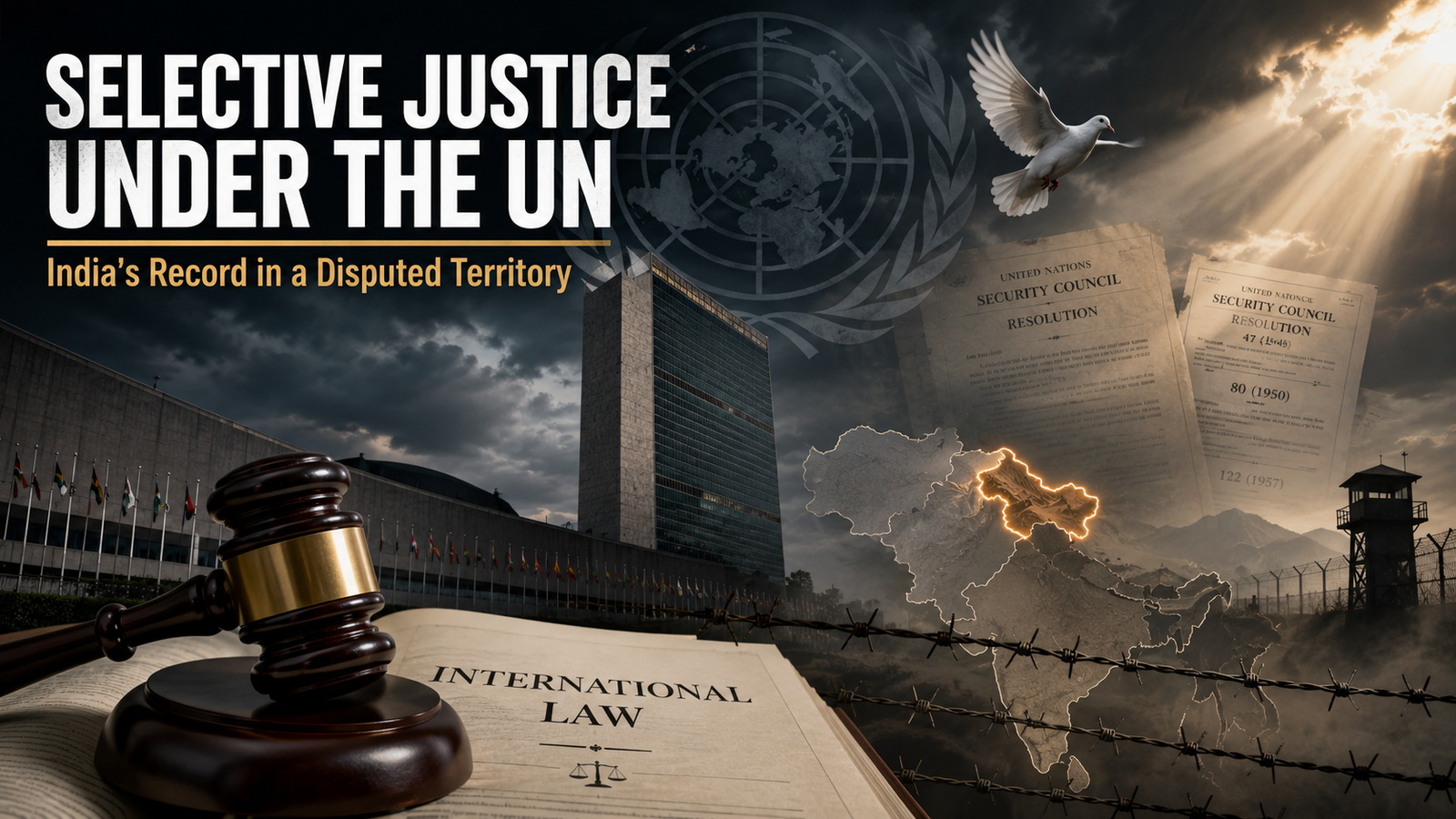
The Kashmir issue was lodged
in the UN records within just months of Partition in 1947 where the conflict
between India and Pakistan over the accession of the princely state of Kashmir
was recorded. The Security Council adopted Resolution 39 to establish a
commission to mediate on 20 January 1948. Resolution 47 which led to a
ceasefire and a phased demilitarization followed on 21 April 1948, along with a
"free and impartial plebiscite" for the people of Jammu and Kashmir
to decide between India and Pakistan. This was a course that India's own
leadership at the time had publicly taken: Jawaharlal Nehru had time and again
declared to the world and to the Kashmiri people that their future would be
decided by their own people's choice once the time was ripe. Soon after, the UN
Commission for India and Pakistan reiterated this with additional resolutions
in August 1948 and January 1949, which both India and Pakistan accepted thus
stating that the problem of accession would be taken up through a UN supervised
plebiscite. This was restated in later Security Council resolutions (Resolution
80, 1950 and Resolution 122, 1957). Over the next few decades, however, India
went from acceptance of the provisional nature of its status to outright
rejection, and it declared that the state constituent assembly in the state of
Kashmir had finalized the issue of accession in 1956, even though Pakistan and
the UN's own resolutions failed to recognize this as a replacement for the
promised plebiscite.
All the independent evidence
of India's actions in the Kashmir Valley has come from the United Nations'
human rights machinery and not from the Pakistanis. The Office of the UN High
Commissioner for Human Rights (OHCHR) also published its first-ever report on
Kashmir in June 2018 which documented that by March 2018 a total of 145
civilians had been killed by Indian security forces since mid-2016 and that the
use of pellet guns by the security forces, a type of gun singled out in the
report as a major weapon of civilian injuries and blinding, was a regular
feature of the protests. In July 2019 a new OHCHR report found that the
situation in terms of human rights had not improved either; it reported that
1,253 people were blinded by pellet munitions between mid-2016 and the end of
2018, and that there had been 160 civilian deaths in 2018 alone the highest in more than 10 years. It examined
extrajudicial executions, arbitrary arrests, custodial deaths, enforced
disappearances and torture, including sexual, by Indian security forces and
found that there was a "virtually non-existent" accountability for
such actions in the cases it examined, despite the many instances of such
killings and arrests. The two reports both demanded an independent
international commission of inquiry into the situation which to date neither
India nor the UN Human Rights Council has set up.
On 5 August 2019 the
Government of India unilaterally withdrew Articles 370 and 35A from its
Constitution which had guaranteed Jammu and Kashmir a degree of autonomy and
had placed restrictions on property rights that were only open to permanent
residents of the region with the aim of preserving the area's demographic
makeup while its status was left un clarified on the international stage. The
move was unconstitutional without any representative body of Kashmir's consent,
along with the bifurcation of the state into two federally administered
territories communications blackout and thousands detained including mainstream
Kashmiri political leaders, who had never opposed the Indian state's
sovereignty in Kashmir. New domicile laws were then enacted that allowed
permanently for the first time non-Kashmiri Indian citizens to enjoy permanent
residency and thus property rights an intention critics allege is to change the
demographic makeup of the region, which has a Muslim majority precisely what
Article 35A sought to avert. This form of unilateral demographic and
constitutional restructure by the administering party is not particularly
compatible with the basic UN principle — enshrined in the UN's own unrestricted
policy on disputed and occupied territories — that ‘no party to a dispute
should take irreversible steps to prejudice the outcome' of the conflict. That
is exactly what India did, without the consent of the UN or the Kashmiris.
The abrogation was not in
isolation, rather it has coincided with the most critical time in the
relationship between India and Pakistan in decades. A few months before the
abrogation, in February 2019, a suicide attack in Pulwama claimed the lives of
40 Indian security forces, leading to Indian airstrikes on Balakot and an air
clash between the two nuclear powers in February 2019, though brief and
serious. Next, in April 2025, the attack against tourists at Pahalgam resulted
in the death of 26 civilians, which was responded to by India in May 2025 with
Operation Sindoor, a missile- and
air-strike campaign against sites within Pakistan and Pakistan-administered
Kashmir. Four days of the most intense direct military confrontation between
the two nations in more than 50 years — artillery barrages and drone attacks at
air defense installations along the border, and explosions and shelling in
Srinagar and Jammu — followed, before a ceasefire brokered by the United States
was violated within hours, when shelling and explosions were again heard in
Srinagar and Jammu. In six years, two nuclear-armed neighbours have been at the
brink of full war over the Kashmir issue twice, without resolving the issue
themselves but only by bringing in external mediators. One of the most possible
flash points for nuclear war in the world right now, according to any honest
interpretation of the UN documents is the dispute over the universal
declaration of human rights. For this region to escape this fate, the
international communit whether the UN Security Council or the regional and
global powers that wield influence over them must refrain from treating the
Kashmir issue as a settled one. The unresolved plebiscite the unaddressed human
rights findings by the UN's own human rights office and the unilateral
constitutional changes carried out in 2019 rule out anything but a return to
the UN framework which India and Pakistan agreed to, but continue to defer
indefinitely.
The Kashmir issue is one of
the most significant and unresolved disputes in South Asia, having far-reaching
implications for regional and international security. The status quo has not
proved to be a long-term solution to peace in recent decades, as it has been
plagued by political conflict, conflicting legal views and repeated military
crises. Each escalation can endanger a broader conflict between two nuclear
powers, and a peaceful solution is a pressing task for the international community.
The repercussions of any military response by either India or Pakistan, without
any convincing proof, or any real attempt to investigate, or any real
diplomatic effort would go well beyond the borders of the South Asian nations.
A miscalculation, retaliation, and quick escalation could lead to a large war
with the potential of devastating humanitarian, economic, and security
repercussions for millions of people. This cannot be achieved by restraint,
discussion and respect for international law, not by the unilateral use of
force. The international community, especially the United Nations and influential
global powers, should take a more active role in helping to defuse tensions and
promote peaceful conflict resolution. Diplomatic cooperation, respect for human
rights, a fair investigation of events that might spark conflict, and
constructive negotiations between all the parties involved are key elements
towards stability.
In conclusion, Kashmir is
one of the key issues that continues to be a matter of dispute between India
and Pakistan. Dialogue, international law and mutual respect are the most
powerful means to forestall future conflicts and to build peace and security in
South Asia in a just, peaceful and sustainable manner. Peace is not possible
through military conflict, it must be achieved through negotiations,
responsibility and a desire to solve the conflict that is the root of it.
_6784.jpg)