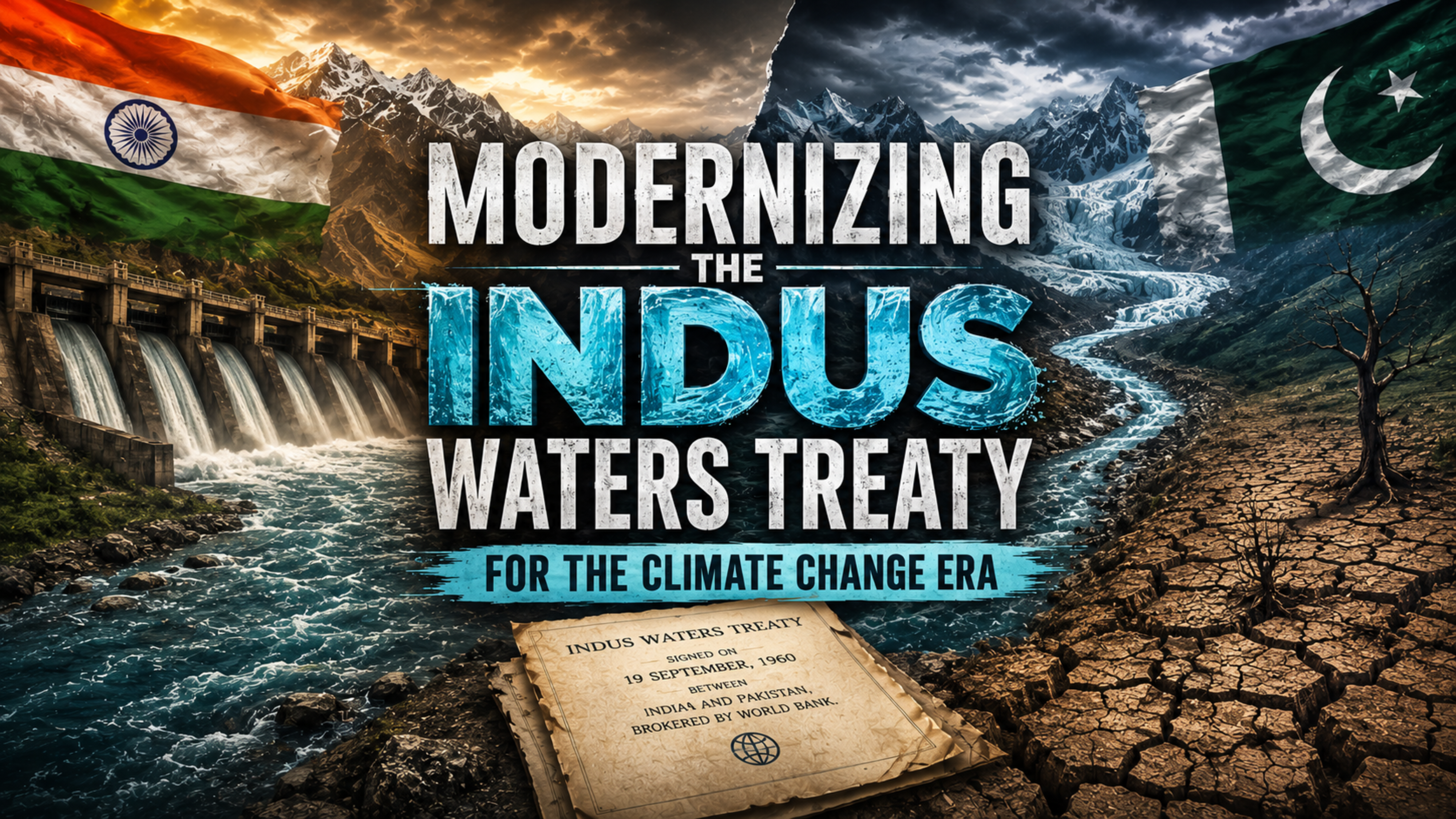

The Indus water Treaty has survived three intense between India and Pakistan, but what it may not survive is the melting of glaciers.Indus water treaty signed on 19 September,1960, between Indian and Pakistan, brokered by World Bank. It was built for a different era where climate conditions and political conditions were different, it wasn’t designed to address contemporary challenges. The accelerating impact on climate change, including rising temperatures, melting glaciers and increasingly unpredictable water flows, highlights the urgent need to modernize the treaty.
Indus water originally originated from glaciers near lake Mansarovar in the Kailash mountain range
of Tibet and flows northwest through the distributed Kashmir region. As a glacier-fed
river system, its flow is highly dependent on seasonal snow and glacial
melt. However, climate change has accelerated glacier melting and altered
precipitation patterns, making river flows increasingly unpredictable. These
emerging hydrological changes were not anticipated when the Indus Waters Treaty
was negotiated in 1960.
There are many more challenges other than climate change
which are making this treaty highly vulnerable. Which include lack of real
time sharing of data hydrological data sharing between India and Pakistan, deforestation
and inadequate afforestation
efforts, Deforestation in the upper catchment areas of Indus River has reduced
the natural ability of forest to regulate glacier melt and maintain stable
river flows. Pakistan and India are both depended on this river but have never
made efforts to its ecosystem There has been insufficient cooperation to
prevent deforestation,
promote afforestation. Poor water management particularly in Pakistan, remains
a major challenge. Pakistan has limited reservoirs storage capacity, resulting
in a significant amount of water flowing unused into the sea instead of being
stored for agricultural, industrial, and domestic use. Reservoir capacity isn't
just an efficiency question it's a matter of life and death. The floods that
have repeatedly devastated Pakistan, displacing tens of millions and killing
thousands, like the 2022 floods,
which killed over
1,700 people and displaced over 30 million) they aren't purely acts of
nature. They're also a failure of storage water that had nowhere to go except
into peoples.
That’s why it’s important to add some supplementary
clauses in the treaty to make it even more effective. The treaty has worked
for 66 years but that does not mean it will be enough for today’s
challenges. If the treaty is not updated it could put people's lives,
livelihoods, and water security at risk.
Given how politically
radioactive a full renegotiation of the treaty would be, the more realistic
path is a supplementary framework one that sits alongside the existing treaty
without touching allocation, usage rights, or sovereign control, and instead
patches the specific gaps identified above. Following clauses should be added
in the treaty to make it more effective and suitable for contemporary period.
Firstly, there should be the Joint Climate and Ecosystem Protection
Cooperation, both countries should agree to adopt a joint climate
resilience approach focused on long term sustainability of the river
system, including:
Glacier monitoring and
seasonal flow assessment.
· Afforestation and reforestation programs
in upper catchment and glacier adjacent areas.
· Prevention of
deforestation in critical watershed cones.
· Promotion of
climate-resilient native vegetation including the fast growing and soil-
stabilizing species such as Deodar cedar, blue pine (Pinus wallichiana),
and other native species, to reduce soil erosion, regulate local temperatures,
enhance carbon sequestration, and maintain ecosystem balance.
· Joint Flood forecasting and drought assessment systems
These measures aim to stabilize watershed
ecosystems and indirectly support glacier sustainability, in alignment with the
United Nations Framework Convention on Climate Change and relevant SDGs (Goal 13).
Secondly, Parties should agree to establish a near real
time data sharing system to enhance to predictability and reduce
uncertainty, including:
·
River flow level at regular
intervals
·
Inflow and outflow data at major
upstream points
·
Non-sensitive
information on gate operations (opening/closing patterns)
· Short-term pondage and release patterns within permitted limitsData shall be shared at mutually agreed intervals, following a flexible, condition-based approach. During normal conditions, periodic updates shall be maintained, while during periods of high variability, flood risk, or significant operational changes, the frequency of updates may increase, including near real-time sharing where feasible.This directly addresses the current gap where only general or delayed data is shared, but operational timing data is missing.And all this will be monitored by the joint technical working group as a technical extension of the existing framework under the Indus Waters Treaty, working alongside the Permanent Indus Commission.
None of these clauses redraw borders or reallocate a single cusec of water. That's the point. It's the difference between renegotiating a treaty and patching its blind spots and given the current political climate between the two countries, patching is the only version of reform with a realistic path forward. But Data and Diplomacy Aren't Enough, Pakistan Has to Fix Its Own Storage Problem
Indus water treaty would be only solving the water information
and protection; it does nothing about the fact that Pakistan currently has some
of the lowest water storage capacity per capita of any major river-dependent
country in the world and that’s Pakistan’s internal problem it has nothing to
do with India. That’s why Pakistan should be focusing on this issue that how
they can effectively manage the water, by engaging with water
resources engineers, hydrologist hydraulic engineers
and other experts to conduct research and improve the reservoir planning and
development.
The Indus Water Treaty upgradation that I have proposed is
quiet modest. It suggests practical improvements rather than rewriting the
entire treaty. It does not ask India to give up water it already has the right to,
nor it ask Pakistan to give up any right of its water. It just focuses on the
gaps that were not addressing contemporary challenges. Along with the
upgradation in the treaty is also suggest that Pakistan must invest in
reservoirs, dams and modern water management systems.



_6784.jpg)