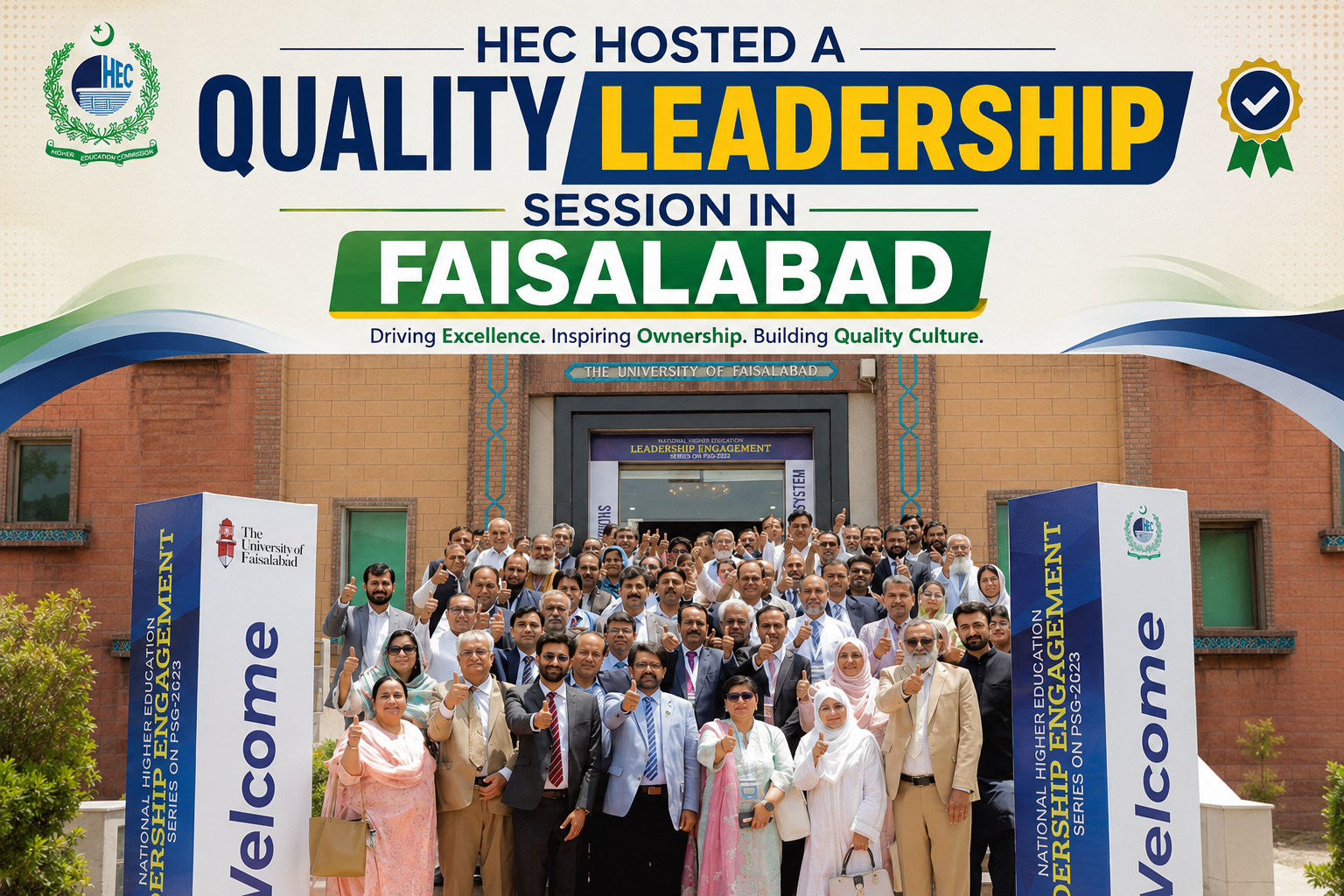

The Higher
Education Commission (HEC) of Pakistan successfully held another regional
meeting of the National Leadership Engagement Series on Pakistan Precepts,
Standards and Guidelines (PSG-2023) titled "The Quality Compact" at
the University of Faisalabad. It was a platform for the Deans, Registrars,
quality assurance officers, those from industry and students from 23
degree-awarding institutions of South Punjab to reinforce a commitment to
excellence in higher education.
The session
was organized by the Quality Assurance Agency (QAA) of HEC and focused on the
theme “From Conformity to Ownership,” which highlighted that the universities
should move beyond the context of regulatory compliance and build a culture of
collective institutional responsibility for quality assurance. The programme is
part of HEC's efforts to improve governance in the higher education system, the
quality of higher education and institutional performance throughout Pakistan.
The
engagement was designed to give the university leadership an understanding of
the Pakistan Precepts, Standards and Guidelines (PSG-2023) which is a detailed
document developed by the HEC that enables continuous quality improvement in
higher education institutions. The participants shared their views on the role
of the framework for creating a transparent governance system in the
university, improving teaching and learning, qualitying research, and improving
student care.
One of the
major achievements of the session was the introduction of the PERLI Golden
Thread framework that showcases how all four processes of institutional vision,
planning, implementation, review and continuous improvement should be connected
to guarantee sustainable quality improvement. Attendees discussed through
dialogue and practical examples ways to integrate the principles of quality
assurance into institutional planning and academic life.
The event
also highlighted the recently launched digital platform, Q-CIRCLE, by HEC for
continuous institutional review, quality monitoring and evidence-based
decision-making. It is expected to modernize the process of quality assurance
on the platform, allowing institutions to monitor quality indicators, record
results, and enhance internal quality assurance processes by leveraging
transparency and technology.
The session
also served to connect with industry professionals and students, acknowledging
the need for a collaborative approach among all stakeholders to drive quality
education. Perspectives were offered by industry members around the theme of
bridging the gap between the changing needs of the workforce and higher
education, and students shared their ideas and suggestions for enhancing their
learning experiences and institutional services. Their involvement underlined
the need to be responsive to society needs and future job market requirements
regarding quality assurance.
The National
Leadership Engagement Series is designed to foster institutional ownership of
quality assurance and not just an exercise of compliance, officials said. HEC
aims to establish a sustainable quality culture that enables universities to
continue to enhance the quality of teaching and learning and the effectiveness
of the institutions.
This
engagement in the region in Faisalabad is another significant initiative
undertaken by HEC to build the capacity of the education institutions and
enhance leadership skills in Pakistan's higher education sector, which is
sustained by continuous innovation and capacity building. The implementation of
PSG-2023 will likely contribute greatly to the improvement of educational
standards, competitiveness of Pakistan's higher education system, and public
confidence in the quality of Pakistan's higher education system with the
efforts of various initiatives like Quality Compact.
The
Islamabad Center for Peace and Education (ICPE) hailed HEC's ongoing initiative
to foster a culture of quality in Pakistan's universities and said the National
Leadership Engagement Series (NLES) was a timely and progressive effort to
develop a culture of quality. ICPE says the shift from 'conformity to
ownership' is a 'significant change in the governance of higher education'. HEC
is empowering university leaders to continuously strive for improvements and
not only regulatory compliance by providing them with up-to-date frameworks
like PSG-2023, the PERLI Golden Thread, and the Q-CIRCLE digital platform.
The ICEP
believes that continuous efforts in quality assurance, academic leadership, and
stakeholder engagement will help build a robust knowledge economy in Pakistan,
making graduates more employable, improving research quality, and boosting the
international credibility of Pakistani universities. ICPE also emphasized that
promoting academic-industry-academic linkages is crucial to creating an
innovative, inclusive, and international higher education system that can
support Pakistan's long-term social and economic development.



_6784.jpg)