
Top Stories
Building Bridges Through Words Understanding Militant Ideologies in Modern Contexts Security: Beyond Walls and Weapons Upcoming Events: Connecting Ideas and People Previous Milestones: Reflecting on Our Journey Fatwas: Reclaiming the Spirit of Ethical Guidance Role of NATO in Conflict Resolution Washington Peace Deal Between Congo and Rwanda Social Justice and Equality in the Qur’ān: Implications for Global Peace The Qurʾānic Concept of Human Equality: An Analysis against Racism and Ethnic Discrimination in Contemporary Societies Reinterpreting Dhimmitude: A Reconsideration of Its Social and Political Functions in the Modern Context How China Is Playing the Long Economic War Ukraine Peace Efforts Advance Cautiously Despite Partial Alignment Among Parties How Pakistan-Libya Military Relations Strategic Outreach, Economic Stakes and Geopolitical Implications Aleppo Clashes as Syria and Kurdish-Led SDF Agree to Ceasefire Across the Border, Pakistani Ulema Stand Against Afghan Girls\' Education Ban Pakistan announce 500 fully-funded scholarships for Bangladeshi students in 8 programs How theTaliban regime threat for reginal peace Women Left Behind in Khyber Pakhtunkhwa’s Education System Sudan’s Civil War: Anatomy of the World’s Largest Humanitarian Crisis Changing Security Architecture in Central Asia Pakistan Leads India on Economic and Peace Indicators in 2026 : Gallup Survey Submerged Classrooms, Long-Term Learning Loss Pakistan Security Report 2025: Terrorism Trends and the Peace Deficit HEC’s MAKTAB Initiative Signals a New Era for Higher Education Southern Yemen Faces Tensions and Urgent Need for Peace IUT Strengthens Education Integrity in Bangladesh Pakistan’s Arms Sales Contracts (2024–25) and the Peace Dimension Pakistan\'s Contribution to UN Peacekeeping Operations for Global Peace Pakistan Enhances Educational Cooperation with Sri Lanka through Scholarship The Growing Defense and Economic Nexus of the Muslim World Charter of Trump’s Board of Peace Pakistan & Myanmar Prioritize Education Strategic Saudi defense agreements are redefining the Middle East\'s security architecture What would be the consequences of the U.S.–Iran Conflict on Pakistan? How Indian Cricket Politics Affect Regional Peace The Kashmir issue remains a central peace and stability in South Asia American Weapons in Afghanistan Are Destabilizing Pakistan Global Education Coalition sixth annual meeting A New Chapter for Pakistan’s Universities: Leadership, Stability, and Vision under the New HEC Chairman The Evolution of the IMCTC into a Global Security Pillar Reintegration Initiative: Analyzing the 2026 IMCTC Engagement in Pakistan Psychosocial Warfare and the IMCTC Peace Journalists Initiative (2026) The Concept of ‘Ummah’ in the Qurʾān: Transcending Race, Tribe, and Ethnicity HEC Reforms Regulation, Defends Academic Freedom Pakistan’s Evolving Role in Fostering Peace and Security on the African Continent Recontextualizing Pakistan’s Role in the Board of Peace War in the Middle East: Measuring the Cost The Silent Bridge: Pakistan’s Strategic Neutrality and the Quest for Middle Eastern Stability The Geography of Escalation: Living in an Age of Permanent Crisis Mapping the Educational Crisis in the Middle East Conflict The Blind Alley of “Epic Fury”; A War with no End game A Pakistani Voice Against Digital Islamophobia: A Landmark Academic Contribution World Eye on Pakistan for Middle East Peace Leading with Truth, ICEP’s Analysis Outlasted the Skeptics on Middle East Crisis World Powers Push for Deal U.S. Presents 15-Point Plan and Iran Responds with 5 Conditions Pakistan and Türkiye Open New Chapter in Academic Cooperation with Strategic Initiatives Pakistan at the Crossroads of Global Trade as a Logistics Revolution Unfolds Why Ethical Dialogue necessary in a Diverse Pakistan for a Peacebuilding Initiative Pakistan\\\'s Game-Changer Role for World Peace Entrepreneurship Education Is Shaping Pakistan\\\'s Economic Future Dr. Jamil Akhtar Featured in Prestigious Brill Encyclopaedia (2026) A Milestone in Global Interfaith Scholarship Peace Light in a Dark Night WAR RESHAPES PAKISTAN’S ECONOMY AND OPEN DOORS FOR INTERPRENEURS From Gaza to Lebanon: ICC, UN, and the Unanswered Duty to Prosecute Can Pakistan turn a temporary ceasefire into lasting middle east peace? Bridging the Gap: Confronting Education Inequality in Pakistan Hierarchical Culture In Pakistani Organizations \"How It Kills Innovation — and What Leaders Can Do About It\" Can Diplomacy Survive the Iran Crisis? Peace Efforts in an Age of Permanent Escalation Why are Peace Talks a US strategic priority? Features of Intellectual Property in the Age of Artificial Intelligence (In the Context of World Intellectual Property Day) A Global Forum for Peace, Governance, and a Better World (France\'s Landmark Contribution to International Dialogue) IS UAE WANT A \\\'CURRENCY SWAP\\\' WITH THE USA Energy War by Sea: The Hormuz Blockade Proves Oil is Still a Weapon The End of Strategic Dependence In Europe? Pakistan\'s Strategic and Structural Evolution from Crisis to Consolidated World Peace Silent Deterrence: Hangor-Class SSP-2800 and Undersea Strategy of Pakistan Inside the $9 Billion Prediction Market Revolution Pakistan at the Crossroads: Between Fragile Stability and the Weight of Structural Crisis WHY DIALOGUE FAILS IN CONFLICT ZONES; A LESSON FOR POLICY MAKERS The Crisis of American Legitimacy in the Post-Unipolar Era THE OIL CLUB UAE JUST QUIT Inside OPEC’s Biggest Defection in Decades — and What It Means for the World The Kashmir Dispute: International Institutional Failure and Humanitarian Consequences The $100 Billion Event the World Refuses to Understand How is Eid-ul-Adha A School of Peace? 250 Million Children Classrooms Zero Learning Ethical Dialogue: The Art of Speaking with Intention Ethical Dialogue: The Moral Weight of an Honest Word Skills in Their Hands, Books in Their Bags Ethical Dialogue : Honoring the Voice of the Other HEC Honors Top Pakistani Scientists and NRPU Grant Recipients at Punjab University What\'s the 14 Point of Peace deal that will be signed in Geneva When Words Carry Power: The Unequal Conversation Why Humanitarian Crises Gain Attention Only When Politicized : An International Law Perspective The Ethics of Saying Nothing The Strait of Hormuz Crisis: Energy Security in an Era of Regional War Ethical Dialogue: The Forgotten Half of Every Conversation Why is Homework Still a Thing In Modern Education Peace Beneath the Red Lines Ethical Dialogue: The Wisdom of Not Being Certain HEC\'s 47th Commission Meeting Charts Reform Path for Higher Education Sector PERIDOT: Franco-Pakistani Research Collaboration Program WINDS OF CHANGE Ethical Dialogue: Persuading Without Deceiving HEC Conducts Scholarship Test Across Bangladesh The significance of the \"same DNA\" statement Phone-free campuses could become the next step in education reform Ethical Dialogue: When Dialogue Becomes a Weapon HEC hosted a Quality Leadership Session in Faisalabad Women\'s Role in Peace-building in Somalia Modernizing the Indus Waters Treaty for the Climate Change Era How Will Pakistan Prevent Another \"Ever Given\" at Bab al-Mandab? HEC Chairman Leads Strategic Higher Education Engagements in Lahore and Karachi
Security

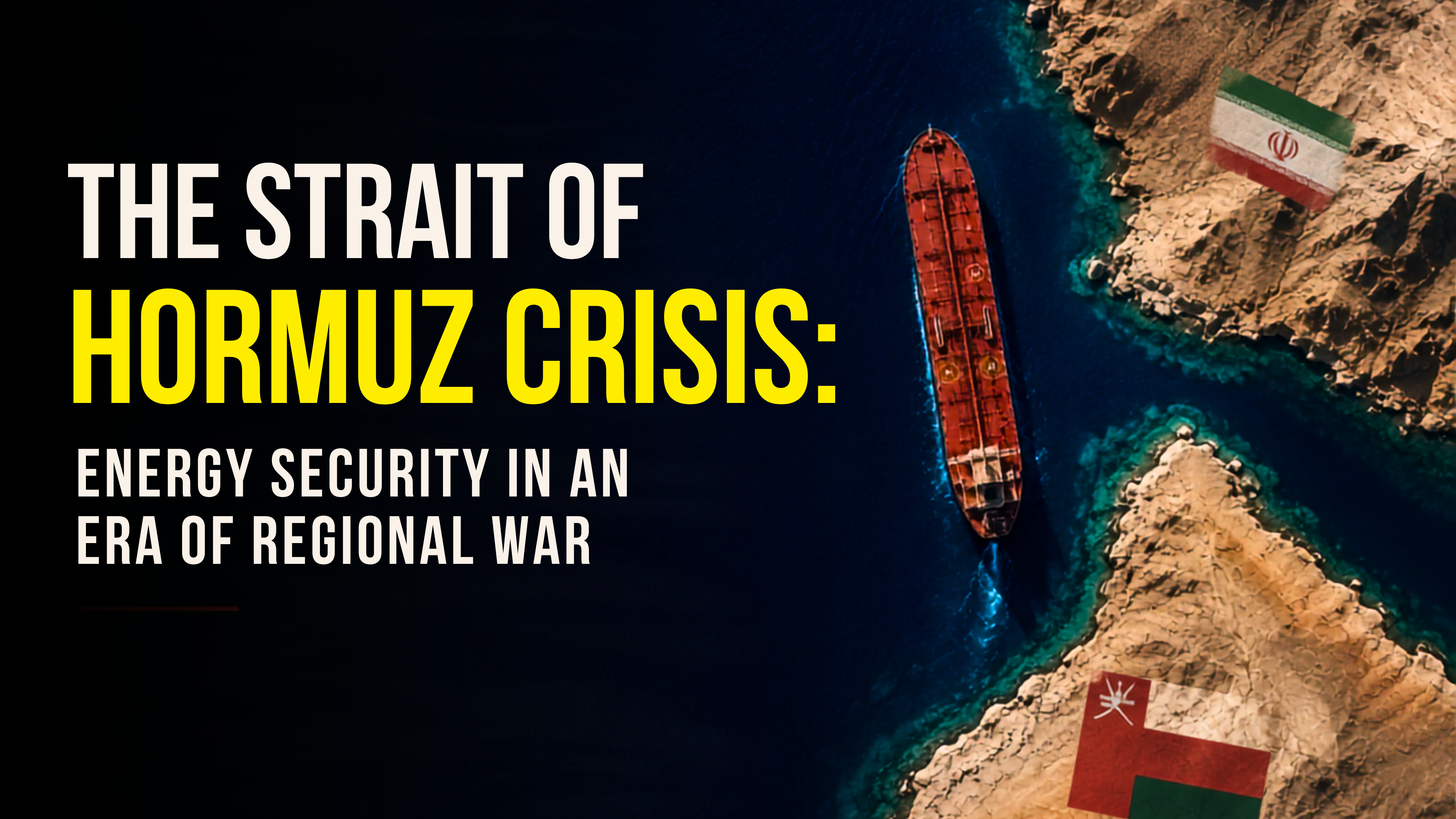
The Strait of Hormuz Crisis: Energy Security in an Era of Regional War

There’s a single choke-point that keeps the lights on in Karachi, the buses running in Lahore, and the mills spinning in Faisalabad. It’s not in Pakistan. It’s a 33-kilometre stretch of water between Iran and Oman, and when it closed, Pakistan stopped. Petrol stations ran dry. Grocery bills doubled in a week. Hospitals started rationing diesel for generators. The Strait of Hormuz shut down, and a country of 240 million people discovered just how fast modern life unravels when one shipping lane does.

The Strait of Hormuz looks unremarkable on a map. Just 33 kilometers wide, tucked between Iran and Oman at the entrance to the Persian Gulf. But in 2024, roughly 20 million barrels of crude oil, condensate, and refined fuels passed through it every day. That’s about a fifth of all the petroleum liquids the world uses. On top of that, Europe gets 12 to 14% of its LNG from Qatar through the same route, plus up to 30% of globally traded fertilizer. All of it squeezed through that one passage.

When the strait effectively shut down on February 28, 2026, the day when US and Israel launched Operation Epic Fury against Iran, the fallout was immediate. Iran hit them back with drones, ballistic missiles, and small attack boats, making the route more risky for commercial ships. Insurance either vanished or it totally became impossibly expensive. Crews refused to sail. Traffic collapsed. What was around 130 ships a day in February dropped to just 6 in March. A 95% fall. The International Energy Agency called it the “greatest global energy security challenge in history” and “the largest supply disruption in the history of the global oil market.”

Pakistan is right in the middle of this mess, not because it lit the match, but because it built its whole energy system next to a powder keg. About 80% of Pakistan’s crude oil imports come through the Strait of Hormuz. And with only 10 to 14 days of reserves, among the lowest anywhere, compared to the IEA’s recommended 90-day buffer, there was no cushion when the crisis hit. Fuel and food prices jumped overnight. Lines formed at petrol stations. The government cut the work week for about four days, shut down the schools, and told people to work from home. Pakistan even asked cricket fans to watch matches at home to save fuel. That small detail says a lot about how bad things got.

The numbers are brutal. If oil stays near $150 a barrel, Pakistan’s monthly fuel bill could triple, hitting $3.5 to $4.5 billion. That isn’t just a budget problem for the finance ministry. It shows up in bus fares, in a sack of flour, in the price of medicine. The Pakistan Institute of Development Economics warned inflation could hit 15 to 17% if the disruption drags on. In a country where so many live hand to mouth, that’s devastating. The World Bank points out that food eats up around 43% of household spending in low-income countries. For Pakistan’s urban poor, daily wages run out long before the week does.

And this isn’t just Pakistan’s problem. Energy prices are set to jump 24% in 2026, the highest since Russia invaded Ukraine in 2022, according to the World Bank’s latest Commodity Markets Outlook. Fertilizer costs have spiked 31%, putting up to 45 million more people at risk of acute food insecurity worldwide. The World Bank’s Chief Economist, Indermit Gill, put it bluntly: “The war is hitting the global economy in cumulative waves: first through higher energy prices, then higher food prices, and finally, higher inflation, which will push up interest rates and make debt even more expensive.”

Asia took the first and hardest hit, with 84% of crude shipments through the strait in 2024 headed for Asian markets. Pakistan, Bangladesh, and Vietnam are among the worst off. The Philippines declared a national energy emergency. On Wall Street and in Washington, people started talking about $200 oil. Traders and energy advisers kept saying the world still hadn’t grasped how serious this was. This is the 1970s oil shock all over again, only bigger, faster, and tied into everything.

In a strange twist, Pakistan ended up playing a key diplomatic role. On June 18, 2026, Pakistan, acting as the main mediator, announced that the US-Iran memorandum meant Tehran would reopen the strait soon. Pakistan helped end a crisis that had almost flattened it. A country with enough pull to broker peace abroad couldn’t even keep its own petrol pumps running. That should rattle every policymaker in Islamabad.

The fix isn’t mysterious. Build strategic oil reserves for at least 60 to 90 days. Go big on solar and hydro-power. Cut reliance on imported LNG. Fix public transport to burn less fuel. Find other ways to bring in oil. None of this is radical. Most middle-income countries figured it out years ago.

Pakistan didn’t start this war. It didn’t mine the strait. It didn’t launch Operation Epic Fury. But it’s paying the price, because years of putting things off left it exposed when the inevitable happened. The waters of the Strait of Hormuz are opening up again. The tankers will move. Prices will come down, eventually. But the vulnerability stays unless Pakistan treats this moment as more than a crisis to survive. It has to be a reason to change.

The question isn’t whether Pakistan can afford to invest in energy independence. The real question, staring us down from every empty fuel station and every overpriced grocery bag, is whether it can afford not to.