Top Stories
Building Bridges Through Words Understanding Militant Ideologies in Modern Contexts Security: Beyond Walls and Weapons Upcoming Events: Connecting Ideas and People Previous Milestones: Reflecting on Our Journey Fatwas: Reclaiming the Spirit of Ethical Guidance Role of NATO in Conflict Resolution Washington Peace Deal Between Congo and Rwanda Social Justice and Equality in the Qur’ān: Implications for Global Peace The Qurʾānic Concept of Human Equality: An Analysis against Racism and Ethnic Discrimination in Contemporary Societies Reinterpreting Dhimmitude: A Reconsideration of Its Social and Political Functions in the Modern Context How China Is Playing the Long Economic War Ukraine Peace Efforts Advance Cautiously Despite Partial Alignment Among Parties How Pakistan-Libya Military Relations Strategic Outreach, Economic Stakes and Geopolitical Implications Aleppo Clashes as Syria and Kurdish-Led SDF Agree to Ceasefire Across the Border, Pakistani Ulema Stand Against Afghan Girls\' Education Ban Pakistan announce 500 fully-funded scholarships for Bangladeshi students in 8 programs How theTaliban regime threat for reginal peace Women Left Behind in Khyber Pakhtunkhwa’s Education System Sudan’s Civil War: Anatomy of the World’s Largest Humanitarian Crisis Changing Security Architecture in Central Asia Pakistan Leads India on Economic and Peace Indicators in 2026 : Gallup Survey Submerged Classrooms, Long-Term Learning Loss Pakistan Security Report 2025: Terrorism Trends and the Peace Deficit HEC’s MAKTAB Initiative Signals a New Era for Higher Education Southern Yemen Faces Tensions and Urgent Need for Peace IUT Strengthens Education Integrity in Bangladesh Pakistan’s Arms Sales Contracts (2024–25) and the Peace Dimension Pakistan\'s Contribution to UN Peacekeeping Operations for Global Peace Pakistan Enhances Educational Cooperation with Sri Lanka through Scholarship The Growing Defense and Economic Nexus of the Muslim World Charter of Trump’s Board of Peace Pakistan & Myanmar Prioritize Education Strategic Saudi defense agreements are redefining the Middle East\'s security architecture What would be the consequences of the U.S.–Iran Conflict on Pakistan? How Indian Cricket Politics Affect Regional Peace The Kashmir issue remains a central peace and stability in South Asia American Weapons in Afghanistan Are Destabilizing Pakistan Global Education Coalition sixth annual meeting A New Chapter for Pakistan’s Universities: Leadership, Stability, and Vision under the New HEC Chairman The Evolution of the IMCTC into a Global Security Pillar Reintegration Initiative: Analyzing the 2026 IMCTC Engagement in Pakistan Psychosocial Warfare and the IMCTC Peace Journalists Initiative (2026) The Concept of ‘Ummah’ in the Qurʾān: Transcending Race, Tribe, and Ethnicity HEC Reforms Regulation, Defends Academic Freedom Pakistan’s Evolving Role in Fostering Peace and Security on the African Continent Recontextualizing Pakistan’s Role in the Board of Peace War in the Middle East: Measuring the Cost The Silent Bridge: Pakistan’s Strategic Neutrality and the Quest for Middle Eastern Stability The Geography of Escalation: Living in an Age of Permanent Crisis Mapping the Educational Crisis in the Middle East Conflict The Blind Alley of “Epic Fury”; A War with no End game A Pakistani Voice Against Digital Islamophobia: A Landmark Academic Contribution World Eye on Pakistan for Middle East Peace Leading with Truth, ICEP’s Analysis Outlasted the Skeptics on Middle East Crisis World Powers Push for Deal U.S. Presents 15-Point Plan and Iran Responds with 5 Conditions Pakistan and Türkiye Open New Chapter in Academic Cooperation with Strategic Initiatives Pakistan at the Crossroads of Global Trade as a Logistics Revolution Unfolds Why Ethical Dialogue necessary in a Diverse Pakistan for a Peacebuilding Initiative Pakistan\\\'s Game-Changer Role for World Peace Entrepreneurship Education Is Shaping Pakistan\\\'s Economic Future Dr. Jamil Akhtar Featured in Prestigious Brill Encyclopaedia (2026) A Milestone in Global Interfaith Scholarship Peace Light in a Dark Night WAR RESHAPES PAKISTAN’S ECONOMY AND OPEN DOORS FOR INTERPRENEURS From Gaza to Lebanon: ICC, UN, and the Unanswered Duty to Prosecute Can Pakistan turn a temporary ceasefire into lasting middle east peace? Bridging the Gap: Confronting Education Inequality in Pakistan Hierarchical Culture In Pakistani Organizations \"How It Kills Innovation — and What Leaders Can Do About It\" Can Diplomacy Survive the Iran Crisis? Peace Efforts in an Age of Permanent Escalation Why are Peace Talks a US strategic priority? Features of Intellectual Property in the Age of Artificial Intelligence (In the Context of World Intellectual Property Day) A Global Forum for Peace, Governance, and a Better World (France\'s Landmark Contribution to International Dialogue) IS UAE WANT A \\\'CURRENCY SWAP\\\' WITH THE USA Energy War by Sea: The Hormuz Blockade Proves Oil is Still a Weapon The End of Strategic Dependence In Europe? Pakistan\'s Strategic and Structural Evolution from Crisis to Consolidated World Peace Silent Deterrence: Hangor-Class SSP-2800 and Undersea Strategy of Pakistan Inside the $9 Billion Prediction Market Revolution Pakistan at the Crossroads: Between Fragile Stability and the Weight of Structural Crisis WHY DIALOGUE FAILS IN CONFLICT ZONES; A LESSON FOR POLICY MAKERS The Crisis of American Legitimacy in the Post-Unipolar Era THE OIL CLUB UAE JUST QUIT Inside OPEC’s Biggest Defection in Decades — and What It Means for the World The Kashmir Dispute: International Institutional Failure and Humanitarian Consequences The $100 Billion Event the World Refuses to Understand How is Eid-ul-Adha A School of Peace? 250 Million Children Classrooms Zero Learning Ethical Dialogue: The Art of Speaking with Intention Ethical Dialogue: The Moral Weight of an Honest Word Skills in Their Hands, Books in Their Bags Ethical Dialogue : Honoring the Voice of the Other HEC Honors Top Pakistani Scientists and NRPU Grant Recipients at Punjab University What\'s the 14 Point of Peace deal that will be signed in Geneva When Words Carry Power: The Unequal Conversation Why Humanitarian Crises Gain Attention Only When Politicized : An International Law Perspective The Ethics of Saying Nothing The Strait of Hormuz Crisis: Energy Security in an Era of Regional War Ethical Dialogue: The Forgotten Half of Every Conversation Why is Homework Still a Thing In Modern Education Peace Beneath the Red Lines Ethical Dialogue: The Wisdom of Not Being Certain HEC\'s 47th Commission Meeting Charts Reform Path for Higher Education Sector PERIDOT: Franco-Pakistani Research Collaboration Program WINDS OF CHANGE Ethical Dialogue: Persuading Without Deceiving HEC Conducts Scholarship Test Across Bangladesh The significance of the \"same DNA\" statement Phone-free campuses could become the next step in education reform Ethical Dialogue: When Dialogue Becomes a Weapon HEC hosted a Quality Leadership Session in Faisalabad Women\'s Role in Peace-building in Somalia Modernizing the Indus Waters Treaty for the Climate Change Era How Will Pakistan Prevent Another \"Ever Given\" at Bab al-Mandab? HEC Chairman Leads Strategic Higher Education Engagements in Lahore and Karachi
Affairs

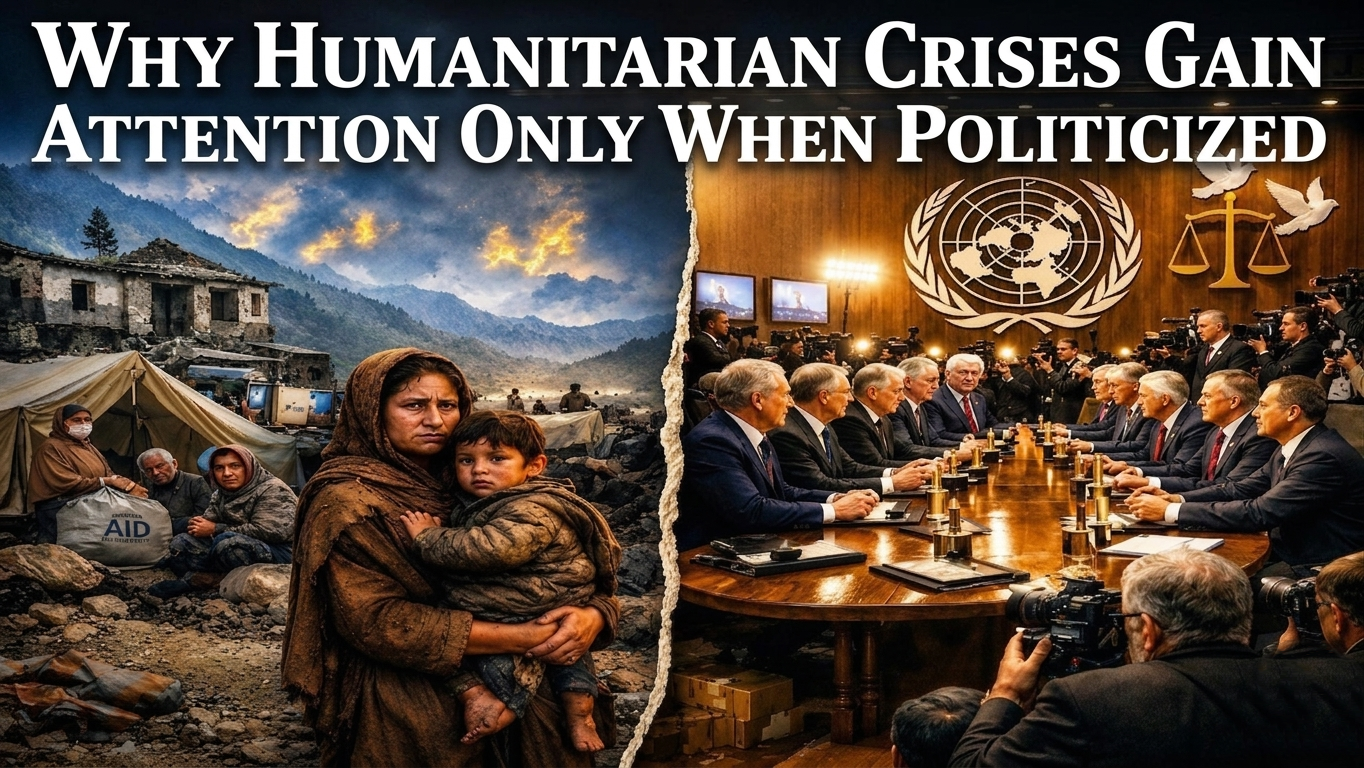
Why Humanitarian Crises Gain Attention Only When Politicized : An International Law Perspective

Suffering is another constant aspect of human experience, but not all sufferings receive the same level of attention and care. Indeed, around the world, many people have lived through violence, displacement, poverty, and insecurity for years without any international attention until these became matters that involved politics and security. This troubling trend can be seen in places such as Khyber Pakhtunkhwa, specifically in regions affected by militancy and displacement like Swat and Federally Administered Tribal Areas (FATA). There, civilians lived under years of violence and insecurity as their houses were razed to the ground, their schools closed, and their lives uprooted; nevertheless, no attention was paid to their humanitarian crisis until it became a matter of national and international security. In particular, the military campaign against the militants in Swat between 2007 and 2009 created an internal displacement crisis in Pakistan, one of the largest in its history.

An important example of this is the Kashmir dispute. For many years now, the people of Kashmir have suffered through humanitarian issues characterized by armed conflict, militarization, curtailment of their freedoms, abductions, and displacement. In spite of this suffering in terms of breaches of basic human rights and international humanitarian law, the world continues to show interest in this conflict at different levels of intensity for various political and strategic reasons, rather than due to humanitarian concerns. The issue of Kashmir reveals the general ineffectiveness of the international community in respecting and upholding values reflected in international laws such as the Geneva Conventions, whose main focus is civilian protection, and UN resolutions which emphasize a peaceful solution and the protection of human rights. There is always a violation of IHL and human rights law in situations of conflict such as those of Kashmir and Swat. Despite the fact that states parties to these conventions are supposed to offer protection regardless of whether the conflict is political or otherwise, there remains inconsistency in the implementation of these values.

A crisis that is linked to issues of national security or political interests will be covered more extensively than others that may be less significant politically, highlighting the uneasy connection that exists where political concerns override humanitarian obligations. It is required under international law that the suffering needs to be responded to without bias and with humanitarianism.

The principles of humanitarianism require the process to be neutral and non-political in nature, but in actuality, humanitarianism and diplomacy are intertwined. For instance, the problems faced by the families in Swat or the Kashmiri population that finds itself at the receiving end of constant warfare do not need any political perspective for humanitarian assistance to be extended to them. It has been stipulated under international law that the civilian population and aid should be provided without political motives. The element of media adds another dimension to the situation. In the era of media, the media dictates the urgency of situations. Crises that occur suddenly and generate media attention receive temporary prominence and then fade out after losing media focus.

Consequences of selective empathy are dire. The populations which have been ignored by the world’s bodies develop a sense of distrust for both the bodies in question as well as their actions. They see their suffering as pertinent only because of the threat they pose to the political structure in place. Thus, the cycle continues leading to instability and prolongation of conflicts. To counter this trend, one needs to accept the non-compromising distinction between humanitarian duty and political pragmatism. It is the responsibility of all stakeholders to acknowledge this fact and ensure that international bodies and states alike follow international law without fail and provide aid and assistance without any political considerations but from an ideological standpoint.Media coverage needs to continue regardless of political significance while military operations should be combined with rehabilitation, education provision and civil protection of the people in need of assistance. More importantly, humanity in general needs to develop empathy and come to the rescue before things get political.

There exist international laws with mechanisms intended to provide safeguards for the safety of civilians, ensuring that humanitarian aid is granted, and helping in the resolution of conflicts in a peaceful manner. However, the lack of enforcement by the international community of these values ensures continued conflicts, as well as a global mistrust of international laws. It should be noted that allowing situations where human tragedies lead to humanitarian interventions only goes against the essence of human rights. The conflicts in Swat, Kashmir, and elsewhere call for immediate action to adhere to the law and respect human lives.

In a nut shell, the problem here isn’t whether the world has the necessary legal instruments to deal with humanitarian emergencies; it has such instruments. The problem lies in whether or not the world has enough political determination to treat all situations on an equal basis. Until such a time when the humanitarian problem takes precedence over politics, thousands of individuals shall suffer violence and injustice in silence. Swat and Kashmir are reminders that humanity needs to have its worth recognized regardless of any political considerations. A more humane international system will have to intervene prior to such crises turning political.

Disclaimer: The views expressed in this article are solely those of the author and do not necessarily reflect the position of ICEP.