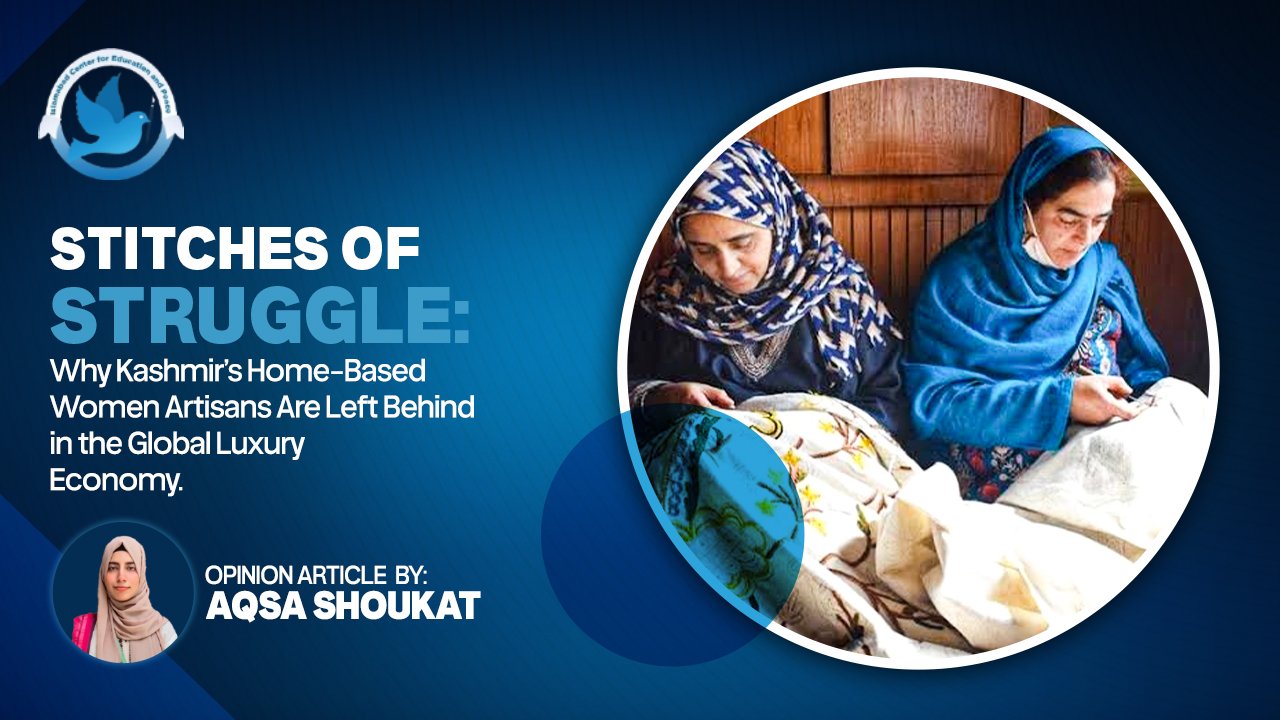
In the high-fashion capitals of Milan, Paris, and New York, a Kashmiri Pashmina shawl or a hand-embroidered Sozni garment is hailed as the ultimate symbol of quiet luxury. Retailing for thousands of dollars, these pieces are celebrated by the global elite for their timeless elegance their generational craftsmanship and their breathtaking detail. But I want you to close your eyes and look past the glowing runways, past the glossy magazine covers and past the air-conditioned boutiques. Look thousands of miles away to the domestic courtyards and cramped, dim rooms of the Kashmir Valley. There sitting on the floor for hours on end, hunched over fine fabrics with aching backs and strained eyes are the women who actually bring these masterpieces to life.
They are the invisible backbone of a multi-million-dollar luxury export market. Yet, in the cruel gears of the global luxury economy, they are systematically left behind trading weeks of grueling, painstaking labor for wages that barely secure a daily survival. How is it possible that the hands weaving the world’s most expensive garments are trembling in poverty? To understand this tragedy we have to look honestly at how the supply chain is built. The Kashmiri handicraft sector relies almost entirely on a decentralized, home-based production model. These women handle the foundational, intensely delicate work, spinning raw cashmere fibers cleaning them and executing complex needlework like Sozni and Aari embroidery.
Because
they work from home, often bound by traditional social norms heavy domestic
care duties, and restricted mobility they are structurally isolated from the
world. They never sit across a table from an exporter a major brand
representative, or an international buyer. Instead, a long predatory chain of
middlemen, brokers and master-craftsmen stands squarely between the artisan
and the global market. By the time a shawl travels from a woman’s modest home
workshop in Srinagar to a velvet-lined retail rack in London or New York its
price has multiplied exponentially. But almost none of that staggering value
inflation ever trickles back down to the woman who poured her soul and eyesight
into every single stitch. Her vulnerability is further crushed by two
relentless pressures exploitative piece-rate wages and the flood of cheap
industrial imitation.
The middlemen who hold the monopoly on raw materials know these women are desperate. They know that isolation, a lack of alternative income, and the immediate need to put food on the table strip away all bargaining power. So they pay them pennies. A piece of embroidery that demands weeks of backbreaking handwork yields a payout that amounts to a meager fraction of a dollar per hour. It is modern exploitation masked by the romantic label of "traditional art". And if that weren't enough there is the devastating shadow of mechanization. Power looms and mass-production machine-embroidery units churn out cheap synthetic knock-offs of traditional Kashmiri designs at lightning speed. Global brands market these machine-made shortcuts as "ethnic fashion," completely undercutting the authentic handcrafts in the open market. Consumers abroad buy them, completely unaware that the "luxury" item in their hands is a mass-produced imitation, while the true artists are being starved out of their own heritage.
Defenders of the current global luxury model argue that international brands and middlemen provide essential market access, global visibility, and logistical channels that isolated home-based artisans could never achieve on their own. Without this established commercial infrastructure they claim, these rural artisans would have zero outlet to sell their products beyond local markets. However while global brands and intermediaries do provide a bridge to international markets this argument collapses under the weight of severe wealth disparity and systemic exploitation. Providing market access does not justify monopolistic control over raw materials sub-minimum piece-rate wages that pay fractions of a dollar per hour, and a lack of transparency. True market integration would empower artisans rather than trapping them in cycles of poverty while luxury houses reap exponential profits.
Historically, this craft was never just a means of scraping by. It was a sacred source of financial independence and profound cultural pride for Kashmiri women. It allowed them to stand tall, to contribute securely to their households, and to pass down a priceless legacy. Today that independence is slipping through their fingers like sand. Because the financial returns are so insulting, younger generations of Kashmiris are abandoning the craft altogether. They are fleeing to low-wage odd jobs that at least promise steadier cash. Elders watch with breaking hearts as centuries of generational knowledge face the very real terrifying threat of extinction. If the global luxury economy wants to claim even an ounce of ethical integrity its romanticized marketing campaigns about "heritage" and "artisanal craft" must stop. True sustainability cannot exist when the human being holding the needle lives in destitution. We have to fix this broken system. We need direct-to-consumer digital co-operatives that empower women by completely bypassing the leeches in the middle, allowing artisan collectives to sell directly to conscious global consumers. We need ironclad enforcement of Geographical Indication protections to defend authentic hand-spun and hand-embroidered goods against industrial fakes. And we demand fair-wage mandates forcing international luxury houses to look into their supply chains and verify that the women weaving their fortunes are actually receiving a living wage.
Until
the global luxury market bridges the vast, shameful chasm between the
air-conditioned boardroom and the artisan's doorstep, every intricate stitch
adorning high fashion will remain stained with quiet. Kashmir’s women are
stitching together the luxury of this world; it is long past time the world
ensures they are no longer left behind in the dark.



_6784.jpg)