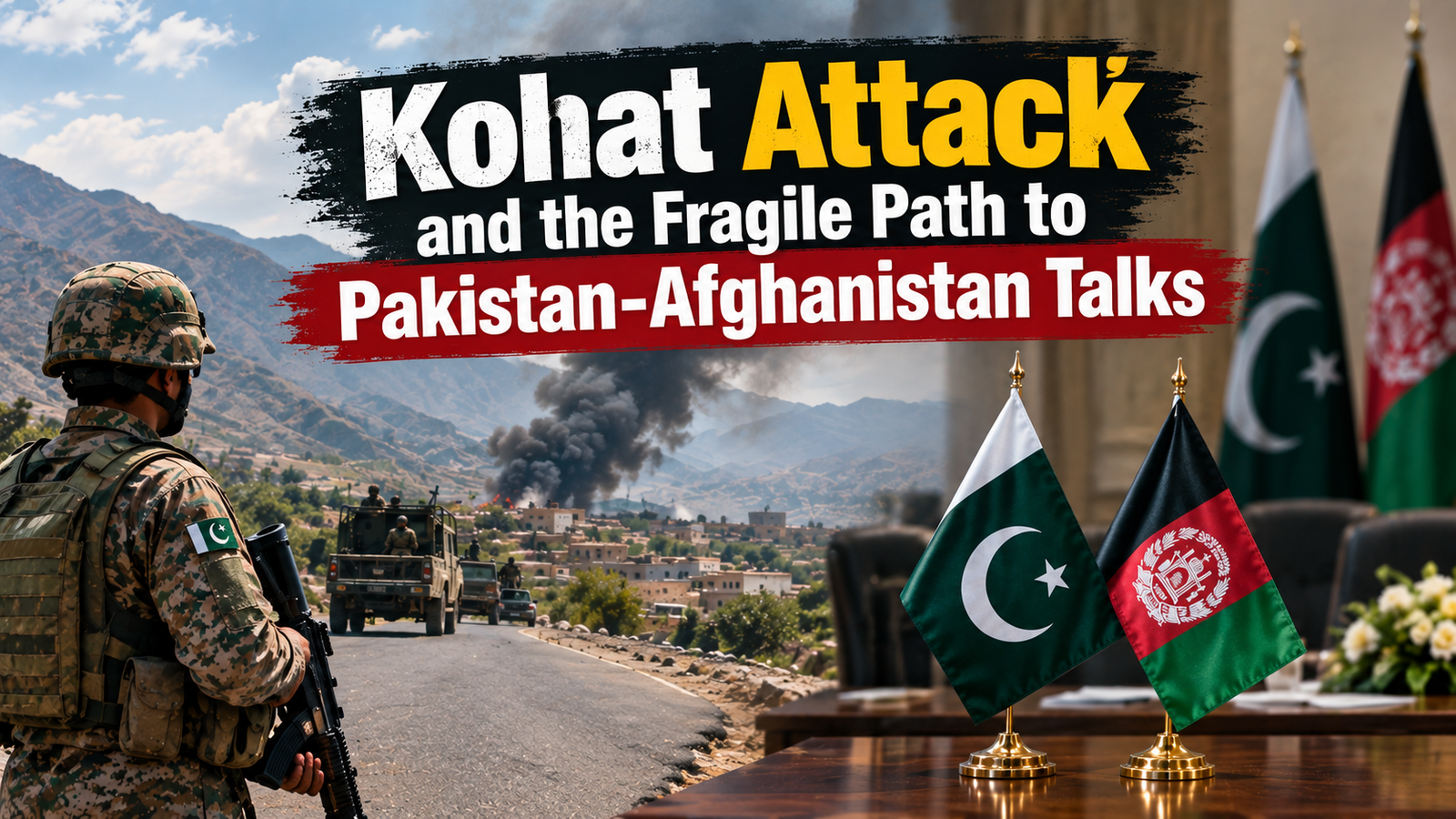
The attack on a mosque in a police compound in Kohat on
September 18 has added an unwelcome wrinkle to the already fragile
Pakistan-Afghanistan ties. First reports said 16 people were killed and 57
injured, but later the numbers were revised to 31 dead and over 100 wounded.
Critically attack took place as senior officials from Turkey and Qatar were
meeting with the Afghan Taliban leadership separately and it was said that
tensions between Pakistan and the Taliban had been part of the talks. This is
not coincidental it puts the attack at the heart of a new but precarious
diplomatic thaw.
Islamabad and Kabul have been engaged in a round of
recrimination over militancy and border security and the deployment of armed
groups inside Afghanistan, for months. Pakistan has repeatedly held that the
Tehreek-e-Taliban Pakistan (TTP) is operating from the Afghan soil while Kabul
has denied the same and said that the Pakistani internal insecurity is an issue
beyond its control. Under these circumstances traditional bilateral diplomacy
is largely ineffective.
However, diplomacy is being afforded another chance. They
have also revived Türkiye and Qatar as major intermediaries recently high-level
officials from both countries met with the leadership of the Taliban in Kabul
and Türkiye's intelligence chief went to Pakistan where they restarted the
Kabul-Islamabad dialogue among the items discussed was the restart of this
dialogue. The two nations also used to engage Pakistan with Afghanistan
including the 2025 ceasefire effort which lent this new effort some
institutional credibility. In this context the Kohat attack is a possible
challenge to this process but not one that is insurmountable.
The main issue is one of attribution and proportional
response. The attack on the police compound and mosque during Friday prayers is
especially significant in terms of public confidence as Pakistan has already
paid a high price for the constant attacks by militants especially in the
province of Khyber Pakhtunkhwa. Again Pakistan has named the sanctuaries being
provided by the Taliban in Afghanistan and now the Taliban has denied that and
the TTP has denied responsibility for this attack. This distinction matters.
Valid long-standing security concerns do not by themselves, constitute
responsibility for a particular incident. If diplomacy is to be maintained in
such a context mechanisms need to be put in place on both sides that are
capable of establishing facts — not only that each new attack will escalate
automatically.
It is Pakistan's steadfastness which it has shown by not
responding to each incident with retaliatory military strikes that occur within
Afghanistan's borders that is a remarkable feature of the present moment. It
also helps to hold back the diplomatic space that Islamabad is demanding in the
form of more robust counterterrorism measures. The Foreign Office has
reiterated its desire to engage contingent on Afghan offers of concrete,
verifiable steps and in its briefing on 17 September made clear the constructive
role played by Türkiye and Qatar in mediation.
The recent public statements in Kabul present a complementary
(though incomplete) area of starting point. Kabul is in dialogue and
cooperation with Pakistan and is open to third-party efforts to resolve
differences between the two states, said Taliban spokesperson Zabihullah
Mujahid in an interview with Al Arabiya English. This is not a solution to the
fundamental differences between the two governments but it is a public
recognition that there is a need for discussion.
Pakistan's stance is conditionally positive Foreign Office
has said it's prepared to hold talks at the state level and coordinate the
activities of the institutions but these will be based on the conditions of
verifiable progress including cessation of cross-border attacks and better
border management. This bilateral dynamic of Afghan eagerness to talk with
Pakistan and Pakistan's insistence on tangible security guarantees could be the
foundation for a more formalized bilateral process, if both parties take it up.
The real risk is the Kohat attack drives the relationship
into confrontation not dialogue. Every major strike adds to the domestic
impetus in Pakistan to abandon engagement altogether and any Pakistan military
action within Afghanistan will likely reinforce hardline voices in Kabul and
give them less room to compromise. That's why the diplomacy underway now can't
depend on a simple message of goodwill, it needs some ways to check on it
intelligence sharing border management and accountability.
Türkiye and Qatar have the potential to be part of this not
only as hosts but as avenues for discussing sensitive security matters without
immediately having to face the public. The previous mediation that also
involved the development of proposals for monitoring and verification shows
that security and diplomacy don't have to go hand in hand.
This new diplomatic initiative should be seen as a test of
the Kohat attack. If the path of bilateral relations should be set by default
by violence then the ability to choose or block the path of bilateral relations
would be in the hands of the militant actors. Conversely if both sides
undertake joint investigations evidence sharing and verifiable commitments, and
maintain communication channels, diplomacy can be a tool of the security
response and not its target. There are significant differences Islamabad wants
assurances from Kabul that Afghanistan won't be used for attacks on Pakistani soil
while Kabul refuses to accept Islamabad's version of the problem. These are not
petty squabbles no one should have a false sense of security about how
difficult it is to resolve the issues.
However recent developments such as Türkiye and Qatar's
renewed mediation efforts, the Foreign Office's continued willingness to engage
and Mujahid's public appeal for cooperation suggest that the diplomatic
channels are still open.
The immediate priority is to avoid this tragic Kohat incident
being the next milestone towards escalation. Restraint doesn't mean tolerance
of terrorism for Pakistan. Support for dialogue in Afghanistan should be
followed up with action. The effectiveness of this new process will depend on
the effectiveness of both sides in turning diplomatic rhetoric into measurable
security commitments. The more important question at this point may not be
whether Pakistan and Afghanistan differ on certain issues — they do — but if
they can continue the dialogue in the face of that difference. The real measure
of the present negotiations is that.
_6784.jpg)