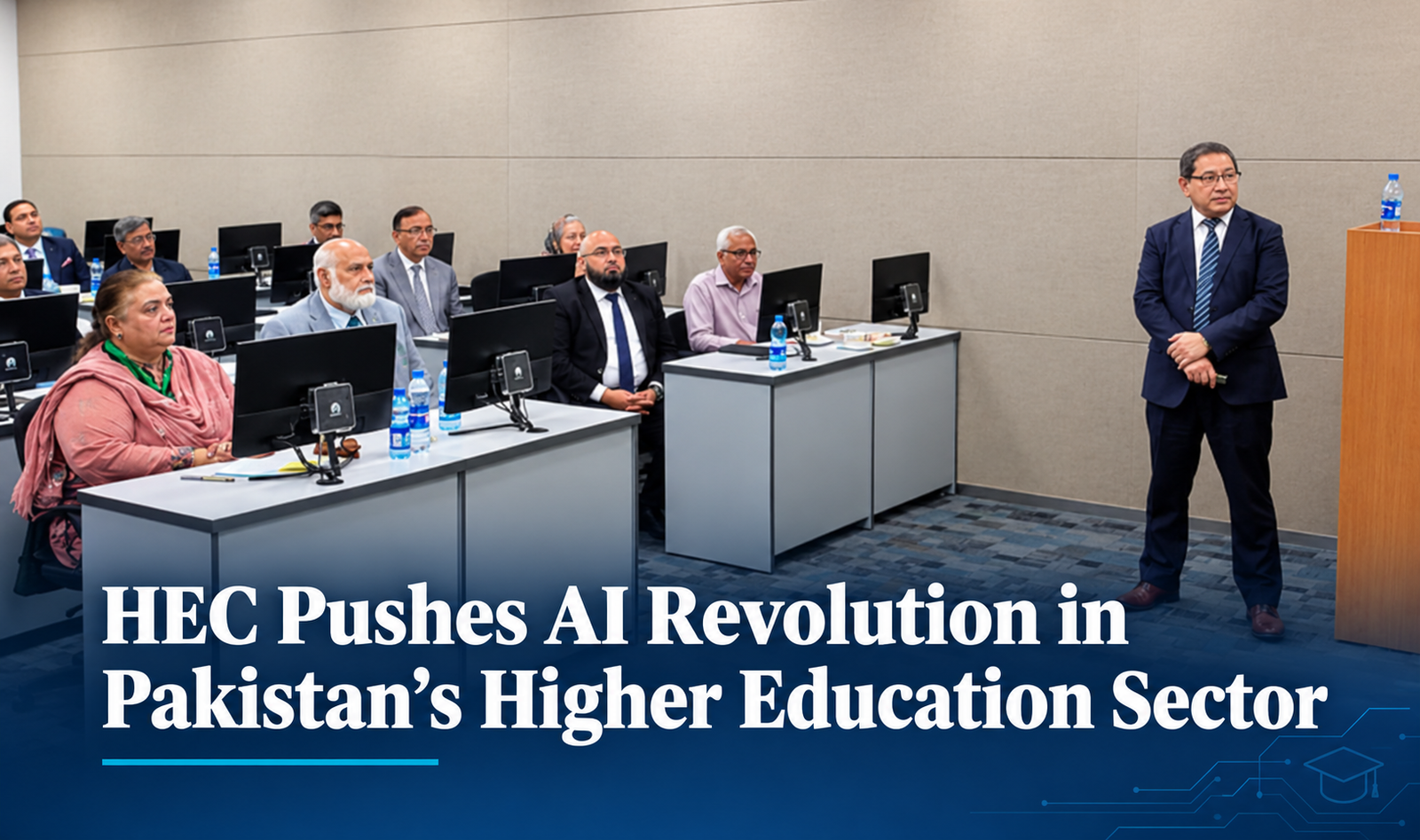
The Higher Education Commission (HEC) of Pakistan has launched a strategic discussion with Vice Chancellors and academic leaders to discuss how the Artificial Intelligence can help in reshaping the future of Higher Education of Pakistan and prepare the universities for the changing technological future. AI's potential to enhance the teaching and learning process, accelerate scientific research and enhance governance and reach to high tech digital resources were discussed. The discussions were divided into four categories – AI for Education, AI for Scientific Research, Smart Classes and Campus Governance, and Cloud and AI Resources. Academic leaders looked at the ways in which these technologies can be used to encourage innovation, boost research capacity, create better learning experiences for students and facilitate the wider digital transformation of universities.
In his address the Chairman of the HEC Prof. Dr. Niaz Ahmad Akhtar highlighted the need to build a future-focused and inclusive higher education ecosystem in Pakistan that is based on Artificial Intelligence. He said that the advantages of the new AI technologies should not just be enjoyed by a handful of technologically sophisticated institutions but by universities and students throughout the nation. The conversation takes place at a moment when AI is transforming the creation, dissemination and management of knowledge throughout the world. The ability of AI to provide personalized learning, academic support, data analysis and research help is just some of the ways the technology is making waves in the realm of higher education. In higher education AI-driven solutions are presenting opportunities for personalized learning, academic support, data analysis and more efficient institutional management.
The participants discussed the potential of AI to improve scientific research such as by supporting researchers in managing vast amounts of data, recognizing patterns, speeding up data analysis and fostering inter-disciplinary connections. The availability of cloud computing and AI resources were also noted as being important requirements for research to be able to conduct advanced and technology intensive projects. The other significant topic of conversation was the design of smart classrooms and campus governance that uses artificial intelligence. These systems can contribute to the enhancement of administrative efficiency, resource optimization, decision-making and student and faculty responsiveness in learning environments within universities. But the chat also emphasized the need to build AI for a broader audience. The shift to digital could exacerbate existing inequalities, if not managed effectively, owing to the differences in digital infrastructure, technical capacity, and financial resources between institutions. Equitable access to computing resources and faculty training and digital infrastructure will therefore be essential.
Academic leadership and institutional readiness will also be crucial to the responsible use of AI. In this regard, universities should not develop inappropriate policies without compromising academic integrity, critical thinking, ethics and human-centered approach to education. The strategic dialogue has demonstrated HEC's shift towards technology-driven transformation in the Higher Education sector of Pakistan. The Commission aims to foster collaboration and create a unified strategy for leveraging AI in the education and research ecosystem and for institutional development. This initiative is ultimately intended to make Pakistan's universities more innovative, technologically adept and ready to meet the future challenges, with the goal of ensuring the opportunities opened by AI are available to all universities and students in the country.



_6784.jpg)