
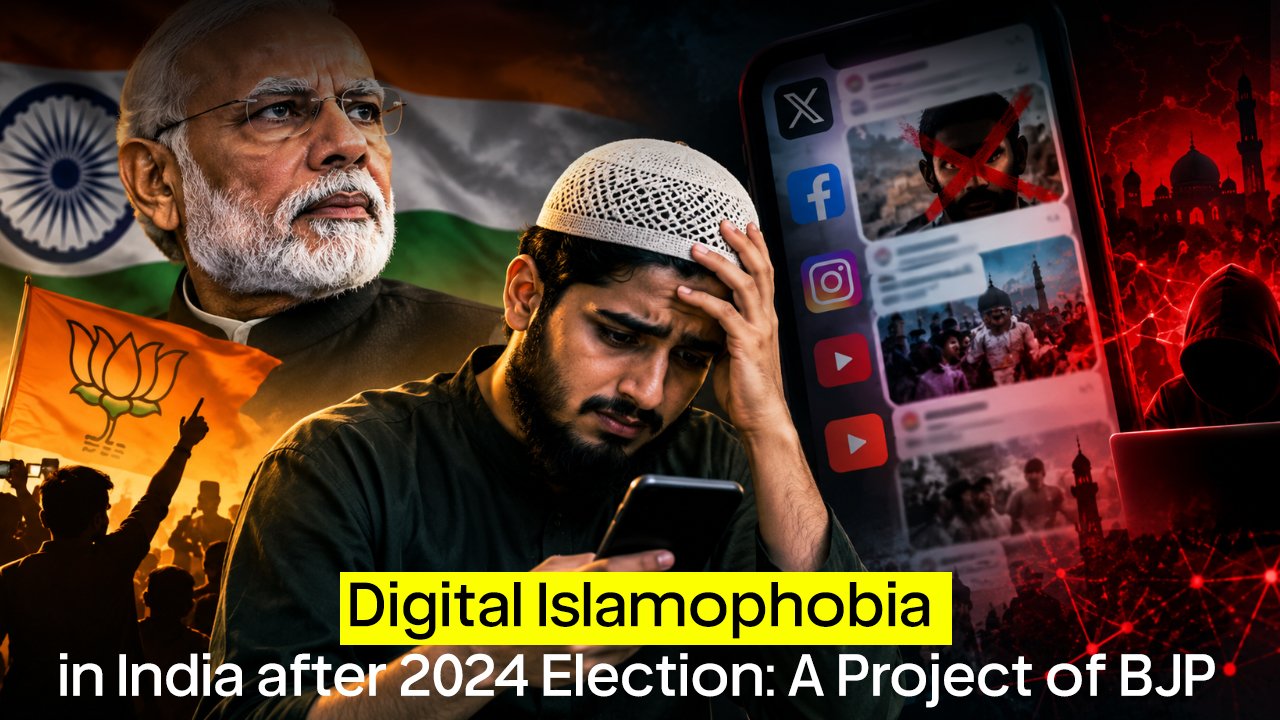
A hateful line at a political rally disappears from the news in a day. But a hateful image made by AI never really disappears. That one difference explains almost everything about digital Islamophobia in India since the 2024 election. And it's why we should stop treating this as a few bad posts here and there and start treating it as a system that is working exactly as it was built to work.
Let's start with the numbers, because they tell the story on their own. In 2025 independent researchers at the Center for the Study of Organized Hate recorded 1,318 hate-speech events in India. That's 13 percent more than in 2024 and almost double the number from 2023. Out of those 1318 events 1289 that's 98 percent targeted Muslims. Now add another finding from the same group just 297 social media accounts posted 1,326 AI-generated anti-Muslim images between mid-2023 and mid-2025. Those posts were viewed and shared over 27 million times. Sexual images of Muslim women alone got 6.7 million interactions. These are not small numbers from a hidden corner of the internet. This is now part of everyday online life for millions of people.
This is the part that's uncomfortable to say clearly but it needs to be said. Human Rights Watch looked at 173 speeches given by Prime Minister Narendra Modi during the 2024 election campaign. In at least 110 of them, they found Islamophobic language Muslims called "infiltrators" described as a community that "has too many children." Other top BJP leaders, including Home Minister Amit Shah and the chief ministers of Uttar Pradesh and Assam, used similar language. This matters because it shows where the words came from. The phrases that later turned into memes, videos and AI images were not invented by random people online. They were first spoken on stage, by the most powerful politicians in the country. So the internet didn't create this hatred out of nothing. It simply took hatred that already existed and made it spread much faster and much further.
And that's really the key connection here the thing that links every part of this problem together. It comes down to one simple idea: repetition. If you hear a claim once, you question it. But if you hear the same claim fifty times, on five different apps in ten different formats something changes. It stops feeling like a claim you should check. It starts feeling like something everyone already knows to be true. AI didn't invent anti-Muslim prejudice in India. What it did was remove the last real barrier to spreading it. In the past, spreading a hateful idea took effort you needed a speechwriter, a printing press or airtime on television. Now, anyone with a laptop can turn that same idea into a shareable image in a few minutes, with no way to trace who made it. One of the researchers who studied this said it best AI tools make old prejudices "scalable, faster, cheaper, and harder to trace." That's not a small side effect. That is exactly how normalization works repeat something enough times through enough channels, and it stops looking like an opinion and starts looking like a fact.
Underneath all of this is one more problem: the platforms themselves. The same reports that found millions of views on AI-generated hate content also found something else this content almost never gets taken down, even after people report it. Compare that to how quickly these same platforms respond when a government asks them to remove something. If a system reacts fast to power but slow to real harm, that's not a technical glitch. That is a choice. And it's a choice that keeps getting made, over and over, about whose safety actually matters. None of this means every single act of violence can be traced back to one specific post online it can't and the evidence doesn't claim that either. But being careful about that doesn't mean we should stay silent about the bigger pattern.
Human Rights Watch's 2025 report documented Muslim homes being illegally demolished after the election and found that authorities often went after the victims of communal violence instead of the people responsible for it. USCIRF an independent U.S. commission has now recommended for seven years in a row that India be named a "country of particular concern" for religious freedom and for the first time, it also recommended real sanctions. India's government rejects all of this as biased, and that response deserves to be mentioned too, not hidden a fair argument doesn't erase the other side, it faces it directly. But rejecting a finding is not the same as disproving it. And when an independent body repeats the same warning for seven straight years that's not something anyone should brush off so easily.
So here's the honest harder truth this isn't a story about
a handful of bad people online. It's a story about political language that got
picked up and massively amplified by a digital system built to reward
attention, not truth and a moderation system that treats the damage as somebody
else's job to fix. Fixing content moderation alone won't stop the speeches.
Stopping the speeches alone won't fix the platforms. Every part of this chain
is connected to the next. And right now every link in that chain is still
holding strong.



_6784.jpg)