Top Stories
Building Bridges Through Words Understanding Militant Ideologies in Modern Contexts Security: Beyond Walls and Weapons Upcoming Events: Connecting Ideas and People Previous Milestones: Reflecting on Our Journey Fatwas: Reclaiming the Spirit of Ethical Guidance Role of NATO in Conflict Resolution Washington Peace Deal Between Congo and Rwanda Social Justice and Equality in the Qur’ān: Implications for Global Peace The Qurʾānic Concept of Human Equality: An Analysis against Racism and Ethnic Discrimination in Contemporary Societies Reinterpreting Dhimmitude: A Reconsideration of Its Social and Political Functions in the Modern Context How China Is Playing the Long Economic War Ukraine Peace Efforts Advance Cautiously Despite Partial Alignment Among Parties How Pakistan-Libya Military Relations Strategic Outreach, Economic Stakes and Geopolitical Implications Aleppo Clashes as Syria and Kurdish-Led SDF Agree to Ceasefire Across the Border, Pakistani Ulema Stand Against Afghan Girls\' Education Ban Pakistan announce 500 fully-funded scholarships for Bangladeshi students in 8 programs How theTaliban regime threat for reginal peace Women Left Behind in Khyber Pakhtunkhwa’s Education System Sudan’s Civil War: Anatomy of the World’s Largest Humanitarian Crisis Changing Security Architecture in Central Asia Pakistan Leads India on Economic and Peace Indicators in 2026 : Gallup Survey Submerged Classrooms, Long-Term Learning Loss Pakistan Security Report 2025: Terrorism Trends and the Peace Deficit HEC’s MAKTAB Initiative Signals a New Era for Higher Education Southern Yemen Faces Tensions and Urgent Need for Peace IUT Strengthens Education Integrity in Bangladesh Pakistan’s Arms Sales Contracts (2024–25) and the Peace Dimension Pakistan\'s Contribution to UN Peacekeeping Operations for Global Peace Pakistan Enhances Educational Cooperation with Sri Lanka through Scholarship The Growing Defense and Economic Nexus of the Muslim World Charter of Trump’s Board of Peace Pakistan & Myanmar Prioritize Education Strategic Saudi defense agreements are redefining the Middle East\'s security architecture What would be the consequences of the U.S.–Iran Conflict on Pakistan? How Indian Cricket Politics Affect Regional Peace The Kashmir issue remains a central peace and stability in South Asia American Weapons in Afghanistan Are Destabilizing Pakistan Global Education Coalition sixth annual meeting A New Chapter for Pakistan’s Universities: Leadership, Stability, and Vision under the New HEC Chairman The Evolution of the IMCTC into a Global Security Pillar Reintegration Initiative: Analyzing the 2026 IMCTC Engagement in Pakistan Psychosocial Warfare and the IMCTC Peace Journalists Initiative (2026) The Concept of ‘Ummah’ in the Qurʾān: Transcending Race, Tribe, and Ethnicity HEC Reforms Regulation, Defends Academic Freedom Pakistan’s Evolving Role in Fostering Peace and Security on the African Continent Recontextualizing Pakistan’s Role in the Board of Peace War in the Middle East: Measuring the Cost The Silent Bridge: Pakistan’s Strategic Neutrality and the Quest for Middle Eastern Stability The Geography of Escalation: Living in an Age of Permanent Crisis Mapping the Educational Crisis in the Middle East Conflict The Blind Alley of “Epic Fury”; A War with no End game A Pakistani Voice Against Digital Islamophobia: A Landmark Academic Contribution World Eye on Pakistan for Middle East Peace Leading with Truth, ICEP’s Analysis Outlasted the Skeptics on Middle East Crisis World Powers Push for Deal U.S. Presents 15-Point Plan and Iran Responds with 5 Conditions Pakistan and Türkiye Open New Chapter in Academic Cooperation with Strategic Initiatives Pakistan at the Crossroads of Global Trade as a Logistics Revolution Unfolds Why Ethical Dialogue necessary in a Diverse Pakistan for a Peacebuilding Initiative Pakistan\\\'s Game-Changer Role for World Peace Entrepreneurship Education Is Shaping Pakistan\\\'s Economic Future Dr. Jamil Akhtar Featured in Prestigious Brill Encyclopaedia (2026) A Milestone in Global Interfaith Scholarship Peace Light in a Dark Night WAR RESHAPES PAKISTAN’S ECONOMY AND OPEN DOORS FOR INTERPRENEURS From Gaza to Lebanon: ICC, UN, and the Unanswered Duty to Prosecute Can Pakistan turn a temporary ceasefire into lasting middle east peace? Bridging the Gap: Confronting Education Inequality in Pakistan Hierarchical Culture In Pakistani Organizations \"How It Kills Innovation — and What Leaders Can Do About It\" Can Diplomacy Survive the Iran Crisis? Peace Efforts in an Age of Permanent Escalation Why are Peace Talks a US strategic priority? Features of Intellectual Property in the Age of Artificial Intelligence (In the Context of World Intellectual Property Day) A Global Forum for Peace, Governance, and a Better World (France\'s Landmark Contribution to International Dialogue) IS UAE WANT A \\\'CURRENCY SWAP\\\' WITH THE USA Energy War by Sea: The Hormuz Blockade Proves Oil is Still a Weapon The End of Strategic Dependence In Europe? Pakistan\'s Strategic and Structural Evolution from Crisis to Consolidated World Peace Silent Deterrence: Hangor-Class SSP-2800 and Undersea Strategy of Pakistan Inside the $9 Billion Prediction Market Revolution Pakistan at the Crossroads: Between Fragile Stability and the Weight of Structural Crisis WHY DIALOGUE FAILS IN CONFLICT ZONES; A LESSON FOR POLICY MAKERS The Crisis of American Legitimacy in the Post-Unipolar Era THE OIL CLUB UAE JUST QUIT Inside OPEC’s Biggest Defection in Decades — and What It Means for the World The Kashmir Dispute: International Institutional Failure and Humanitarian Consequences The $100 Billion Event the World Refuses to Understand How is Eid-ul-Adha A School of Peace? 250 Million Children Classrooms Zero Learning Ethical Dialogue: The Art of Speaking with Intention Ethical Dialogue: The Moral Weight of an Honest Word Skills in Their Hands, Books in Their Bags Ethical Dialogue : Honoring the Voice of the Other HEC Honors Top Pakistani Scientists and NRPU Grant Recipients at Punjab University What\'s the 14 Point of Peace deal that will be signed in Geneva When Words Carry Power: The Unequal Conversation Why Humanitarian Crises Gain Attention Only When Politicized : An International Law Perspective The Ethics of Saying Nothing The Strait of Hormuz Crisis: Energy Security in an Era of Regional War Ethical Dialogue: The Forgotten Half of Every Conversation Why is Homework Still a Thing In Modern Education Peace Beneath the Red Lines Ethical Dialogue: The Wisdom of Not Being Certain HEC\'s 47th Commission Meeting Charts Reform Path for Higher Education Sector PERIDOT: Franco-Pakistani Research Collaboration Program WINDS OF CHANGE Ethical Dialogue: Persuading Without Deceiving HEC Conducts Scholarship Test Across Bangladesh The significance of the \"same DNA\" statement Phone-free campuses could become the next step in education reform Ethical Dialogue: When Dialogue Becomes a Weapon HEC hosted a Quality Leadership Session in Faisalabad Women\'s Role in Peace-building in Somalia Modernizing the Indus Waters Treaty for the Climate Change Era How Will Pakistan Prevent Another \"Ever Given\" at Bab al-Mandab? HEC Chairman Leads Strategic Higher Education Engagements in Lahore and Karachi A Nation Cannot Prosper While Its Children Suffer NIPIS\'26 Welcomes Largest-Ever International Cohort of 50 Interns from 15 Countries The Bermuda Triangle of Promises: U.S. and Iran in Negotiations Pakistan\'s New Strategic Architecture in the Gulf Pakistan Unveils First International Defense Technology Incubation and Investment Platform Selective Justice Under the UN: India\'s Record in a Disputed Territory Married Off Instead of Educated: How Child Marriage Quietly Empties Pakistan\'s Classrooms Between Unemployment and Extremism: Can Vocational Training Break the Cycle for Pakistan\'s Youth? Winning Battles, Losing Peace: Why Military Force Has Failed in Sudan Kashmir Seven Years After Article 370: Development, Rights, and Regional Challenges HEC-NAHE Launches Strategic Planning & Leadership Excellence Workshop for University Leaders Could the Iran-US Conflict Escalate Into a NATO Crisis? Quality Education - Dawn of Tomorrow Beyond the Indus Water Treaty : Re thinking Pakistan’s water security after India’s suspension Can Justice truly exist without Morality? Climate Change as a Non-Traditional Security Threat in Pakistan HOW DOES SOCIAL MEDIA INFLUENCE STUDENTS’ ACADEMIC PERFORMANCE? How Article 370 Pushed the Kashmir Dispute Out of Delhi\'s Courts and Into International Arbitration Digital Literacy as Pakistan’s Best Armour Against Online Extremism Beyond direct talks: why backchannel mediators are crucial for modern crisis de-escalation? How Medical Education Can Promote Peace and Reduce Conflict in Pakistan? The Age of Narrative Warfare The Role of Youth in Community-Level Peacebuilding Digital Islamophobia in India after 2024 Election Article 140-A: The Constitutional Solution Pakistan Keeps Ignoring HEC Pushes AI Revolution in Pakistan’s Higher Education Sector If Iran Joins the Makkah Pact, Pakistan\'s Balancing Act Gets Harder Why Trump Refused Saudi Arabia’s Call for Direct Action Against the Houthis Is India’s BRICS Achievement Really a Diplomatic Victory? Makkah Defence Alliance Is Defensive, Says DG ISPR Ethics of Dialogue: The Courage to Speak When It Costs Something Can Kashmir’s Ecological Crisis Become a Regional Climate Security Threat? Pakistan-Türkiye Higher Education Ties Strengthened Through NUST Engagement Kohat Attack and the Fragile Path to Pakistan-Afghanistan Talks From Insurgents to Stakeholders: The Transformation of the Houthis in Yemen Stitches of Struggle: Why Kashmir’s Home-Based Women Artisans Are Left Behind in the Global Luxury Economy Soft Power without Hollywood: How China Is Making Culture a Strategic Asset The Rise of Ittehad-ul-Mujahideen Pakistan: A new challenge to Pakistan’s militant landscape The New U.S- Iran Maritime Standoff - Who Controls Hormuz

Beyond the Indus Water Treaty : Re thinking Pakistan’s water security after India’s suspension

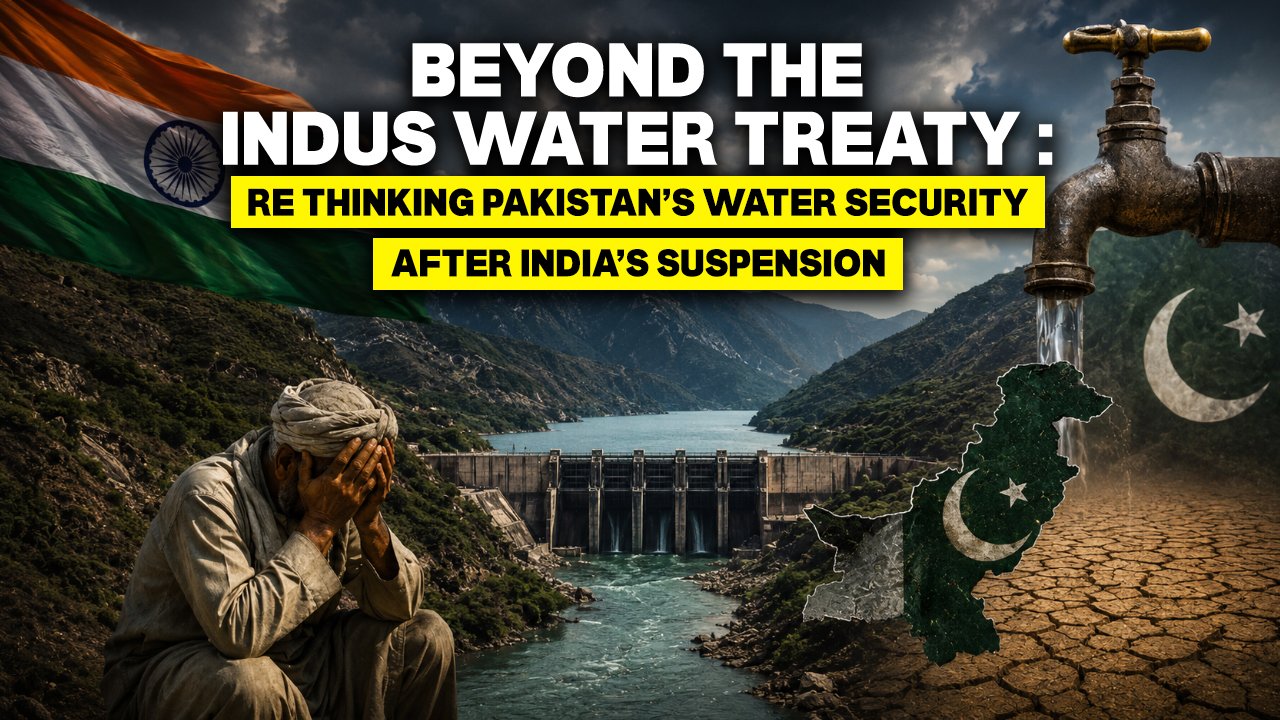
In the 21st century, wars are no longer fought solely over territory or ideology. Instead, natural resources are becoming strategic assets, and among them, water has emerged as one of the most crucial. The water crisis in Pakistan is not just a national issue but a daily struggle for millions of families who wake up without knowing where their next glass of clean water will come from. The International Organization for Migration (IOM) predicted that Pakistan will slip into absolute water scarcity by 2035. For Pakistan, water scarcity is no longer merely an environmental concern; it is evolving into a national security challenge with economic, political, and geopolitical consequences. While population growth has undoubtedly increased the demand for water, the crisis also stems from systematic failures, as nearly half of Pakistan’s available water is lost due to outdated and inefficient irrigation systems. India’s decision to suspend the Indus Waters Treaty has added a new strategic dimension to an already fragile situation. Rather than viewing the suspension as merely a diplomatic setback, Pakistan should treat it as an opportunity to strengthen domestic water governance, modernise its infrastructure, and adopt proactive water diplomacy.

Pakistan’s annual per capita water availability has declined from over 5,000 cubic metres at independence to nearly 900 cubic metres today, placing it close to the internationally recognised threshold of absolute water scarcity. What contributes to the country’s water crisis are both human-made and natural problems, including climate change, due to which the country has faced unprecedented heatwaves in recent years, causing glacier melting and a rise in sea levels. Along with that, Pakistan’s vulnerability is compounded by its limited storage capacity, preventing the country from effectively storing surplus rainwater or glacial melt for lean periods. Yet these internal challenges became far more urgent after uncertainty emerged around the Indus Waters Treaty.

The Indus Waters Treaty was signed on September 19, 1960, between India and Pakistan and was brokered by the World Bank to address both countries’ concerns regarding the use of the Indus River system. The treaty assigned the waters of the western rivers—the Indus, Jhelum, and Chenab—to Pakistan and the eastern rivers—the Ravi, Beas, and Sutlej—to India. In addition, mechanisms for resolving disputes were provided. However, as the upstream state, India occupies a strategically advantageous position, and disagreements over the interpretation and implementation of certain treaty provisions have caused tensions with Pakistan. For more than six decades, the treaty stood as a testament to the power of diplomacy between two rival nuclear-armed states. However, on April 23, 2025, following the Pahalgam attack, India announced the suspension of the treaty. Since then, India has reportedly ramped up infrastructure development on the western rivers and has aggressively claimed that “not a single drop of water will flow to Pakistan.” Such remarks have caused tension between the two states, as Pakistan has also stated that “any attempt to obstruct the flow of water to Pakistan would be regarded as war.”

However, the suspension exposed Pakistan’s heavy dependence on a single river system and highlighted the need to strengthen its own water-management capacity. Regardless of future diplomatic outcomes, Pakistan cannot rely solely on international agreements to ensure long-term water security. While these challenges are significant, they are not unavoidable. Pakistan’s response must now shift from crisis management to long-term water security.

Irrigation in Pakistan started developing in the late 19th century. At that time, the main goal was simply to reduce the risk of food shortages and help maintain stability in the region. Even today, most of the system still depends on the Indus Basin network, which does a huge job of supporting agriculture. At the same time, a significant amount of water is still lost. Pakistan needs to develop modern irrigation systems because the most sustainable source of new water for Pakistan is not another river but better management of the water it already has. Pakistan also has limited water-storage capacity for monsoon rains and glacier melt, leaving it vulnerable during dry seasons. Investing in new dams, reservoirs, and recharge structures could help the country capture surplus water instead of experiencing floods that leave the country in ruins.

Water scarcity depends not only on how much water a country receives but also on how effectively it manages that water. Lastly, Pakistan should shift from reactive to proactive water governance and diplomacy. It should strengthen domestic water governance through better regulation of groundwater, digital monitoring of water use, and coordinated national planning. These measures should be complemented by proactive water diplomacy to preserve dialogue and cooperation over shared rivers. Long-term water security will depend not only on protecting international agreements but also on strengthening Pakistan’s own capacity to manage its water resources effectively.

Water scarcity has evolved from an environmental concern into a pressing national security challenge for Pakistan. While India’s suspension of the Indus Waters Treaty has intensified concerns over the country’s water future, it also serves as a reminder that long-term water security cannot solely rely on one treaty or river system. Strengthening national water governance, investing in infrastructure, and adopting proactive diplomacy are equally essential. By viewing this challenge as an opportunity for reform rather than merely a crisis, Pakistan can build a more resilient and secure water future for generations to come. In the end, Pakistan’s water security will be determined not only by shared rivers but also by the choices it makes today.