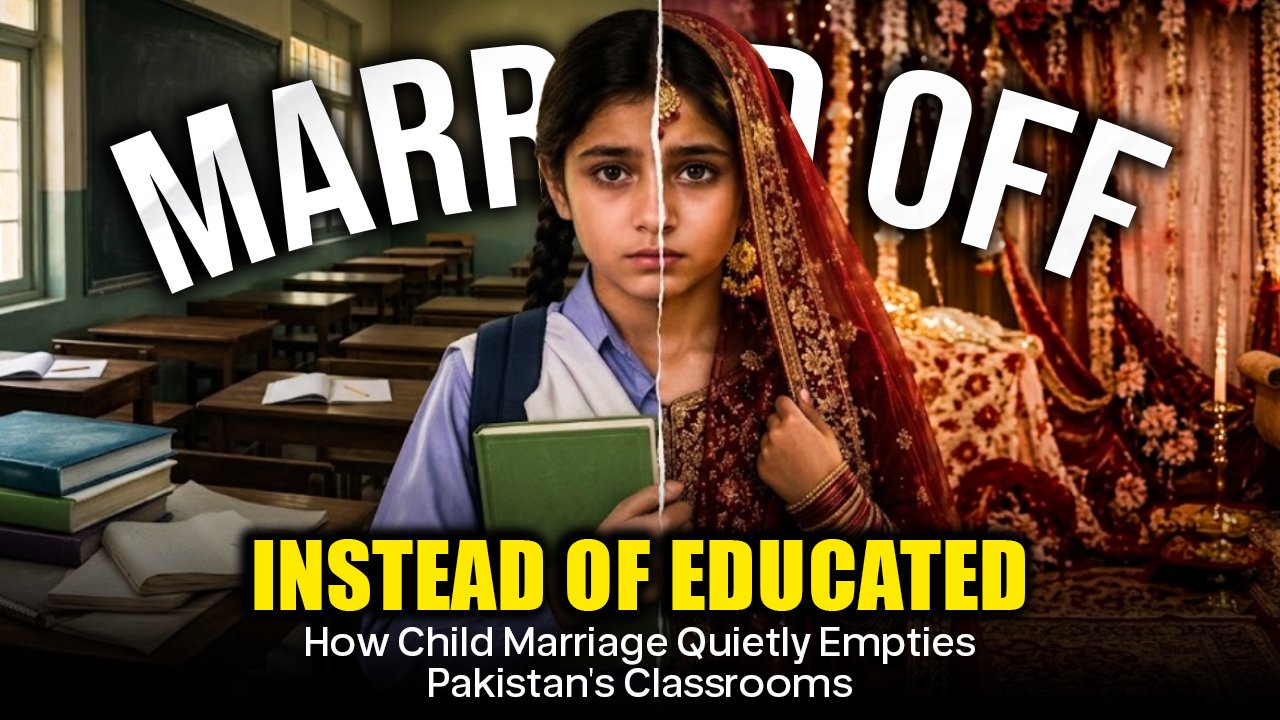
Married Off Instead of Educated: How Child Marriage Quietly Empties Pakistan\'s Classrooms
In many government girls' schools
across rural Pakistan,
the ninth-grade classroom tells a quieter story than any dropout statistic. The
rows that were full in sixth grade begin to thin out, not because the girls who
are missing have failed their exams, but because many of them are already
wives, and some are already mothers. Child marriage in Pakistan is often discussed as a
health issue or a human rights violation, and it is both. But it is also, just
as urgently, an education crisis, one that empties classrooms one signature on
a nikah nama at a time.
For a student of international
relations, the issue is best understood through the lens of human security: a
framework that looks beyond the state and asks whether individuals, especially
the most vulnerable, are protected from the everyday threats that shape their
lives. Seen this way, child marriage is not simply a private family decision.
It is a structural failure that intersects with poverty, weak enforcement of
existing laws, and gaps in access to schooling, and it directly undermines a
girl's right to education long before she has any say in the matter.
The scale of the problem is
significant. National estimates suggest that roughly eighteen percent of girls
in Pakistan
marry before the age of eighteen, though the figure varies sharply by income
and geography. Among the poorest households, the share of girls married as
children is nearly five times higher than among the wealthiest, a gap that
points less to culture alone and more to economic desperation. Families facing
poverty, displacement after floods or other disasters, or a lack of nearby
schools often see early marriage as a form of security, one less mouth to feed,
one daughter settled. Education, meanwhile, remains one of the few proven
protections against this practice; girls with no schooling are far more likely
to be married as children than those who complete secondary education. The relationship,
however, runs both ways. Just as a lack of schooling leaves girls more
vulnerable to early marriage, marriage itself is one of the leading reasons
girls leave school in the first place.
The dropout figures make this
connection difficult to ignore. Girls drop out of school at notably higher
rates than boys, and by the end of sixth grade, well over half of girls
enrolled have already left the system entirely, a steeper decline than their
male classmates experience. At the secondary level, the gender gap widens
further, particularly in rural districts where middle and high schools are
located far from home. Once a girl is married, continuing her education is
rarely treated as a priority. Domestic responsibilities, early pregnancy, and
social expectations about a married woman's role combine to push schooling to
the margins, even in cases where the family might otherwise have supported her
studies. In this way, child marriage does not merely coincide with low female
literacy; it actively produces it, generation after generation.
Beyond the immediate loss of
education, the long-term consequences are profound. Girls who leave school
early are more likely to remain economically dependent, limiting their
participation in the workforce and narrowing their life choices. Lower levels
of female education are closely linked to poorer health outcomes, reduced civic
participation, and slower economic growth. When a girl is married off before
completing her education, the cost is not borne by her alone. It is absorbed by
communities and, ultimately, by the country’s development trajectory.
The picture also differs by
province, which matters for anyone thinking about solutions. Sindh moved early,
raising the minimum marriage age to eighteen for both genders in 2014 and
making violations a punishable offence. Balochistan, where surveys suggest
close to two-thirds of marriages occur before girls turn eighteen, has more
recently introduced its own criminalising legislation, following years of
advocacy from civil society groups and reporting on the province's education
gaps. These legal steps are meaningful, but critics have argued that
legislation alone has limited reach in regions where enforcement is weak,
courts are distant, and marriage registration itself is informal or unrecorded.
Difficult terrain, understaffed schools, and long-standing gender norms that
expect girls to remain at home compound the challenge in these areas, meaning a
law on paper does not automatically change a decision made inside a household under
economic pressure.
Punjab
and Khyber Pakhtunkhwa have also debated reforms, yet disparities between urban
and rural districts remain stark. In remote communities, the absence of girls’
secondary schools within safe travelling distance effectively narrows choices
for families. Where schools exist but lack boundary walls, sanitation
facilities, or female teachers, parents may withdraw daughters at puberty,
fearing for their safety or reputation. In such contexts, marriage can appear
as the socially acceptable alternative to uncertainty.
None of this is to suggest that
the problem is unsolvable. Programs that combine community awareness sessions
with tangible support, such as stipends for keeping girls in school or
investment in nearby secondary schools, have shown that families do respond
when the incentives around a daughter's future shift. Conditional cash transfer
initiatives in particular have demonstrated measurable improvements in girls’
enrollment and retention. What the evidence consistently shows is that
education and child marriage are locked in a cycle: each additional year a girl
stays in school lowers her risk of early marriage, and each marriage prevented
keeps a girl in the classroom a little longer.
Religious scholars, local
leaders, and teachers also have a critical role to play in reshaping community
narratives. Where sermons, village meetings, and school outreach programs
emphasise the compatibility of girls’ education with cultural and religious
values, resistance often softens. When communities see educated women
contributing as teachers, health workers, and entrepreneurs, the perceived
return on educating daughters becomes more tangible.
In sum, child marriage in Pakistan
functions as both a cause and a consequence of girls' exclusion from education.
National data shows a clear link between poverty, low school access, and early
marriage, while dropout figures confirm that marriage itself is a leading
reason girls leave the classroom before completing their schooling. Provincial
legislation in Sindh and Balochistan represents genuine progress, but the
persistence of the practice across income groups and regions suggests that
legal reform alone cannot fill classrooms' empty seats. Addressing the economic
pressures that push families toward early marriage, expanding girls' access to
secondary schools, improving school infrastructure, and strengthening
enforcement of existing laws together offer a more complete path toward keeping
Pakistan's daughters in school rather than married off before they have the
chance to finish their education.




_6784.jpg)