
Top Stories
Building Bridges Through Words Understanding Militant Ideologies in Modern Contexts Security: Beyond Walls and Weapons Upcoming Events: Connecting Ideas and People Previous Milestones: Reflecting on Our Journey Fatwas: Reclaiming the Spirit of Ethical Guidance Role of NATO in Conflict Resolution Washington Peace Deal Between Congo and Rwanda Social Justice and Equality in the Qur’ān: Implications for Global Peace The Qurʾānic Concept of Human Equality: An Analysis against Racism and Ethnic Discrimination in Contemporary Societies Reinterpreting Dhimmitude: A Reconsideration of Its Social and Political Functions in the Modern Context How China Is Playing the Long Economic War Ukraine Peace Efforts Advance Cautiously Despite Partial Alignment Among Parties How Pakistan-Libya Military Relations Strategic Outreach, Economic Stakes and Geopolitical Implications Aleppo Clashes as Syria and Kurdish-Led SDF Agree to Ceasefire Across the Border, Pakistani Ulema Stand Against Afghan Girls\' Education Ban Pakistan announce 500 fully-funded scholarships for Bangladeshi students in 8 programs How theTaliban regime threat for reginal peace Women Left Behind in Khyber Pakhtunkhwa’s Education System Sudan’s Civil War: Anatomy of the World’s Largest Humanitarian Crisis Changing Security Architecture in Central Asia Pakistan Leads India on Economic and Peace Indicators in 2026 : Gallup Survey Submerged Classrooms, Long-Term Learning Loss Pakistan Security Report 2025: Terrorism Trends and the Peace Deficit HEC’s MAKTAB Initiative Signals a New Era for Higher Education Southern Yemen Faces Tensions and Urgent Need for Peace IUT Strengthens Education Integrity in Bangladesh Pakistan’s Arms Sales Contracts (2024–25) and the Peace Dimension Pakistan\'s Contribution to UN Peacekeeping Operations for Global Peace Pakistan Enhances Educational Cooperation with Sri Lanka through Scholarship The Growing Defense and Economic Nexus of the Muslim World Charter of Trump’s Board of Peace Pakistan & Myanmar Prioritize Education Strategic Saudi defense agreements are redefining the Middle East\'s security architecture What would be the consequences of the U.S.–Iran Conflict on Pakistan? How Indian Cricket Politics Affect Regional Peace The Kashmir issue remains a central peace and stability in South Asia American Weapons in Afghanistan Are Destabilizing Pakistan Global Education Coalition sixth annual meeting A New Chapter for Pakistan’s Universities: Leadership, Stability, and Vision under the New HEC Chairman The Evolution of the IMCTC into a Global Security Pillar Reintegration Initiative: Analyzing the 2026 IMCTC Engagement in Pakistan Psychosocial Warfare and the IMCTC Peace Journalists Initiative (2026) The Concept of ‘Ummah’ in the Qurʾān: Transcending Race, Tribe, and Ethnicity HEC Reforms Regulation, Defends Academic Freedom Pakistan’s Evolving Role in Fostering Peace and Security on the African Continent Recontextualizing Pakistan’s Role in the Board of Peace War in the Middle East: Measuring the Cost The Silent Bridge: Pakistan’s Strategic Neutrality and the Quest for Middle Eastern Stability The Geography of Escalation: Living in an Age of Permanent Crisis Mapping the Educational Crisis in the Middle East Conflict The Blind Alley of “Epic Fury”; A War with no End game A Pakistani Voice Against Digital Islamophobia: A Landmark Academic Contribution World Eye on Pakistan for Middle East Peace Leading with Truth, ICEP’s Analysis Outlasted the Skeptics on Middle East Crisis World Powers Push for Deal U.S. Presents 15-Point Plan and Iran Responds with 5 Conditions Pakistan and Türkiye Open New Chapter in Academic Cooperation with Strategic Initiatives Pakistan at the Crossroads of Global Trade as a Logistics Revolution Unfolds Why Ethical Dialogue necessary in a Diverse Pakistan for a Peacebuilding Initiative Pakistan\\\'s Game-Changer Role for World Peace Entrepreneurship Education Is Shaping Pakistan\\\'s Economic Future Dr. Jamil Akhtar Featured in Prestigious Brill Encyclopaedia (2026) A Milestone in Global Interfaith Scholarship Peace Light in a Dark Night WAR RESHAPES PAKISTAN’S ECONOMY AND OPEN DOORS FOR INTERPRENEURS From Gaza to Lebanon: ICC, UN, and the Unanswered Duty to Prosecute Can Pakistan turn a temporary ceasefire into lasting middle east peace? Bridging the Gap: Confronting Education Inequality in Pakistan Hierarchical Culture In Pakistani Organizations \"How It Kills Innovation — and What Leaders Can Do About It\" Can Diplomacy Survive the Iran Crisis? Peace Efforts in an Age of Permanent Escalation Why are Peace Talks a US strategic priority? Features of Intellectual Property in the Age of Artificial Intelligence (In the Context of World Intellectual Property Day) A Global Forum for Peace, Governance, and a Better World (France\'s Landmark Contribution to International Dialogue) IS UAE WANT A \\\'CURRENCY SWAP\\\' WITH THE USA Energy War by Sea: The Hormuz Blockade Proves Oil is Still a Weapon The End of Strategic Dependence In Europe? Pakistan\'s Strategic and Structural Evolution from Crisis to Consolidated World Peace Silent Deterrence: Hangor-Class SSP-2800 and Undersea Strategy of Pakistan Inside the $9 Billion Prediction Market Revolution Pakistan at the Crossroads: Between Fragile Stability and the Weight of Structural Crisis WHY DIALOGUE FAILS IN CONFLICT ZONES; A LESSON FOR POLICY MAKERS The Crisis of American Legitimacy in the Post-Unipolar Era THE OIL CLUB UAE JUST QUIT Inside OPEC’s Biggest Defection in Decades — and What It Means for the World The Kashmir Dispute: International Institutional Failure and Humanitarian Consequences The $100 Billion Event the World Refuses to Understand How is Eid-ul-Adha A School of Peace? 250 Million Children Classrooms Zero Learning Ethical Dialogue: The Art of Speaking with Intention Ethical Dialogue: The Moral Weight of an Honest Word Skills in Their Hands, Books in Their Bags Ethical Dialogue : Honoring the Voice of the Other HEC Honors Top Pakistani Scientists and NRPU Grant Recipients at Punjab University What\'s the 14 Point of Peace deal that will be signed in Geneva When Words Carry Power: The Unequal Conversation Why Humanitarian Crises Gain Attention Only When Politicized : An International Law Perspective The Ethics of Saying Nothing The Strait of Hormuz Crisis: Energy Security in an Era of Regional War Ethical Dialogue: The Forgotten Half of Every Conversation Why is Homework Still a Thing In Modern Education Peace Beneath the Red Lines Ethical Dialogue: The Wisdom of Not Being Certain HEC\'s 47th Commission Meeting Charts Reform Path for Higher Education Sector PERIDOT: Franco-Pakistani Research Collaboration Program WINDS OF CHANGE Ethical Dialogue: Persuading Without Deceiving HEC Conducts Scholarship Test Across Bangladesh The significance of the \"same DNA\" statement Phone-free campuses could become the next step in education reform Ethical Dialogue: When Dialogue Becomes a Weapon HEC hosted a Quality Leadership Session in Faisalabad Women\'s Role in Peace-building in Somalia Modernizing the Indus Waters Treaty for the Climate Change Era How Will Pakistan Prevent Another \"Ever Given\" at Bab al-Mandab? HEC Chairman Leads Strategic Higher Education Engagements in Lahore and Karachi
Conflict

Modernizing the Indus Waters Treaty for the Climate Change Era

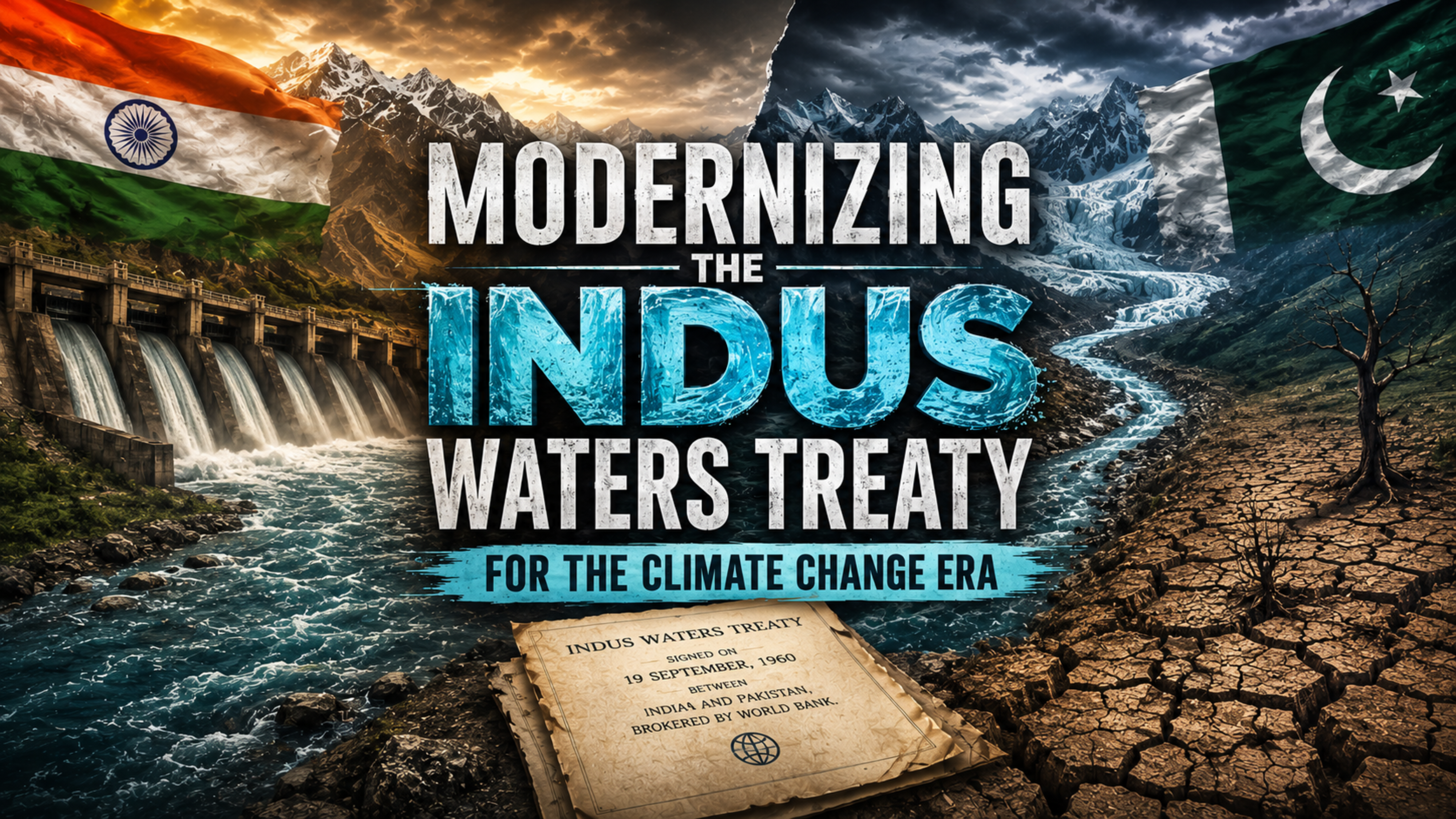
The Indus water Treaty has survived three intense between India and Pakistan, but what it may not survive is the melting of glaciers.Indus water treaty signed on 19 September,1960, between Indian and Pakistan, brokered by World Bank. It was built for a different era where climate conditions and political conditions were different, it wasn’t designed to address contemporary challenges. The accelerating impact on climate change, including rising temperatures, melting glaciers and increasingly unpredictable water flows, highlights the urgent need to modernize the treaty.

Indus water originally originated from glaciers near lake Mansarovar in the Kailash mountain range of Tibet and flows northwest through the distributed Kashmir region. As a glacier-fed river system, its flow is highly dependent on seasonal snow and glacial melt. However, climate change has accelerated glacier melting and altered precipitation patterns, making river flows increasingly unpredictable. These emerging hydrological changes were not anticipated when the Indus Waters Treaty was negotiated in 1960.

There are many more challenges other than climate change which are making this treaty highly vulnerable. Which include lack of real time sharing of data hydrological data sharing between India and Pakistan, deforestation and inadequate afforestation efforts, Deforestation in the upper catchment areas of Indus River has reduced the natural ability of forest to regulate glacier melt and maintain stable river flows. Pakistan and India are both depended on this river but have never made efforts to its ecosystem There has been insufficient cooperation to prevent deforestation, promote afforestation. Poor water management particularly in Pakistan, remains a major challenge. Pakistan has limited reservoirs storage capacity, resulting in a significant amount of water flowing unused into the sea instead of being stored for agricultural, industrial, and domestic use. Reservoir capacity isn't just an efficiency question it's a matter of life and death. The floods that have repeatedly devastated Pakistan, displacing tens of millions and killing thousands, like the 2022 floods, which killed over 1,700 people and displaced over 30 million) they aren't purely acts of nature. They're also a failure of storage water that had nowhere to go except into peoples.

That’s why it’s important to add some supplementary clauses in the treaty to make it even more effective. The treaty has worked for 66 years but that does not mean it will be enough for today’s challenges. If the treaty is not updated it could put people's lives, livelihoods, and water security at risk.

Given how politically radioactive a full renegotiation of the treaty would be, the more realistic path is a supplementary framework one that sits alongside the existing treaty without touching allocation, usage rights, or sovereign control, and instead patches the specific gaps identified above. Following clauses should be added in the treaty to make it more effective and suitable for contemporary period. Firstly, there should be the Joint Climate and Ecosystem Protection Cooperation, both countries should agree to adopt a joint climate resilience approach focused on long term sustainability of the river system, including:

  Glacier monitoring and seasonal flow assessment.

·  Afforestation and reforestation programs in upper catchment and glacier adjacent areas.

·    Prevention of deforestation in critical watershed cones.

·     Promotion of climate-resilient native vegetation including the fast growing and soil- stabilizing species such as Deodar cedar, blue pine (Pinus wallichiana), and other native species, to reduce soil erosion, regulate local temperatures, enhance carbon sequestration, and maintain ecosystem balance.

·         Joint Flood forecasting and drought assessment systems

These measures aim to stabilize watershed ecosystems and indirectly support glacier sustainability, in alignment with the United Nations Framework Convention on Climate Change and relevant SDGs (Goal 13).

Secondly, Parties should agree to establish a near real time data sharing system to enhance to predictability and reduce uncertainty, including:

·         River flow level at regular intervals

·         Inflow and outflow data at major upstream points

·         Non-sensitive information on gate operations (opening/closing patterns)

·         Short-term pondage and release patterns within permitted limitsData shall be shared at mutually agreed intervals, following a flexible, condition-based approach. During normal conditions, periodic updates shall be maintained, while during periods of high variability, flood risk, or significant operational changes, the frequency of updates may increase, including near real-time sharing where feasible.This directly addresses the current gap where only general or delayed data is shared, but operational timing data is missing.And all this will be monitored by the joint technical working group as a technical extension of the existing framework under the Indus Waters Treaty, working alongside the Permanent Indus Commission.

None of these clauses redraw borders or reallocate a single cusec of water. That's the point. It's the difference between renegotiating a treaty and patching its blind spots and given the current political climate between the two countries, patching is the only version of reform with a realistic path forward. But Data and Diplomacy Aren't Enough, Pakistan Has to Fix Its Own Storage Problem

Indus water treaty would be only solving the water information and protection; it does nothing about the fact that Pakistan currently has some of the lowest water storage capacity per capita of any major river-dependent country in the world and that’s Pakistan’s internal problem it has nothing to do with India. That’s why Pakistan should be focusing on this issue that how they can effectively manage the water, by engaging with water resources engineers, hydrologist hydraulic engineers and other experts to conduct research and improve the reservoir planning and development.

The Indus Water Treaty upgradation that I have proposed is quiet modest. It suggests practical improvements rather than rewriting the entire treaty. It does not ask India to give up water it already has the right to, nor it ask Pakistan to give up any right of its water. It just focuses on the gaps that were not addressing contemporary challenges. Along with the upgradation in the treaty is also suggest that Pakistan must invest in reservoirs, dams and modern water management systems.