In Pakistan public
conversations frequently commence with the promise of mutual understanding yet
culminate in mistrust. Whether in televised talk shows classrooms, workplaces,
familial settings, or social media exchanges, many individuals have encountered
situations in which their views were dismissed before being fully articulated.
A woman reporting harassment is dismissed as "too emotional." A young
professional who challenges outdated workplace norms is labelled
"disrespectful." A member of a religious minority who recounts an
experience of discrimination is accused of exaggeration. In each instance the
underlying difficulty is not mere disagreement but a more fundamental failure
to genuinely apprehend another person's lived experience. Dialogue is widely
extolled as the foundation of democracy, peaceful coexistence and social
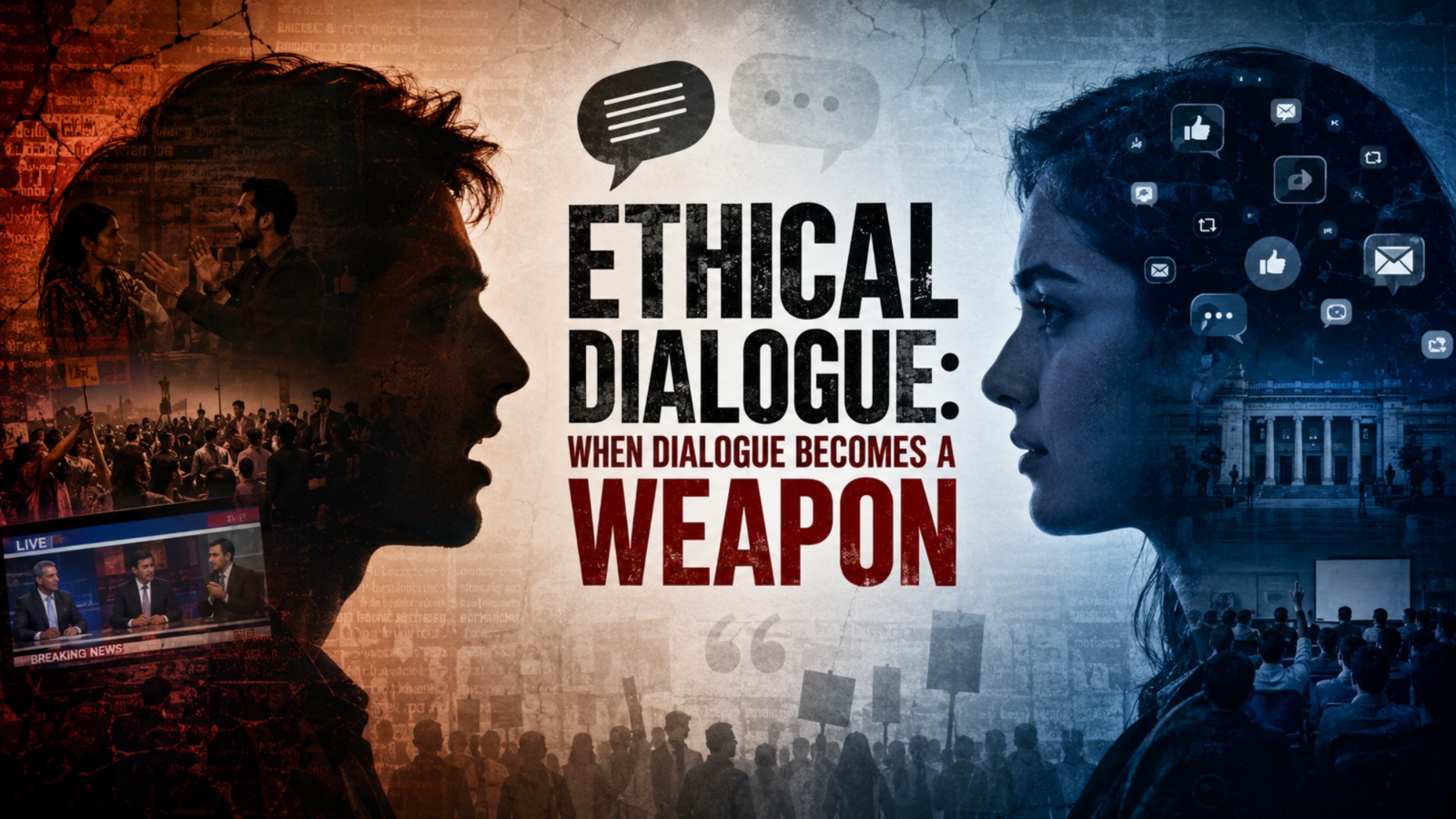
progress. Yet dialogue is not inherently ethical by virtue of occurring. When
conversation is deployed to manipulate, silence or delegitimize others it
ceases to function as a vehicle of understanding and instead becomes an
instrument of power. This raises a question of considerable consequence for
Pakistani society. How might conversations be structured so as to cultivate
trust rather than deepen division?
Dialogue is commonly
misconceived as the mere exchange of opinions. In substance, however, ethical
dialogue demands considerably more, honesty, openness, mutual respect and a
willingness to interrogate one's own assumptions. Regrettably, much
contemporary discourse is animated not by a desire to learn but by a desire to
prevail. Political debate is increasingly structured as competition rather than
deliberation; televised panels privilege confrontation over clarity, social
media algorithms reward outrage over considered engagement. Even within
educational institutions, students often hesitate to question instructors since
disagreement is frequently construed as insubordination. When dialogue becomes
performative rather than sincere, it forfeits its ethical substance.
The French philosopher Jean-Paul
Sartre articulated the concept of “bad
faith” a mode of self-deception through which individuals evade
responsibility for their choices. Applied to conversation, bad faith manifests
when participants feign honest engagement while harboring no genuine intention
of listening or revising their position. An individual acting in bad faith may
pose questions merely to project an appearance of reasonableness, invite
discussion while summarily dismissing every counter-argument, or pledge
compromise without any intention of honoring it. Such conduct produces the
semblance of dialogue while foreclosing its substance.
This form of manipulation
resists easy detection precisely because the individual has technically
participated in the exchange, and may subsequently claim to have listened and
afforded others the opportunity to speak. Meaningful dialogue, however requires
more than mere participation it requires sincerity of intent. Pakistan's public
discourse is frequently afflicted by this pathology. Political leaders, media
commentators, and ordinary citizens alike often enter discussion in search of
confirmation for pre-existing convictions rather than genuine engagement with
alternative perspectives. Conversation, under these conditions, tends to
generate polarization rather than resolution.
A further analytical lens is
offered by the concept of “epistemic
injustice” introduced by the British philosopher Miranda Fricker.
Epistemic injustice arises when individuals are treated unfairly in their
capacity as knowers that is, when their claims to knowledge are accorded
diminished credibility. One salient form is testimonial injustice wherein a speaker's testimony is
discounted on the basis of prejudice rather than the merits of the evidence
presented.
Instances of this phenomenon
are readily observable across Pakistani society. Women's accounts of workplace
discrimination are frequently subjected to more rigorous scrutiny than
comparable accounts offered by men. Young professionals often struggle to have
their contributions taken seriously on account of age alone. Rural communities
possess considerable local knowledge concerning agriculture, climatic patterns,
and water management, yet policy deliberation remains disproportionately
dominated by urban experts. Religious minorities, similarly frequently find
their lived experiences filtered through majoritarian assumptions rather than
engaged with on their own terms. In each case, the individual is not
discredited on account of weak evidence, but because society allocates
differential credibility across social groups. The consequences of this dynamic
extend well beyond individual grievance, when people lose confidence that their
voices carry weight, they withdraw from civic participation, public trust
erodes, and policymaking becomes correspondingly less representative.
Pakistan is a country of considerable linguistic, cultural, religious and ethnic diversity a condition that ought properly to constitute a source of national strength. Realizing this potential, however, requires institutions capable of adjudicating fairly among competing perspectives. Much of the national conversation is oriented toward constitutional reform, economic development and security policy. While these concerns are undeniably significant comparatively little attention is directed toward the quality of the deliberative processes through which such decisions are reached. Policy outcomes are demonstrably more likely to succeed when informed by a plurality of lived experience. Farmers possess an understanding of agricultural realities frequently invisible to urban policymakers; teachers apprehend classroom dynamics more acutely than administrative officials; local communities often hold practical knowledge of environmental risk that formal institutions overlook. The exclusion of such voices is not merely a matter of inefficiency — it constitutes an ethical failing, insofar as it denies individuals equal recognition as legitimate contributors to knowledge.
The promotion of ethical dialogue cannot be left to individual disposition alone, institutions bear a corresponding obligation. Universities should actively encourage open academic debate. News organizations should privilege informed discussion over sensationalized confrontation. Government agencies should design consultative mechanisms that meaningfully incorporate marginalized communities, rather than treating public participation as a procedural formality. Workplaces likewise should cultivate cultures in which employees may raise concerns without fear of retaliation, and community organizations should establish protected spaces for respectful disagreement. Institutional trust is strengthened when individuals believe they will be heard fairly, irrespective of whether others ultimately concur with their position. Ethical dialogue rests upon a principle at once simple and demanding: every person is entitled to be heard with dignity. This is not to suggest that all opinions warrant equal epistemic standing; rather, it requires that arguments be evaluated on their merits, rather than filtered through considerations of gender, age, religion, ethnicity, or social status. Pakistan's future depends not merely upon economic growth or technological advancement, but equally upon the quality of its public conversations. Democratic institutions flourish when citizens trust that their experiences are of consequence and that disagreement may occur without humiliation or exclusion.
Ultimately dialogue must never be permitted to function as an instrument of silencing. It should instead remain a bridge across differing experiences, ideas and communities. In an era of intensifying polarization, safeguarding the ethics of conversation may constitute one of the most consequential investments Pakistan can make in its democratic future.


_6784.jpg)