Top Stories
Building Bridges Through Words Understanding Militant Ideologies in Modern Contexts Security: Beyond Walls and Weapons Upcoming Events: Connecting Ideas and People Previous Milestones: Reflecting on Our Journey Fatwas: Reclaiming the Spirit of Ethical Guidance Role of NATO in Conflict Resolution Washington Peace Deal Between Congo and Rwanda Social Justice and Equality in the Qur’ān: Implications for Global Peace The Qurʾānic Concept of Human Equality: An Analysis against Racism and Ethnic Discrimination in Contemporary Societies Reinterpreting Dhimmitude: A Reconsideration of Its Social and Political Functions in the Modern Context How China Is Playing the Long Economic War Ukraine Peace Efforts Advance Cautiously Despite Partial Alignment Among Parties How Pakistan-Libya Military Relations Strategic Outreach, Economic Stakes and Geopolitical Implications Aleppo Clashes as Syria and Kurdish-Led SDF Agree to Ceasefire Across the Border, Pakistani Ulema Stand Against Afghan Girls\' Education Ban Pakistan announce 500 fully-funded scholarships for Bangladeshi students in 8 programs How theTaliban regime threat for reginal peace Women Left Behind in Khyber Pakhtunkhwa’s Education System Sudan’s Civil War: Anatomy of the World’s Largest Humanitarian Crisis Changing Security Architecture in Central Asia Pakistan Leads India on Economic and Peace Indicators in 2026 : Gallup Survey Submerged Classrooms, Long-Term Learning Loss Pakistan Security Report 2025: Terrorism Trends and the Peace Deficit HEC’s MAKTAB Initiative Signals a New Era for Higher Education Southern Yemen Faces Tensions and Urgent Need for Peace IUT Strengthens Education Integrity in Bangladesh Pakistan’s Arms Sales Contracts (2024–25) and the Peace Dimension Pakistan\'s Contribution to UN Peacekeeping Operations for Global Peace Pakistan Enhances Educational Cooperation with Sri Lanka through Scholarship The Growing Defense and Economic Nexus of the Muslim World Charter of Trump’s Board of Peace Pakistan & Myanmar Prioritize Education Strategic Saudi defense agreements are redefining the Middle East\'s security architecture What would be the consequences of the U.S.–Iran Conflict on Pakistan? How Indian Cricket Politics Affect Regional Peace The Kashmir issue remains a central peace and stability in South Asia American Weapons in Afghanistan Are Destabilizing Pakistan Global Education Coalition sixth annual meeting A New Chapter for Pakistan’s Universities: Leadership, Stability, and Vision under the New HEC Chairman The Evolution of the IMCTC into a Global Security Pillar Reintegration Initiative: Analyzing the 2026 IMCTC Engagement in Pakistan Psychosocial Warfare and the IMCTC Peace Journalists Initiative (2026) The Concept of ‘Ummah’ in the Qurʾān: Transcending Race, Tribe, and Ethnicity HEC Reforms Regulation, Defends Academic Freedom Pakistan’s Evolving Role in Fostering Peace and Security on the African Continent Recontextualizing Pakistan’s Role in the Board of Peace War in the Middle East: Measuring the Cost The Silent Bridge: Pakistan’s Strategic Neutrality and the Quest for Middle Eastern Stability The Geography of Escalation: Living in an Age of Permanent Crisis Mapping the Educational Crisis in the Middle East Conflict The Blind Alley of “Epic Fury”; A War with no End game A Pakistani Voice Against Digital Islamophobia: A Landmark Academic Contribution World Eye on Pakistan for Middle East Peace Leading with Truth, ICEP’s Analysis Outlasted the Skeptics on Middle East Crisis World Powers Push for Deal U.S. Presents 15-Point Plan and Iran Responds with 5 Conditions Pakistan and Türkiye Open New Chapter in Academic Cooperation with Strategic Initiatives Pakistan at the Crossroads of Global Trade as a Logistics Revolution Unfolds Why Ethical Dialogue necessary in a Diverse Pakistan for a Peacebuilding Initiative Pakistan\\\'s Game-Changer Role for World Peace Entrepreneurship Education Is Shaping Pakistan\\\'s Economic Future Dr. Jamil Akhtar Featured in Prestigious Brill Encyclopaedia (2026) A Milestone in Global Interfaith Scholarship Peace Light in a Dark Night WAR RESHAPES PAKISTAN’S ECONOMY AND OPEN DOORS FOR INTERPRENEURS From Gaza to Lebanon: ICC, UN, and the Unanswered Duty to Prosecute Can Pakistan turn a temporary ceasefire into lasting middle east peace? Bridging the Gap: Confronting Education Inequality in Pakistan Hierarchical Culture In Pakistani Organizations \"How It Kills Innovation — and What Leaders Can Do About It\" Can Diplomacy Survive the Iran Crisis? Peace Efforts in an Age of Permanent Escalation Why are Peace Talks a US strategic priority? Features of Intellectual Property in the Age of Artificial Intelligence (In the Context of World Intellectual Property Day) A Global Forum for Peace, Governance, and a Better World (France\'s Landmark Contribution to International Dialogue) IS UAE WANT A \\\'CURRENCY SWAP\\\' WITH THE USA Energy War by Sea: The Hormuz Blockade Proves Oil is Still a Weapon The End of Strategic Dependence In Europe? Pakistan\'s Strategic and Structural Evolution from Crisis to Consolidated World Peace Silent Deterrence: Hangor-Class SSP-2800 and Undersea Strategy of Pakistan Inside the $9 Billion Prediction Market Revolution Pakistan at the Crossroads: Between Fragile Stability and the Weight of Structural Crisis WHY DIALOGUE FAILS IN CONFLICT ZONES; A LESSON FOR POLICY MAKERS The Crisis of American Legitimacy in the Post-Unipolar Era THE OIL CLUB UAE JUST QUIT Inside OPEC’s Biggest Defection in Decades — and What It Means for the World The Kashmir Dispute: International Institutional Failure and Humanitarian Consequences The $100 Billion Event the World Refuses to Understand How is Eid-ul-Adha A School of Peace? 250 Million Children Classrooms Zero Learning Ethical Dialogue: The Art of Speaking with Intention Ethical Dialogue: The Moral Weight of an Honest Word Skills in Their Hands, Books in Their Bags Ethical Dialogue : Honoring the Voice of the Other HEC Honors Top Pakistani Scientists and NRPU Grant Recipients at Punjab University What\'s the 14 Point of Peace deal that will be signed in Geneva When Words Carry Power: The Unequal Conversation Why Humanitarian Crises Gain Attention Only When Politicized : An International Law Perspective The Ethics of Saying Nothing
Education

Skills in Their Hands, Books in Their Bags

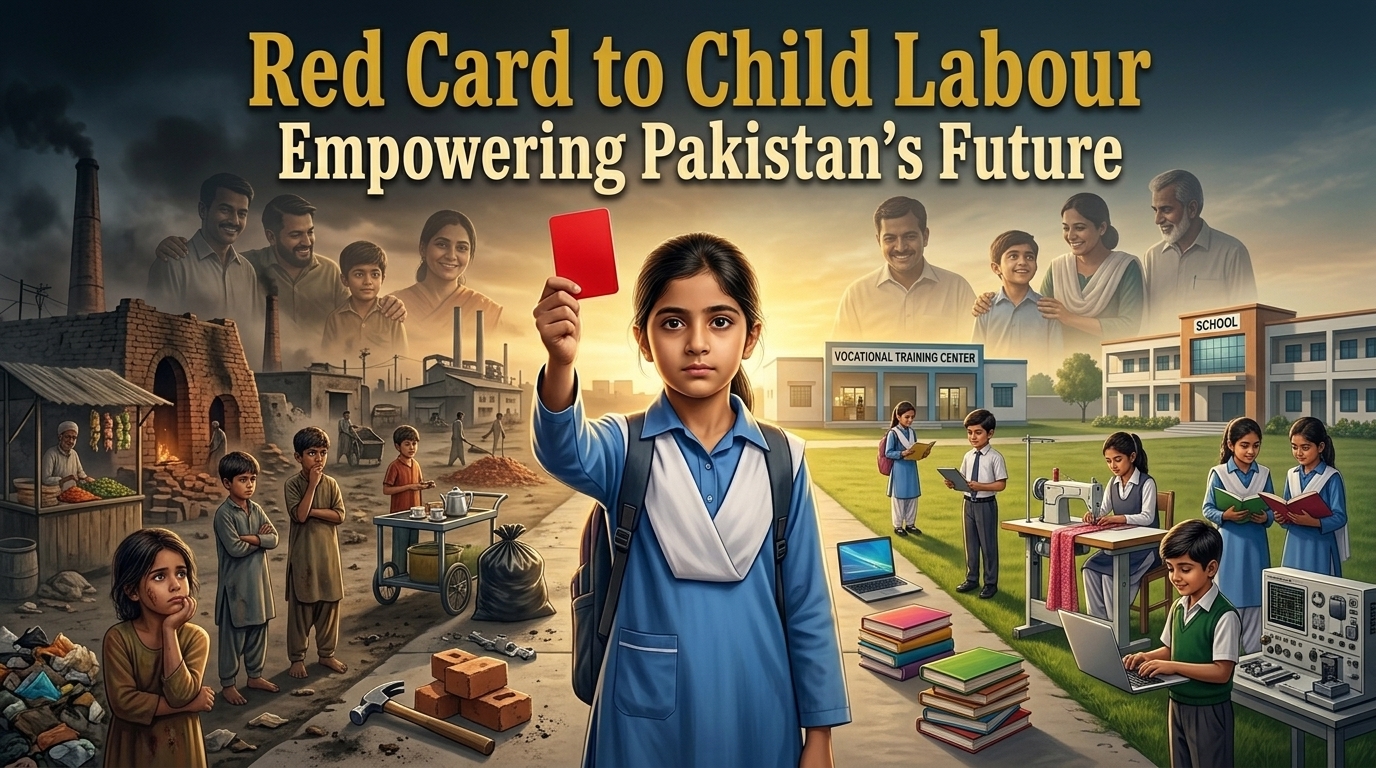
In Pakistan millions of kids get up each morning to a task rather than to school. They are not lazy and they don't work in the police because it isn't a good option for their families to survive, they work in the bricks in Lahore, the newspaper stalls in the intersections of Karachi, they crouch down, they sort waste in the informal settlements of Quetta because their families have calculated it is not a good option for them to be idle. Pakistan is being called to action on this World Day Against Child Labour, celebrated on 12 June with the theme ‘Red Card to Child Labour: Fair Play for Children, Decent Work for Adults', as the problem extends beyond parental neglect to the structural poverty. The answers as the Islamabad Center for Education & Peace has always said have to be in the realm of education and peace — and of economic dignity for the poor families.

The Scale of the Crisis

 The Challenge of the crisis According to the Federal Ministry of Education, Pakistan had 26 million out-of-school children in 2024, ranking its performance on child education as one of the worst in the world. A provincial survey in January 2024 revealed that 0.9 per cent (more than 745,000) of children aged 5-17 in the Province of Khyber Pakhtunkhwa are engaged in child labour, of which almost 74 per cent are involved in hazardous work. Although boys are not as exposed as girls, they do carry a heavy burden too, particularly in the form of invisible domestic labour. About 20 per cent of children in the same age group suffer the same fate in Sindh. According to the latest ILO-UNICEF estimates, there are almost 138 million children in child labour worldwide, of which 54 million are in hazardous work in 2024. The elimination target for 2025 has been missed and Pakistan has an undue burden for this unfinished target. 

Why Poor Families Send Children to Work

The reasons that poor families send their children to work. Implicating parents in the moral failing of child labour is an unhelpful and persistent mistake. Its driving force is poverty and not indifference. Education is a luxury in low-income households in rural Punjab, southern Sindh, and peri-urban Balochistan due to school fees and lost income. A child earning Rs. A family's diet could be a matter of 400-600 a day. More than 65 percent of respondents in a KP study in 2024 said “economic hardship” was the determining factor. Parents understand the importance of education, but that is the only thing they have to survive by — and that is only for the moment.

Islamabad Center for Education & Peace (ICEP)

The Islamabad Center for Education & Peace (ICEP) has consistently argued that enforcement alone cannot solve Pakistan’s child labour crisis. Raids on workshops and kilns, while necessary, are insufficient — removing income without a replacement simply pushes children into less visible, more dangerous work. ICEP’s field research reveals that many poor parents are not hostile to education: they seek a model that lets children gain marketable skills while remaining in school. Pakistan’s TVET system targets youth aged 16 and above, leaving those aged 10–15 without support at the moment they are most vulnerable. ICEP recommends three responses: community skills micro-centers within government schools conditional cash transfers tied to skill-module completion; and parent mobilization programmes treating skills as a complement to schooling. Education and peace, ICEP insists, are impossible without economic security for families.

Skills Alongside Schooling

 Skills Alongside Schooling The message to the poor parents of Pakistan on this World Day is not a lecture, it is an invitation. You cannot compare a 12-year-old child working in a workshop in Rawalpindi for twelve hours to a 12-year-old child who is learning a technical skill of electrical repair in school and getting paid for it during weekends, and later he will be able to use it to earn a livelihood. Afternoons tailoring classes may be held in a school in Rahim Yar Khan and the girls could earn money at home without endangering themselves. A mobile repair shop is a trade that is in growing demand and has low start-up costs, a trade that a school in Mardan could offer. These are models that are replicable but are encountered in fragmented forms throughout Pakistan, and need institutional will to scale. 

The Role of Government and Civil Society

The role of government and civil society organizations. The legal framework in Pakistan, both National as well as provincial, mandates that children under 14 years of age are not allowed to work in factories or hazardous environment. However, enforcement is still very weak: labour inspectorates in the provinces are poorly funded, under resourced and corrupt. Community-level interventions have been shown by civil society to have an effect. Hundreds of thousands of out-of-school children have been reached by non-formal education centres, mobile school programmes and community learning hubs. UNICEF's vocational training programs in Pakistan engaged more than 13,000 youth in 2024 of which 70 per cent were successfully placed. 

A Different Kind of Red Card

The results demonstrate that when education and peace are seen as interrelated objectives supported by real political commitment, results are possible. A Different Kind of Red Card Football and cricket bring people together from Gilgit to Gwadar in Pakistan and the ILO's 2026 campaign is raising a red card to child labour - an apt metaphor for the country. However, if there is no replacement for a red card, then it is just a punishment. Families need a new playbook where education isn't a tradeoff, skills aren't a distraction from school, and a poor parent's dream for their kid can't be in competition with this month's rent. Access to education and peace is through the poorest families in Pakistan. The child who is gripping a book in one hand while learning a skill in the other isn't a compromise, she's the future that the country desperately needs.