

where
classified intel meets the world's
accurate market
Somewhere in the United States Army, there is a soldier
sitting in a cell right now because he made too much money too fast on a
website most of his commanding officers had never heard of. The DOJ announced
his charges on April 26, 2026. He had access to classified intelligence about a
covert operation to capture Venezuelan president Nicolas Maduro. Instead of
keeping that information to himself, he opened Polymarket, placed a $33,000 bet
that the raid would happen, and walked away with $400,000 when it did. The case
made front pages not because a soldier broke the law — soldiers break laws all
the time and nobody writes about it — but because of what it said about the
platform he chose. He did not call a bookie. He did not tip off a hedge fund.
He went to Polymarket. Because in April 2026, if you know something the world
does not, Polymarket is where that knowledge is worth the most money.
Two days after those charges were announced, on April 28,
Polymarket did two things at once. It launched the biggest technical upgrade in
its history — new smart contracts, a new order book, a new currency called USD,
and a million-dollar programme to attract serious traders. And Bloomberg
reported that the company was in active conversations with American regulators
to bring its main platform back to the United States, where it has been
technically banned since 2022. The platform that processed $54 million in
January 2024 and $2.63 billion in November of the same year — a 48-fold jump in
eleven months — is now trying to come home. And the question is not whether
Polymarket is legitimate. A soldier risking federal prison to use it answered
that question already.
"Polymarket is accurate more than 94% of the time
an entire month before an outcome is definitively known."
Polymarket Official Accuracy Statistics, April 2026
What Is Polymarket?
Here is how it works. Someone creates a question. Will the
Federal Reserve cut rates before June? Two types of shares appear — YES and NO.
Together they always add up to one dollar. If you think YES, you buy YES shares
at whatever the current price is. Say they are trading at seventy cents. If the
Fed cuts rates, your shares pay out a dollar each. You make thirty cents per
share. If the Fed does not cut, you lose your seventy cents. That is the whole
thing. No complicated options chains. No leverage calculations. Just a question,
a price, and real money on the answer.
The price itself is the important part. Seventy cents on YES
does not mean someone guessed 70 percent. It means that after thousands of
people have bought and sold — each one putting real money on their conviction —
the market has settled at a price that implies 70 percent probability. Think
about what makes that different from a poll. When a pollster calls someone and
asks who they think will win an election, that person answers freely, with zero
consequence for being wrong. When a Polymarket trader puts ten thousand dollars
on YES, they answer with their wallet. They research. They update when things
change. They do not vote with their gut. They vote with their savings. That one
difference — consequence — is why prediction markets have beaten every other
forecasting method ever studied. And it is why a soldier with classified
information chose Polymarket over every other option available to him.
"When people have money on the line, they research properly, update when new information arrives, and do not vote with their feelings."
Robin Hanson — Economist and Prediction Market Pioneer, George Mason University
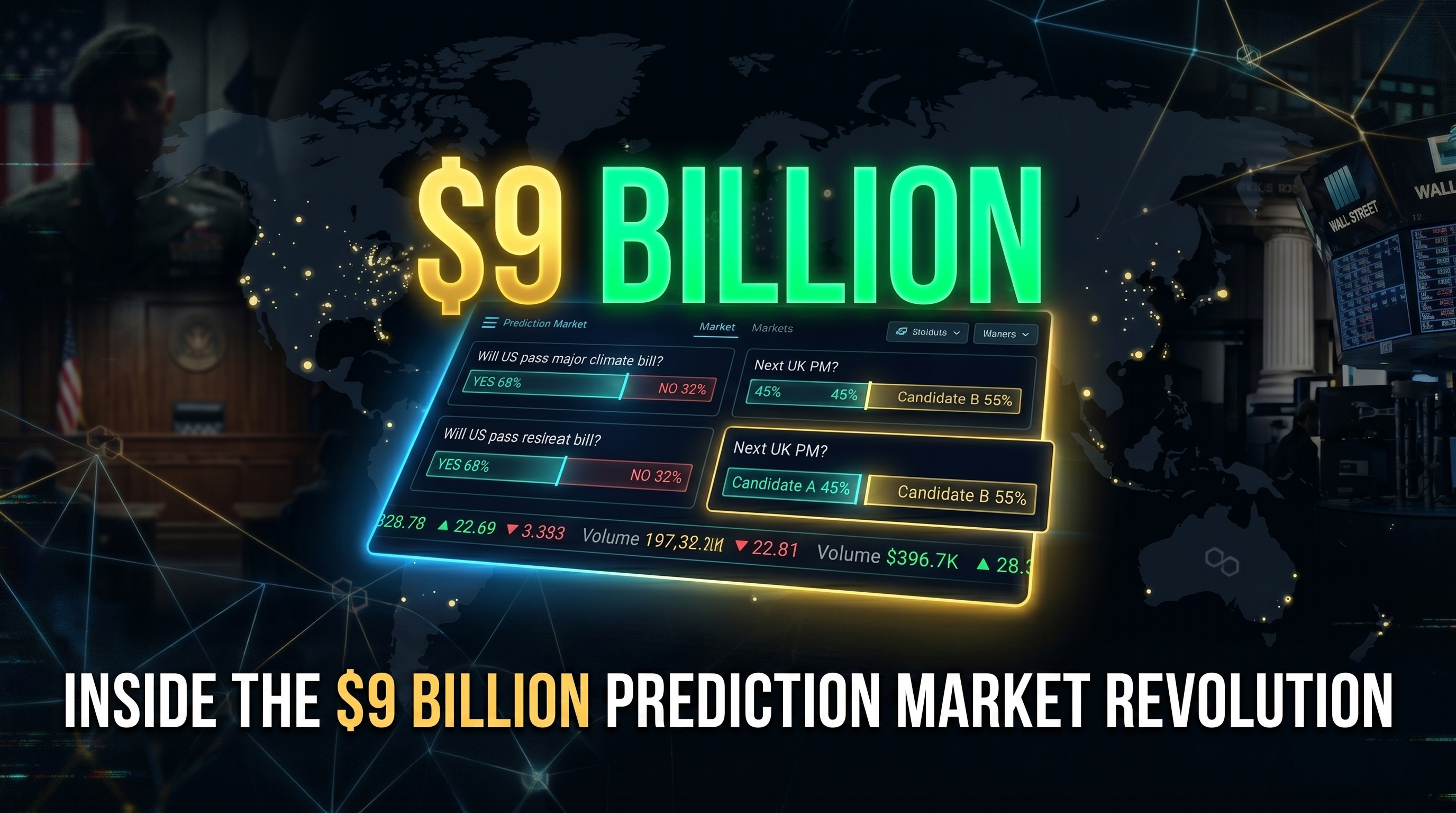
In 2023, Polymarket processed $73 million in total trading volume across the entire year. In 2024, that number was $9 billion. That is not a typo. The same platform, twelve months later, 12,000 percent larger. The monthly peak was $2.63 billion in November 2024 — the month of the U.S. presidential election. At its height, open interest hit $510 million. That means half a billion dollars was sitting on open positions simultaneously, all waiting on the same event. Over 1.2 million unique traders from 180 countries participated across the year. Five hundred thousand of them — nearly half the entire platform's user base — joined in the last three months alone. The average user was thirty-two years old. Twenty-eight percent were women. Sixty percent were on mobile.But here is the number that matters most, and that nobody in the breathless coverage of Polymarket's growth tends to mention. Of all the wallets that ever traded on the platform, only 0.51 percent — just over one in two hundred — ever made more than $1,000 in profit. Seventy percent of all trading volume came from just one percent of users. About 12,000 people out of 1.2 million were making serious money. The rest were feeding them. Polymarket is not a lottery where anyone can win. It is a market where information is the edge, and most people do not have enough of it. The soldier who used classified intelligence understood this perfectly. He was not gambling. He had an edge that was essentially unbeatable, and he used the most efficient available market to extract its value. That, in miniature, is the whole logic of how Polymarket works.
"Volume grew from $73 million in 2023 to $9 billion in 2024. In January of that year, monthly volume was $54 million. By November it was $2.63 billion. A 48-fold jump in eleven months."
The Block, Polymarket Annual Data Report, January 2025
On November 5, 2024, every major American TV network was calling the presidential race too close to call. Anchors hedged. Pollsters refreshed spreadsheets. The New York Times model had Harris and Trump in a virtual tie. Nate Silver, the most famous election data analyst in America, gave Harris a slight edge. Meanwhile, on Polymarket, Trump had been trading above sixty cents — implying a 60-plus percent chance of winning — since September. For two months, while the entire American media establishment was telling the world it was a coin flip, the people betting real money on the outcome were saying something different. When Trump won decisively, the question became unavoidable: how did a crypto prediction market know what the professional forecasters missed?
Part of the answer was a French trader who had spent months
doing the work that the pollsters were not doing. He studied county-level
voting patterns. He looked at economic indicators that historically predicted
incumbent-party performance. He found a systematic gap between what the polls
were showing and what the underlying data suggested. He built his position
slowly. By election night, he had $30 million on Trump. When the results came
in, he collected $85 million — the largest single prediction market profit ever
recorded. He was not lucky. He was right. And Polymarket was the place where
being right paid $85 million. Today, the 2026 midterms already have $5.8
million traded on them, with the market currently pricing Democrats at 48.5
percent odds to sweep both chambers — driven by Trump's net approval sitting at
negative 17 percent and historical patterns of midterm losses for the
president's party. The election is seven months away. The market is already
working.
"The reason prediction markets outperform polls
is simple. Polls ask what you think. Markets ask what you will bet. Those are
very different questions — and they produce very different answers."
Philip Tetlock — Author of Superforecasting, University of Pennsylvania
The Money, the Tech, and What Happens Next
Polymarket was built by Shayne Coplan when he was twenty years old. It runs on blockchain — Polygon specifically — and until April 28, 2026, settled trades in USDC, a digital dollar. The April 28 upgrade switched the platform to pUSD, Polymarket's own token, backed one-to-one by USDC with the backing enforced by smart contract. When a market resolves, the smart contract pays winners automatically. No human approves it. No company holds the funds. The code runs and the money moves. This is not just a technical detail. It is the reason the platform survived the 2022 CFTC fine and kept operating after being formally ordered to stop serving Americans. When you cannot freeze the settlement mechanism, you cannot truly shut the platform down.
The money behind Polymarket now stands at $2.164 billion in total disclosed funding. That includes a $1 billion investment from the Intercontinental Exchange — the company that owns the New York Stock Exchange — announced in October 2025. Valuation discussions have reached $12 to $15 billion. And as of April 28, 2026, Bloomberg reported that Polymarket was in active talks with CFTC officials to lift the ban on American users entirely. If that goes through, the platform that has been technically closed to the world's largest retail trading market for four years suddenly opens its doors to tens of millions of new users. The CFTC has four vacant commissioner seats. The chairman has publicly defended federal authority over prediction markets against state gambling regulators. The vote, when it comes, may not be as complicated as it looks. But even while the regulatory question hangs open, Polymarket has already crossed the threshold that most financial startups never reach. It is not a clever idea anymore. It is infrastructure. It is where serious money goes to price serious questions. And when a U.S. Army soldier chose it over every other available tool to turn classified intelligence into cash, he said everything that needed to be said about how far Polymarket has come.
"Polymarket is taking steps to bring its main
exchange back to the US — potentially supercharging an already fast-growing
industry by letting Americans access the platform."
Bloomberg, April 28, 2026
There is a simple test for whether a financial product has truly arrived. It is not the valuation. It is not the press coverage. It is whether the people with the best information in the world choose it as the place to act on what they know. Hedge fund managers have Bloomberg terminals. Investment banks have proprietary data feeds. And a U.S. Army soldier with classified intelligence about a covert operation chose Polymarket. He is facing federal charges now. But he is also, in a strange way, the most credible endorsement the platform has ever received. The market that started with $54 million in monthly volume less than three years ago now has the New York Stock Exchange's parent company as a backer, is in negotiations to return to the United States, and processes billions every month from traders in 180 countries. It is accurate 94 percent of the time a full month before outcomes are known. It called the 2024 election correctly while every major pollster got it wrong. And it is just getting started.
"When money speaks, truth tends to follow."
Robin Hanson — George Mason University
Conclusion
Polymarket’s evolution from a niche crypto platform to a multi-billion-dollar global force represents a fundamental shift in how the world prices truth by replacing the "zero-consequence" nature of traditional polling with a system driven by financial conviction. This "incentive-based" forecasting consistently outperforms established media and data analysts, achieving a 94% accuracy rate a full month before outcomes are finalized. The platform's resilience—evidenced by a trading volume explosion from $73 million in 2023 to $9 billion in 2024—is now supported by a $1 billion investment from the parent company of the New York Stock Exchange and active negotiations to return to the U.S. market. Ultimately, Polymarket has proven that when people are forced to bet with their savings rather than their feelings, the resulting market price becomes a highly reliable indicator of reality, validating the principle that "when money speaks, truth tends to follow".



_6784.jpg)