Beyond Ritual — toward Moral
Reconstruction
More than 2 billion Muslims are called to
sacrifice something they love— something that God has commanded them to give up
on each year. In much of today's Muslim world, however, this great day has been
made all the more superficial in ways ranging from new clothes to feasting and
social media documentation.
This article
seeks to bring back the moral structure of Eid-ul-Adha and to make one-point
argument: If this festival is celebrated in the original and authentic context
then it becomes one of the strongest instrument for peace which humanity has.
The challenge of this day is to educate communities, families, and institutions
about what this day calls for.
The meaning
of the word Qurbani is taken from the Arabic root qurb which means nearness to
the divine. Sacrifice isn't intrinsically linked to loss. It has to do with the
redirecting of the heart, with the voluntary turning away from one's own good
to something higher and more moral. Peace with God, peace with oneself, peace
with others is the greatest kind of inner peace a believer can have when he or
she decides to give up something of value to gain the love of the community.
This is
altogether anti-culturational in a world where one's desire is the primary life
force. Eid-ul-Adha is deprived of its transformative quality if education is
not imparted in this logic, in homes, mosques, and schools. The first
graduation gift of the Sacrifice is peace within the soul -- the ultimate
school of human moral maturity.
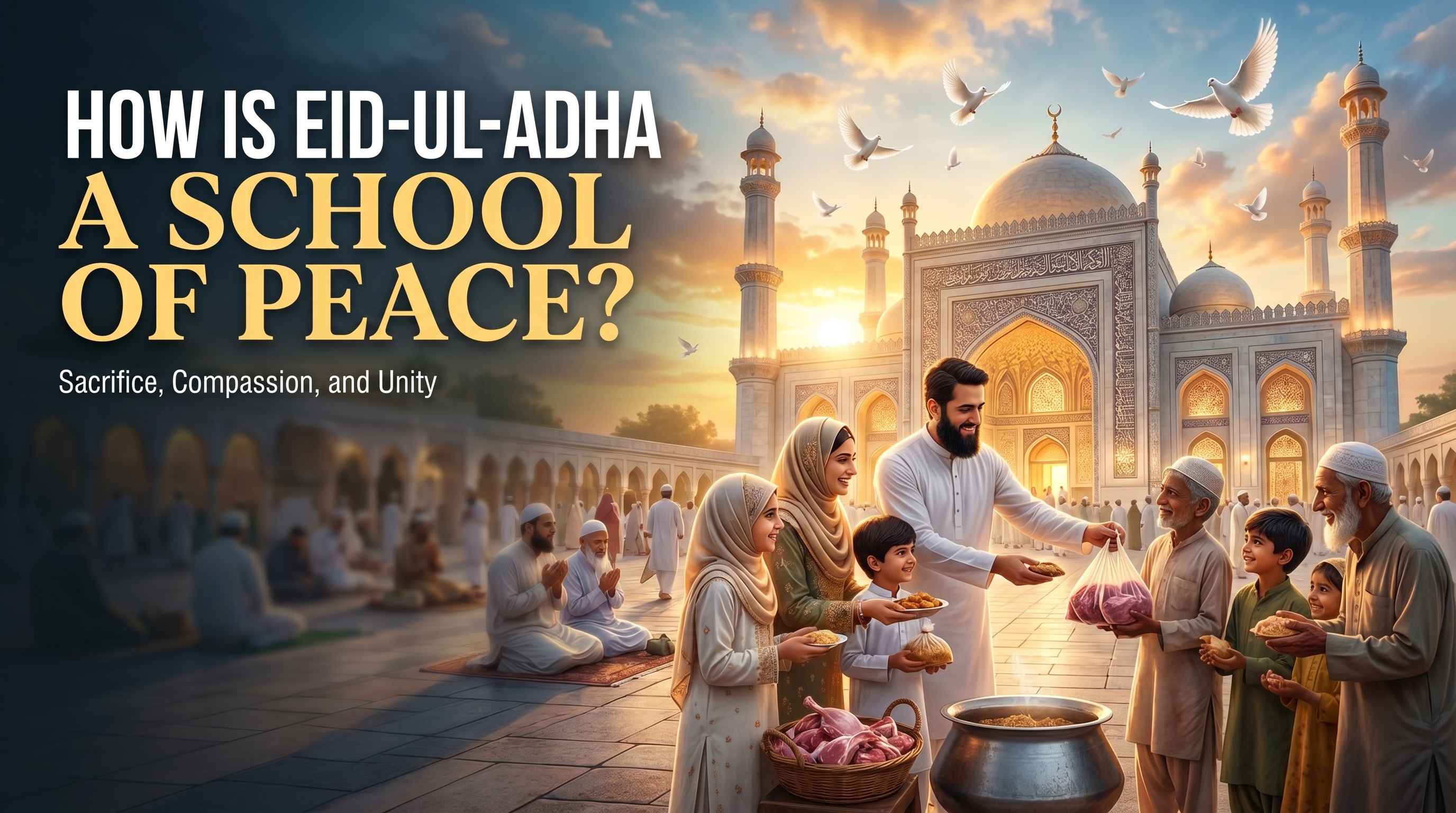
One third of
the meat was given to the family, one third to the neighbors and one third to
those in need, a tradition which is one of the most systematically just
redistributive practices in any religion. It's not a matter of feeling generous
or impulse. It institutionalizes it, making a personal act of piety a
community's building of care.
It's not
philanthropy, where the giver and the receiver remain permanently separate from
each other by power. It is solidarity, a lived assertion, that the poor and
destitute are equal members of a moral community, entitled to an equitable
distribution of its good. If done from the heart, this act eradicates
resentment and inequality, which are in every age the cause of conflict.
But peace
cannot be established in diplomatic halls only. Constructed on the table. When
understood, that table is set each year by Eid-ul-Adha. However, this knowledge
needs to be imparted. For the peace-making potential of Qurbani to be realized,
a prerequisite is that the next generation be educated in the why of Qurbani,
not just how.
In
Eid-ul-Adha the values that are embedded in it constitute a wholesome ethical
system. When imbibed through real education each one is a contributor to
enduring peace:
·
Sacrifice : Putting moral values before comfort. An
educated person in the ways of sacrifice desires justice rather than ease and
neighborliness rather than selfishness.
·
Equality: God does not pay attention to the
circumstances of wealth or rank, but only to a sincere heart. A society that is
educated in this principle is one that resists injustice-producing hierarchical
structures.
·
Humility: Clothing is a gift, not a right. A community
that has this belief is far less likely to hoard, exploit or oppress.
·
Solidarity: Human bonds renewed through common ritual
and shared meal. This is the glue that holds the world together in place of the
atomization which leads to many of the world's conflicts and loneliness.
The duty of
Qurbani is incumbent on every Muslim who has the means, a king or a common
citizen. As God's Word in the Qur'ān has stated, acceptance is not dependent on
social status, but on niyyah, or intention, and the quality of character. It is
an explicit confrontation from a theological point of view of any system that
assigns moral value on the basis of privilege.
This is not
a theological truism in a world where access to dignity and justice is so
unequal. It is a demand. No institution with an ethical basis should be able to
evade its responsibility for those it has let down, and it must answer – again
and again, and in very specific ways. The teaching in this aspect of
Eid-ul-Adha prepare the believers for not only personal piety, but civic
bravery and the ability to seek peace in society with justice and fairness at
the structural level.
The communal
aspects of Eid-ul-Adha—congregational prayer, communal feasting, family and
neighbour, class. socializing—are a form of social architecture which secular
modernity has not yet been able to replicate. This willful encounter isn't
sentiment in societies where there is epidemic loneliness and political
polarization. It is medicine.
Eid ul Adha
has the power to reconnect the social fabric when it is celebrated at its
fullness – through memory and commitment. It declares that the separate person
is not a total moral individual, human flourishing is a communal reality. Peace
is more than the lack of war. It's the feeling of connectivity, shared
responsibility, and belonging to something greater than you.
But all this
does not happen without effort. The communities need to be inculcated with the
significance of the ritual – continuously and deliberately. As parents we must
make sure that we don't just make children do the sacrifice, but we get them to
understand what they are giving up, and why.
Eid-ul-Adha,
as it is supposed to be celebrated, is the world's model of compassion,
redistribution, humility and solidarity. This is not a festival to celebrate
the old. It is a living curriculum that is updated annually and aims to create
the kind of human beings able to support peace.
The issue is
not the festival itself, but the underlying problem. The problem is the lack of
education, not just how to do it, but what it is for, not just what to do, but
what to do with it. If Muslims celebrate Eid-ul-Adha in awareness of what is
expected of them, then it is not just a holy day that they are celebrating.
They are agents of peace in a world that is in desperate need for peace.

_6784.jpg)