Top Stories
Building Bridges Through Words Understanding Militant Ideologies in Modern Contexts Security: Beyond Walls and Weapons Upcoming Events: Connecting Ideas and People Previous Milestones: Reflecting on Our Journey Fatwas: Reclaiming the Spirit of Ethical Guidance Role of NATO in Conflict Resolution Washington Peace Deal Between Congo and Rwanda Social Justice and Equality in the Qur’ān: Implications for Global Peace The Qurʾānic Concept of Human Equality: An Analysis against Racism and Ethnic Discrimination in Contemporary Societies Reinterpreting Dhimmitude: A Reconsideration of Its Social and Political Functions in the Modern Context How China Is Playing the Long Economic War Ukraine Peace Efforts Advance Cautiously Despite Partial Alignment Among Parties How Pakistan-Libya Military Relations Strategic Outreach, Economic Stakes and Geopolitical Implications Aleppo Clashes as Syria and Kurdish-Led SDF Agree to Ceasefire Across the Border, Pakistani Ulema Stand Against Afghan Girls\' Education Ban Pakistan announce 500 fully-funded scholarships for Bangladeshi students in 8 programs How theTaliban regime threat for reginal peace Women Left Behind in Khyber Pakhtunkhwa’s Education System Sudan’s Civil War: Anatomy of the World’s Largest Humanitarian Crisis Changing Security Architecture in Central Asia Pakistan Leads India on Economic and Peace Indicators in 2026 : Gallup Survey Submerged Classrooms, Long-Term Learning Loss Pakistan Security Report 2025: Terrorism Trends and the Peace Deficit HEC’s MAKTAB Initiative Signals a New Era for Higher Education Southern Yemen Faces Tensions and Urgent Need for Peace IUT Strengthens Education Integrity in Bangladesh Pakistan’s Arms Sales Contracts (2024–25) and the Peace Dimension Pakistan\'s Contribution to UN Peacekeeping Operations for Global Peace Pakistan Enhances Educational Cooperation with Sri Lanka through Scholarship The Growing Defense and Economic Nexus of the Muslim World Charter of Trump’s Board of Peace Pakistan & Myanmar Prioritize Education Strategic Saudi defense agreements are redefining the Middle East\'s security architecture What would be the consequences of the U.S.–Iran Conflict on Pakistan? How Indian Cricket Politics Affect Regional Peace The Kashmir issue remains a central peace and stability in South Asia American Weapons in Afghanistan Are Destabilizing Pakistan Global Education Coalition sixth annual meeting A New Chapter for Pakistan’s Universities: Leadership, Stability, and Vision under the New HEC Chairman The Evolution of the IMCTC into a Global Security Pillar Reintegration Initiative: Analyzing the 2026 IMCTC Engagement in Pakistan Psychosocial Warfare and the IMCTC Peace Journalists Initiative (2026) The Concept of ‘Ummah’ in the Qurʾān: Transcending Race, Tribe, and Ethnicity HEC Reforms Regulation, Defends Academic Freedom Pakistan’s Evolving Role in Fostering Peace and Security on the African Continent Recontextualizing Pakistan’s Role in the Board of Peace War in the Middle East: Measuring the Cost The Silent Bridge: Pakistan’s Strategic Neutrality and the Quest for Middle Eastern Stability The Geography of Escalation: Living in an Age of Permanent Crisis Mapping the Educational Crisis in the Middle East Conflict The Blind Alley of “Epic Fury”; A War with no End game A Pakistani Voice Against Digital Islamophobia: A Landmark Academic Contribution World Eye on Pakistan for Middle East Peace Leading with Truth, ICEP’s Analysis Outlasted the Skeptics on Middle East Crisis World Powers Push for Deal U.S. Presents 15-Point Plan and Iran Responds with 5 Conditions Pakistan and Türkiye Open New Chapter in Academic Cooperation with Strategic Initiatives Pakistan at the Crossroads of Global Trade as a Logistics Revolution Unfolds Why Ethical Dialogue necessary in a Diverse Pakistan for a Peacebuilding Initiative Pakistan\\\'s Game-Changer Role for World Peace Entrepreneurship Education Is Shaping Pakistan\'s Economic Future Dr. Jamil Akhtar Featured in Prestigious Brill Encyclopaedia (2026) A Milestone in Global Interfaith Scholarship Peace Light in a Dark Night WAR RESHAPES PAKISTAN’S ECONOMY AND OPEN DOORS FOR INTERPRENEURS From Gaza to Lebanon: ICC, UN, and the Unanswered Duty to Prosecute Can Pakistan turn a temporary ceasefire into lasting middle east peace? Bridging the Gap: Confronting Education Inequality in Pakistan Hierarchical Culture In Pakistani Organizations \"How It Kills Innovation — and What Leaders Can Do About It\" Can Diplomacy Survive the Iran Crisis? Peace Efforts in an Age of Permanent Escalation Why are Peace Talks a US strategic priority? Features of Intellectual Property in the Age of Artificial Intelligence (In the Context of World Intellectual Property Day) A Global Forum for Peace, Governance, and a Better World (France\'s Landmark Contribution to International Dialogue) IS UAE WANT A \\\'CURRENCY SWAP\\\' WITH THE USA Energy War by Sea: The Hormuz Blockade Proves Oil is Still a Weapon The End of Strategic Dependence In Europe? Pakistan\'s Strategic and Structural Evolution from Crisis to Consolidated World Peace Silent Deterrence: Hangor-Class SSP-2800 and Undersea Strategy of Pakistan Inside the $9 Billion Prediction Market Revolution Pakistan at the Crossroads: Between Fragile Stability and the Weight of Structural Crisis WHY DIALOGUE FAILS IN CONFLICT ZONES; A LESSON FOR POLICY MAKERS The Crisis of American Legitimacy in the Post-Unipolar Era THE OIL CLUB UAE JUST QUIT Inside OPEC’s Biggest Defection in Decades — and What It Means for the World The Kashmir Dispute: International Institutional Failure and Humanitarian Consequences The $100 Billion Event the World Refuses to Understand How is Eid-ul-Adha A School of Peace?
Education

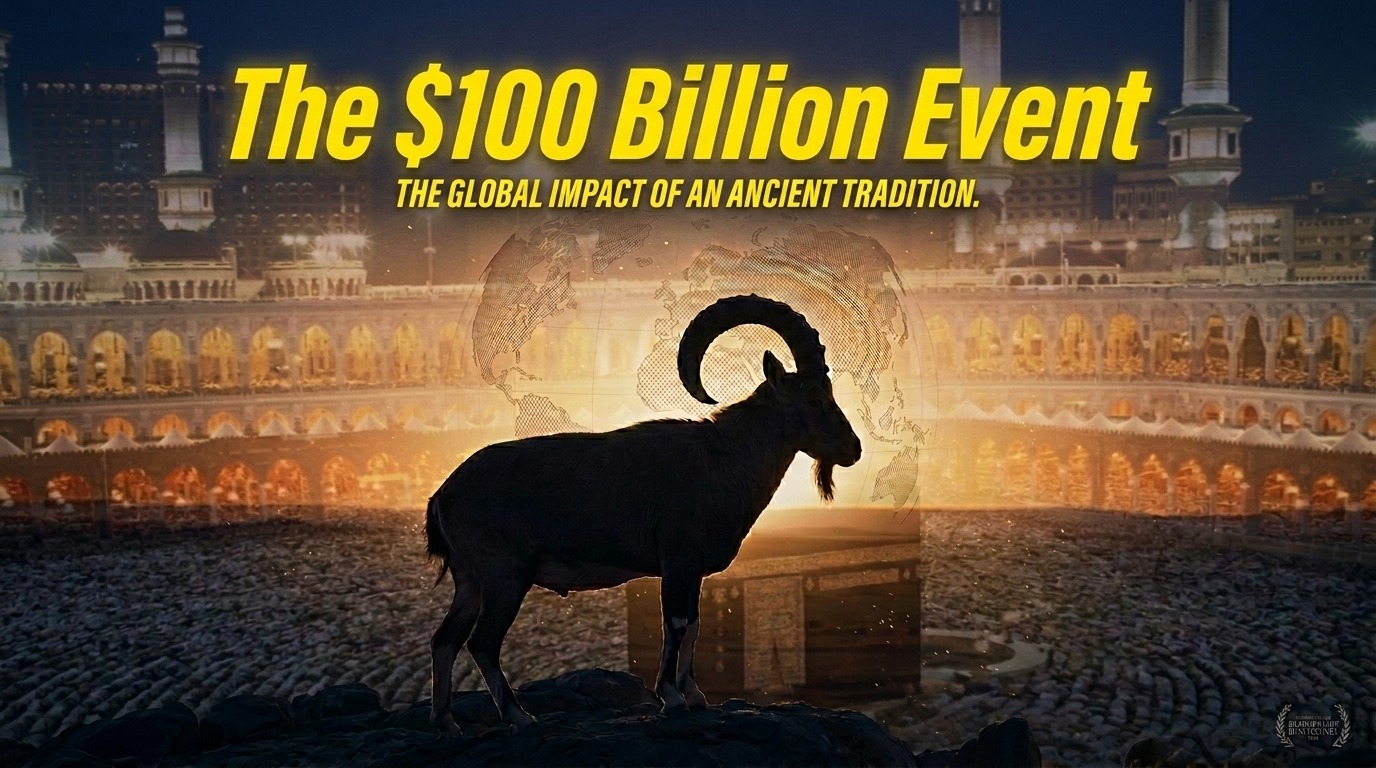
The $100 Billion Event the World Refuses to Understand

And somehow, the rest of the world has no idea this is happening.

During a period of approximately 72 hours, approximately 50 million animals are sacrificed annually on Eid al-Adha, by Muslims worldwide. The economic activity from this single religious event tops $100 billion. If you are not a Muslim, the odds are very high that you don't know about any of this.

It is one of the largest economic events on the planet, involving almost two billion participants, and barely mentioned in the global financial media. That's not a reporting problem. It's a lack of education, a collective ignorance of more than a quarter of mankind. The price we pay for this ignorance is incalculable in terms of world peace, economic sense and human unity.

What It Actually Is

The celebration of Eid al-Adha is actually the time that God tested the Prophet Ibrahim with the order to sacrifice his beloved possession, which in the end was the sacrifice of a ram, which substituted his son. Today Muslims sacrifice animals as a re-enactment of that time, known as Qurbani. It is a matter of faith, submission and generosity.

The rules are specific; It must be a healthy animal. There are three parts to the meat: a share for the family, a share for relatives and friends, and a share for those who can't afford food. The last part is not an added option, it is the purpose of it. Eid al-Adha is essentially a large built-in food redistribution system, on a scale not matched by any government programme. It is a theology of peace in action — a planned, annual redistribution of resources from the ‘have' to the ‘have not'.

A book listing the numbers nobody is talking about."$100 billion, 50 million animals, 72 hours a year.

Just in Pakistan alone, 6.8 million animals were sacrificed in 2024, which contributed around 1% of the country's annual GDP for three days. Bangladesh sacrificed over 10 million animals: one for every 16 citizens. Saudi Arabia slaughtered an estimated 1.5 million with imports from Romania, Spain and Sudan. Include the Muslim minority in Indonesia, the Muslim community in Turkey, Egypt, Nigeria and in other European and North American countries. Worldwide: 50,000,000 animals. Three days.

And that's just the cost of the animal itself, not to mention other costs like the feed, water and additional expenses needed to keep the animals alive. The true impact is much greater. The annual world-wide rawhide harvest is approximately 60% during Eid. The raw materials of the leather industry are obtained in Bangladesh half by Eid al-Adha alone throughout the year. That leather, which is leather, winds up as shoes and handbags in Italian and American shops, without a tag to identify it as leather from the field in Lahore or Dhaka.

The difference in education here is not just a cultural one. It is economic. Those who fail to consider this event are missing a crucial piece of the puzzle when it comes to how global supply chains and consumer behavior in emerging markets are developing.

Not all years are hunky-dunky. In 2025, the numbers decreased significantly. There was a drop of 57 percent in available sacrificial animals in Jakarta, caused by foot and mouth disease and rising prices. In Pakistan, summer heat had a negative impact on the hides which were not collected before it was an extreme heat and almost ruined the raw leather market. However, the festival was not to be stopped. It never does.

Under Islamic law, up to six families can share a single animal if a Muslim’s income is not sufficient to buy it for himself. People who have no money are just the ones getting the meat, and that's the way it's supposed to be. This is a lesson in its own, that a tradition of peace and a shared responsibility does not fail under pressure where market driven systems do. It will absorb the impact and keep on feeding people anyway.

IMF is not monitoring this. Bloomberg isn't reporting on it. The event that moves $100 billion in 72 hours and nourishes millions of the world's poorest and neediest is at best a footnote in the culture and at worst invisible.

This is a failure of education at the top. The lack of a capacity and interest in grasping the analytical value of Eid al-Adha is not just a financial and policy institutional missed opportunity, it is also a missed opportunity. They are adding to the misconceptions that hinder peaceful world. There you will never be able to make bridges between civilizations you don't study. You can't make peace with a people you never took the time to know.

The Eid al-Adha statistics tell a true story of the economic well-being and social integration of almost 2 billion people. It is more than that, this festival is a blueprint of what the world has spent billions of dollars to create with foreign aid and development finance, a self-sustaining, community-driven system of redistribution that creates peace from the ground, each and every year, without any single bureaucrat to coordinate.

The world doesn't need to believe in God to value His creation. That requires a bit of schooling, however.