Top Stories
Building Bridges Through Words Understanding Militant Ideologies in Modern Contexts Security: Beyond Walls and Weapons Upcoming Events: Connecting Ideas and People Previous Milestones: Reflecting on Our Journey Fatwas: Reclaiming the Spirit of Ethical Guidance Role of NATO in Conflict Resolution Washington Peace Deal Between Congo and Rwanda Social Justice and Equality in the Qur’ān: Implications for Global Peace The Qurʾānic Concept of Human Equality: An Analysis against Racism and Ethnic Discrimination in Contemporary Societies Reinterpreting Dhimmitude: A Reconsideration of Its Social and Political Functions in the Modern Context How China Is Playing the Long Economic War Ukraine Peace Efforts Advance Cautiously Despite Partial Alignment Among Parties How Pakistan-Libya Military Relations Strategic Outreach, Economic Stakes and Geopolitical Implications Aleppo Clashes as Syria and Kurdish-Led SDF Agree to Ceasefire Across the Border, Pakistani Ulema Stand Against Afghan Girls\' Education Ban Pakistan announce 500 fully-funded scholarships for Bangladeshi students in 8 programs How theTaliban regime threat for reginal peace Women Left Behind in Khyber Pakhtunkhwa’s Education System Sudan’s Civil War: Anatomy of the World’s Largest Humanitarian Crisis Changing Security Architecture in Central Asia Pakistan Leads India on Economic and Peace Indicators in 2026 : Gallup Survey Submerged Classrooms, Long-Term Learning Loss Pakistan Security Report 2025: Terrorism Trends and the Peace Deficit HEC’s MAKTAB Initiative Signals a New Era for Higher Education Southern Yemen Faces Tensions and Urgent Need for Peace IUT Strengthens Education Integrity in Bangladesh Pakistan’s Arms Sales Contracts (2024–25) and the Peace Dimension Pakistan\'s Contribution to UN Peacekeeping Operations for Global Peace Pakistan Enhances Educational Cooperation with Sri Lanka through Scholarship The Growing Defense and Economic Nexus of the Muslim World Charter of Trump’s Board of Peace Pakistan & Myanmar Prioritize Education Strategic Saudi defense agreements are redefining the Middle East\'s security architecture What would be the consequences of the U.S.–Iran Conflict on Pakistan? How Indian Cricket Politics Affect Regional Peace The Kashmir issue remains a central peace and stability in South Asia American Weapons in Afghanistan Are Destabilizing Pakistan Global Education Coalition sixth annual meeting A New Chapter for Pakistan’s Universities: Leadership, Stability, and Vision under the New HEC Chairman The Evolution of the IMCTC into a Global Security Pillar Reintegration Initiative: Analyzing the 2026 IMCTC Engagement in Pakistan Psychosocial Warfare and the IMCTC Peace Journalists Initiative (2026) The Concept of ‘Ummah’ in the Qurʾān: Transcending Race, Tribe, and Ethnicity HEC Reforms Regulation, Defends Academic Freedom Pakistan’s Evolving Role in Fostering Peace and Security on the African Continent Recontextualizing Pakistan’s Role in the Board of Peace War in the Middle East: Measuring the Cost The Silent Bridge: Pakistan’s Strategic Neutrality and the Quest for Middle Eastern Stability The Geography of Escalation: Living in an Age of Permanent Crisis Mapping the Educational Crisis in the Middle East Conflict The Blind Alley of “Epic Fury”; A War with no End game A Pakistani Voice Against Digital Islamophobia: A Landmark Academic Contribution World Eye on Pakistan for Middle East Peace Leading with Truth, ICEP’s Analysis Outlasted the Skeptics on Middle East Crisis World Powers Push for Deal U.S. Presents 15-Point Plan and Iran Responds with 5 Conditions Pakistan and Türkiye Open New Chapter in Academic Cooperation with Strategic Initiatives Pakistan at the Crossroads of Global Trade as a Logistics Revolution Unfolds Why Ethical Dialogue necessary in a Diverse Pakistan for a Peacebuilding Initiative Pakistan\\\'s Game-Changer Role for World Peace Entrepreneurship Education Is Shaping Pakistan\'s Economic Future Dr. Jamil Akhtar Featured in Prestigious Brill Encyclopaedia (2026) A Milestone in Global Interfaith Scholarship Peace Light in a Dark Night WAR RESHAPES PAKISTAN’S ECONOMY AND OPEN DOORS FOR INTERPRENEURS From Gaza to Lebanon: ICC, UN, and the Unanswered Duty to Prosecute Can Pakistan turn a temporary ceasefire into lasting middle east peace? Bridging the Gap: Confronting Education Inequality in Pakistan Hierarchical Culture In Pakistani Organizations \"How It Kills Innovation — and What Leaders Can Do About It\" Can Diplomacy Survive the Iran Crisis? Peace Efforts in an Age of Permanent Escalation Why are Peace Talks a US strategic priority? Features of Intellectual Property in the Age of Artificial Intelligence (In the Context of World Intellectual Property Day) A Global Forum for Peace, Governance, and a Better World (France\'s Landmark Contribution to International Dialogue) IS UAE WANT A \\\'CURRENCY SWAP\\\' WITH THE USA Energy War by Sea: The Hormuz Blockade Proves Oil is Still a Weapon The End of Strategic Dependence In Europe? Pakistan\'s Strategic and Structural Evolution from Crisis to Consolidated World Peace Silent Deterrence: Hangor-Class SSP-2800 and Undersea Strategy of Pakistan Inside the $9 Billion Prediction Market Revolution Pakistan at the Crossroads: Between Fragile Stability and the Weight of Structural Crisis WHY DIALOGUE FAILS IN CONFLICT ZONES; A LESSON FOR POLICY MAKERS The Crisis of American Legitimacy in the Post-Unipolar Era THE OIL CLUB UAE JUST QUIT Inside OPEC’s Biggest Defection in Decades — and What It Means for the World The Kashmir Dispute: International Institutional Failure and Humanitarian Consequences
Dialogue

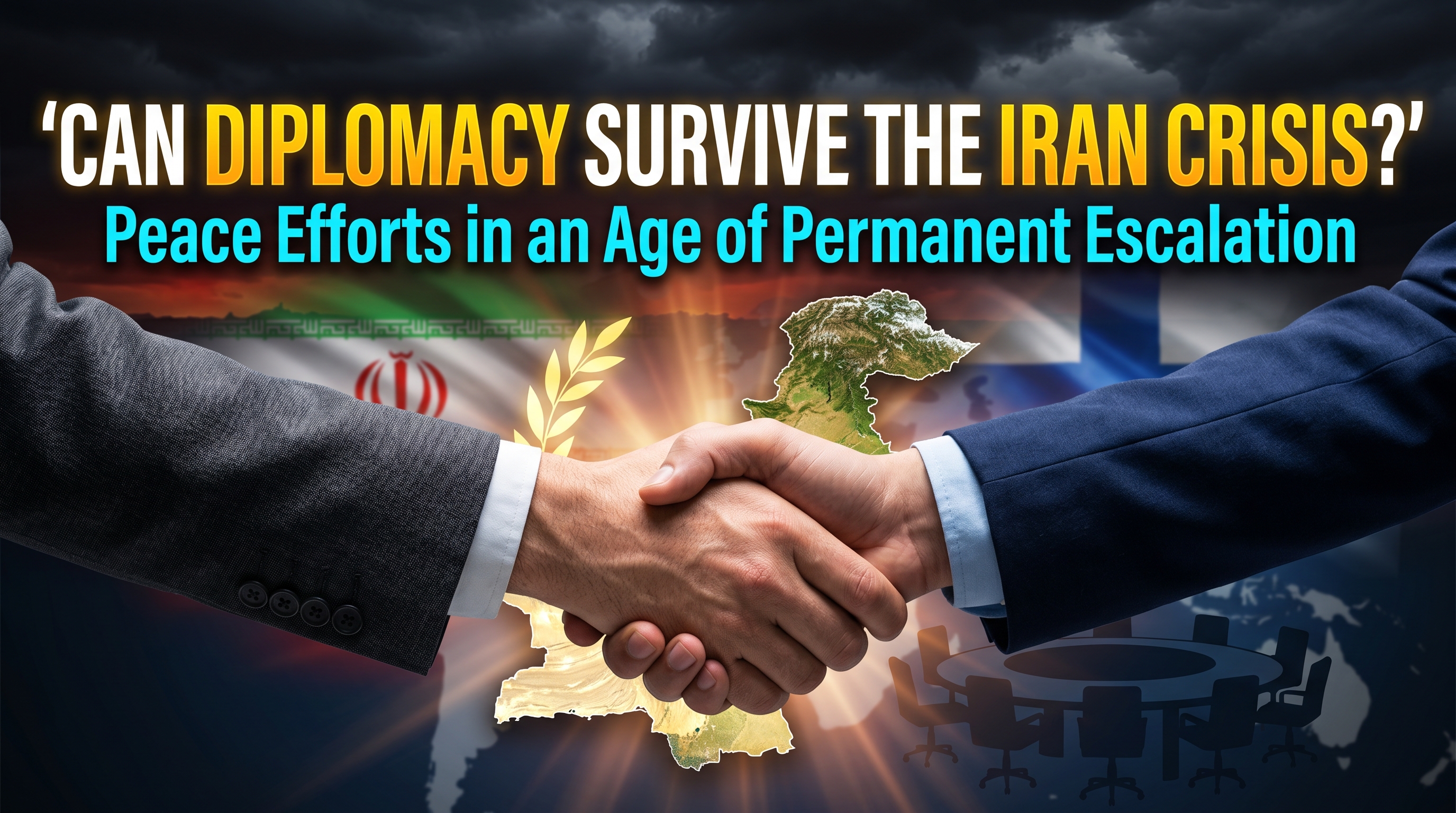
Can Diplomacy Survive the Iran Crisis? Peace Efforts in an Age of Permanent Escalation

The idea of Peace and War existing simultaneously would have seemed paradoxical if you were analysing the geopolitical landscape of the world during the Cold War. But today, even as tensions escalate among Western powers and Iran, diplomacy persists. The Middle East is witnessing naval deployments, missile and drone exchanges, and active mediation efforts through diplomatic backchannels all at the same time. Oil shipping routes through the Strait of Hormuz remain under constant surveillance, while the United States maintains a strong military presence in that region to deter and influence negotiations. Traditionally, diplomacy and confrontation rarely coexisted; during the Cold War, détente followed escalation, but today it occurs within the crisis itself. The ongoing clash and negotiation between Iran, Israel, and the United States, and other global patterns, illustrate this shift.

Iran's 2015 agreement with the P5 and the European Union, the Joint Comprehensive Plan of Action (JCPOA), sought to limit uranium enrichment to 3.67%. It also capped Iran's stockpile of low-enriched uranium at 300 kilograms. The deal included continuous oversight of Iran's nuclear activities by the International Atomic Energy Agency. Following the United States’ withdrawal in 2018 and subsequent sanctions, Iran gradually followed a non-compliance strategy, slowly drifting away from its commitments under JCPOA. Recent assessments indicate Iran has managed to achieve uranium enrichment levels of 60% (weapon-grade: 90%) and has increased its uranium stockpile to several thousand kilograms, a number far above the JCPOA cap. Moreover, it has installed Advanced centrifuges (IR-2m, IR-6), and limited monitoring by IAEA inspectors as compared to the 2016-2018 period.

Iran has further expanded its missile arsenal and possesses one of the largest missile arsenals in the Middle East, with more than 3,000 ballistic missiles of varying ranges. Operationalisation of precision-guided missiles with an estimated error probability of 10-30 meters highlights Iranian advancement in missile technology. Furthermore, the manufacturing and subsequent adoption of low-cost drones in regional warfare increased sharply after 2020. Since 2017, Israel has conducted hundreds of airstrikes in Syria, targeting Iran-linked logistics hubs, transfer routes, and security depots. Iran maintains its relations with partners and proxy groups such as Hezbollah, and other militias in Lebanon, Iraq, Syria and the Red Sea Region that openly operate against Israel. These realities show that Middle Eastern actors prefer limited escalation aimed at deterrence and imposing pressure while avoiding casualties and staying below the threshold of a total war.

Israel perceives the Iranian nuclear program as a national security threat and uses preventive and pre-emptive coercion to stop Iran from acquiring nuclear weapons. Other Gulf states like Saudi Arabia, Oman, Qatar, UAE” fear economic repercussions of an all-out war, so they play active mediating roles in the conflicts with Iran while holding close relations with the Western powers. Regional mediators and global powers keep the parallel diplomatic tracks open for indirect communication, which allows diplomacy alongside military deterrence.

These dynamics extend beyond the Iran conflict, mirroring a wider shift in contemporary warfare. Diplomacy, rather than serving as a definitive solution, is employed to mitigate conflicts across various regions. The Russo-Ukrainian conflict exemplifies this trend; despite diplomatic initiatives since 2014, the results have been modest, encompassing humanitarian corridors and prisoner exchanges, yet failing to achieve a comprehensive resolution.
A similar pattern appears in recurrent cycles of conflict in Gaza between Israel and Palestinian armed groups. Negotiations happen during an ongoing conflict, which creates temporary and non-durable ceasefires, without solving the underlying political disputes.

Globally, states rely on indirect tools of competition. Economic sanctions allow long-term coercive pressure; similarly, cyber operations allow confrontation without ever crossing the threshold of total war. This has blurred the line between peace and conflict. Scholars of contemporary security studies have observed that modern wars rarely conclude in a decisive victory. Instead, they end up in a stalemate where diplomacy works to manage escalation and the prevention of an all-out war.

This broader pattern suggests that the current Iran crisis isn't an exception, but rather a clear example of how diplomatic practices have changed. In this context, the main goal of negotiations has shifted from ending conflicts to reducing their negative effects. The presence of multiple conflicts, indirect communication, and regional mediation indicates that modern diplomacy focuses on managing confrontations, rather than completely resolving them.

Seen in this light, the question is not whether diplomacy would stop the Iran war but whether diplomacy has adapted to survive in an era where escalation never really ends and diplomacy survives not by preventing conflict, but by managing its permanence.