Top Stories
Building Bridges Through Words Understanding Militant Ideologies in Modern Contexts Security: Beyond Walls and Weapons Upcoming Events: Connecting Ideas and People Previous Milestones: Reflecting on Our Journey Fatwas: Reclaiming the Spirit of Ethical Guidance Role of NATO in Conflict Resolution Washington Peace Deal Between Congo and Rwanda Social Justice and Equality in the Qur’ān: Implications for Global Peace The Qurʾānic Concept of Human Equality: An Analysis against Racism and Ethnic Discrimination in Contemporary Societies Reinterpreting Dhimmitude: A Reconsideration of Its Social and Political Functions in the Modern Context How China Is Playing the Long Economic War Ukraine Peace Efforts Advance Cautiously Despite Partial Alignment Among Parties How Pakistan-Libya Military Relations Strategic Outreach, Economic Stakes and Geopolitical Implications Aleppo Clashes as Syria and Kurdish-Led SDF Agree to Ceasefire Across the Border, Pakistani Ulema Stand Against Afghan Girls\' Education Ban Pakistan announce 500 fully-funded scholarships for Bangladeshi students in 8 programs How theTaliban regime threat for reginal peace Women Left Behind in Khyber Pakhtunkhwa’s Education System Sudan’s Civil War: Anatomy of the World’s Largest Humanitarian Crisis Changing Security Architecture in Central Asia Pakistan Leads India on Economic and Peace Indicators in 2026 : Gallup Survey Submerged Classrooms, Long-Term Learning Loss Pakistan Security Report 2025: Terrorism Trends and the Peace Deficit HEC’s MAKTAB Initiative Signals a New Era for Higher Education Southern Yemen Faces Tensions and Urgent Need for Peace IUT Strengthens Education Integrity in Bangladesh Pakistan’s Arms Sales Contracts (2024–25) and the Peace Dimension Pakistan\'s Contribution to UN Peacekeeping Operations for Global Peace Pakistan Enhances Educational Cooperation with Sri Lanka through Scholarship The Growing Defense and Economic Nexus of the Muslim World Charter of Trump’s Board of Peace Pakistan & Myanmar Prioritize Education Strategic Saudi defense agreements are redefining the Middle East\'s security architecture What would be the consequences of the U.S.–Iran Conflict on Pakistan? How Indian Cricket Politics Affect Regional Peace The Kashmir issue remains a central peace and stability in South Asia American Weapons in Afghanistan Are Destabilizing Pakistan Global Education Coalition sixth annual meeting A New Chapter for Pakistan’s Universities: Leadership, Stability, and Vision under the New HEC Chairman The Evolution of the IMCTC into a Global Security Pillar Reintegration Initiative: Analyzing the 2026 IMCTC Engagement in Pakistan Psychosocial Warfare and the IMCTC Peace Journalists Initiative (2026) The Concept of ‘Ummah’ in the Qurʾān: Transcending Race, Tribe, and Ethnicity HEC Reforms Regulation, Defends Academic Freedom Pakistan’s Evolving Role in Fostering Peace and Security on the African Continent Recontextualizing Pakistan’s Role in the Board of Peace War in the Middle East: Measuring the Cost The Silent Bridge: Pakistan’s Strategic Neutrality and the Quest for Middle Eastern Stability The Geography of Escalation: Living in an Age of Permanent Crisis Mapping the Educational Crisis in the Middle East Conflict The Blind Alley of “Epic Fury”; A War with no End game A Pakistani Voice Against Digital Islamophobia: A Landmark Academic Contribution World Eye on Pakistan for Middle East Peace Leading with Truth, ICEP’s Analysis Outlasted the Skeptics on Middle East Crisis World Powers Push for Deal U.S. Presents 15-Point Plan and Iran Responds with 5 Conditions Pakistan and Türkiye Open New Chapter in Academic Cooperation with Strategic Initiatives Pakistan at the Crossroads of Global Trade as a Logistics Revolution Unfolds Why Ethical Dialogue necessary in a Diverse Pakistan for a Peacebuilding Initiative Pakistan\\\'s Game-Changer Role for World Peace Entrepreneurship Education Is Shaping Pakistan\'s Economic Future Dr. Jamil Akhtar Featured in Prestigious Brill Encyclopaedia (2026) A Milestone in Global Interfaith Scholarship Peace Light in a Dark Night WAR RESHAPES PAKISTAN’S ECONOMY AND OPEN DOORS FOR INTERPRENEURS From Gaza to Lebanon: ICC, UN, and the Unanswered Duty to Prosecute Can Pakistan turn a temporary ceasefire into lasting middle east peace? Bridging the Gap: Confronting Education Inequality in Pakistan Hierarchical Culture In Pakistani Organizations \"How It Kills Innovation — and What Leaders Can Do About It\" Can Diplomacy Survive the Iran Crisis? Peace Efforts in an Age of Permanent Escalation Why are Peace Talks a US strategic priority? Features of Intellectual Property in the Age of Artificial Intelligence (In the Context of World Intellectual Property Day) A Global Forum for Peace, Governance, and a Better World (France\'s Landmark Contribution to International Dialogue) IS UAE WANT A \\\'CURRENCY SWAP\\\' WITH THE USA Energy War by Sea: The Hormuz Blockade Proves Oil is Still a Weapon The End of Strategic Dependence In Europe? Pakistan\'s Strategic and Structural Evolution from Crisis to Consolidated World Peace Silent Deterrence: Hangor-Class SSP-2800 and Undersea Strategy of Pakistan Inside the $9 Billion Prediction Market Revolution Pakistan at the Crossroads: Between Fragile Stability and the Weight of Structural Crisis WHY DIALOGUE FAILS IN CONFLICT ZONES; A LESSON FOR POLICY MAKERS The Crisis of American Legitimacy in the Post-Unipolar Era THE OIL CLUB UAE JUST QUIT Inside OPEC’s Biggest Defection in Decades — and What It Means for the World The Kashmir Dispute: International Institutional Failure and Humanitarian Consequences
Peace

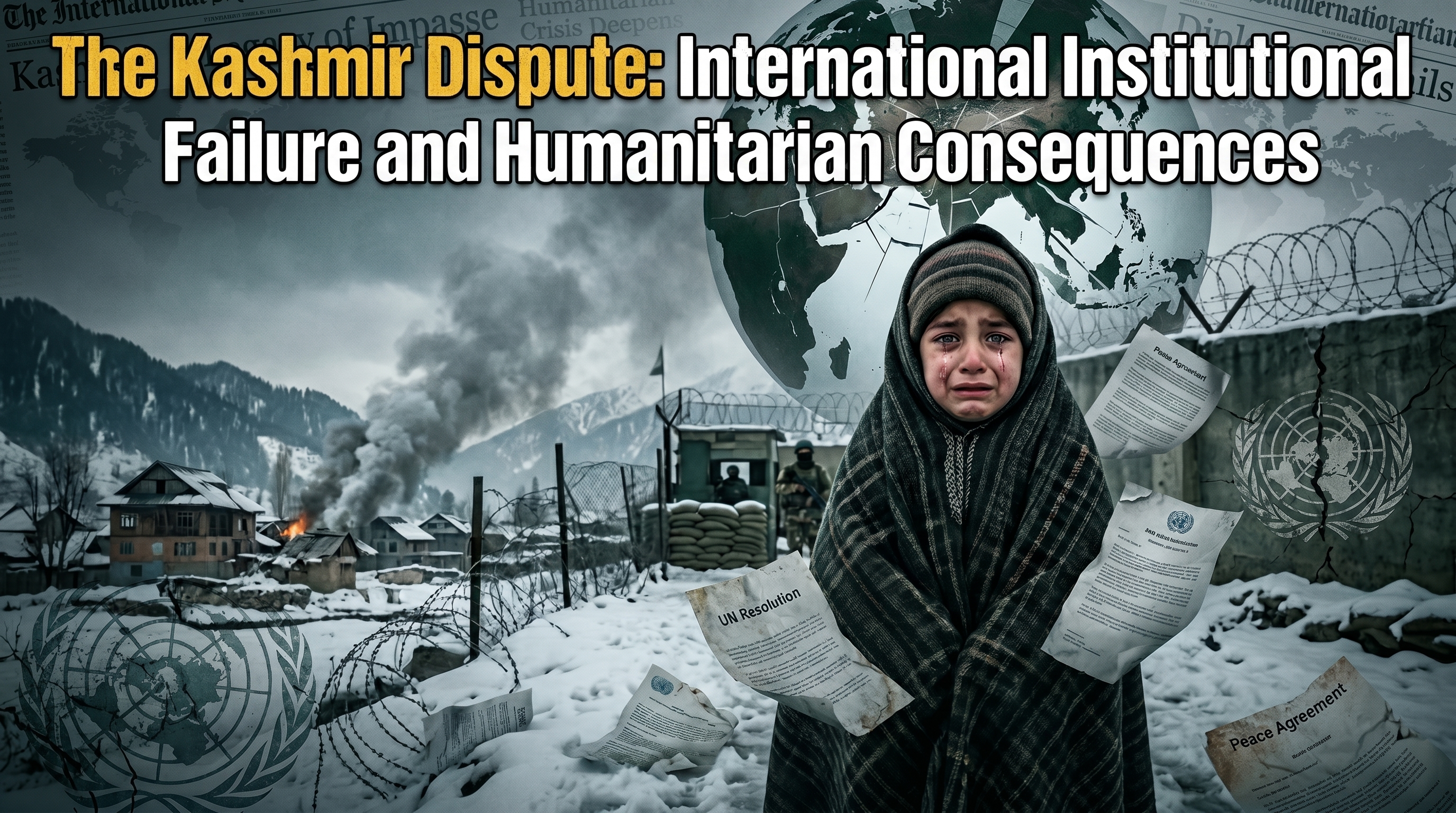
The Kashmir Dispute: International Institutional Failure and Humanitarian Consequences

For many years, Kashmir has been a major issue in the world. This matter could have been resolved many years ago if strict rules had been followed, but unfortunately, Kashmir’s suffering is not coming to an end and is not even near an end. This inability of international institutions to effectively resolve the Kashmir dispute has prolonged the conflict and contributed to militarization and serious violations of fundamental rights under international humanitarian law. In 1947, India assumed control over Kashmir without the consent of the Kashmiri majority and pressured Maharaja Hari Singh, which initiated this issue. Pakistan then tried for the accession of Kashmir, calling this occupation fraud, but nothing happened. Kashmir faced curfews, communication blackouts, closure of schools, offices, and businesses, health care restrictions, abuse, torture, killings, and much more. The people who protested were arrested, and extensive force was used against them “Kashmir Under Lockdown: Reports Cite Curfews, Arrests, and Civilian Hardships". According to Common Article 3 of the Geneva Convention, in the case of non-international armed conflict, everyone should be treated as a human being regardless of whose side they are on.The situation in Kashmir reflects the limited effectiveness of international institutions in enforcing humanitarian norms.

The situation that Kashmir faced indicates political failure and humanitarian consequences. The United Nations Commission for India and Pakistan (UNCIP), UNSC resolutions on Kashmir, and the implementation of a plebiscite failed because if they had worked, then Kashmir would have been free till now. International law is not coercive, but there should be strict rules if international humanitarian law is violated because the main purpose of these international institutions is to maintain peace and stop civilian suffering. If this is not happening, then giving speeches and resolutions that cannot be implemented will not be enough.

Lack of implementation of UN resolutions and the ineffectiveness of international pressure made Kashmir a protracted conflict, and protracted conflicts are very difficult to resolve. The veto powers also played a part in elongating this issue as they used vetoes to prevent resolving it. This can be due to strategic alliances, which prefer neutrality and indirectly take the side of India due to economic ties and regional interests. Kashmir is the region that connects South Asia to Central Asia and China. India fears that if Kashmir gets separated, then access to Central Asia would become difficult. Major rivers of the Indus basin originate from here. India is taking advantage of Kashmir, and major powers are supporting India so they can also benefit. India demanded a bilateral focus between India and Pakistan only, with no intervention from a third party. Due to unsuccessful mediation attempts, sustainable peace initiatives also failed.

With no third-party interference, tensions escalated, due to which India and Pakistan fought three wars over Kashmir, i.e., 1947–48, 1965, and 1999 (Kargil War), which caused regional instability and nuclear risks. India crossed the limits of human rights violations and caused civilian casualties, missing persons, psychological and social impacts on families, restrictions on freedom of expression and speech, and arrests of journalists and activists so that no one could hear the news of abuses of the basic principles of international humanitarian law “According to a 2016 US State Department report, more than 90 people were killed during protests in Kashmir, while over 4,500 civilians and 4,000 security personnel were injured.” They did this to create fear among Kashmiri people so that they would not even think of separating from India, or it might be due to religious differences and extremism.

Article 370 and 35A were also revoked. The special autonomous status that was given to Jammu and Kashmir was taken away. It divided Jammu and Kashmir into two union territories, i.e., Jammu and Kashmir and Ladakh, on which India justified that it did this for national integration, development, and security concerns. Debates on federalism and autonomy were held, and petitions were filed in the Supreme Court of India, but this made no difference. On the other hand, Kashmiris feared demographic transformation and outsiders purchasing land and settling in Kashmir. This also increased regional tensions “Reports in August 2019 stated that more than 2,000 people had been detained after the revocation of Article 370, while some reports estimated detentions at around 4,000 people”. The concerns were there, but strong international intervention was lacking despite these concerns. This shows the weakness of international organizations because they are saying that what is happening is wrong but are not taking any action.

The Kashmir dispute remains one of the longest unresolved conflicts in modern international politics despite decades of involvement by the United Nations. The inability of international institutions to implement resolutions prolonged political instability and humanitarian suffering in Kashmir. The use of vetoes made this conflict more prolonged and weakened the effectiveness of the UN Security Council and prevented timely action in humanitarian crises. To resolve these kinds of conflicts, permanent members (veto members) should not be allowed to use veto power in cases of crimes against humanity, war crimes, and large-scale human suffering, and at least two permanent members should be required to veto a resolution before it is blocked. Humanitarian protection should be prioritized over geopolitical interests.