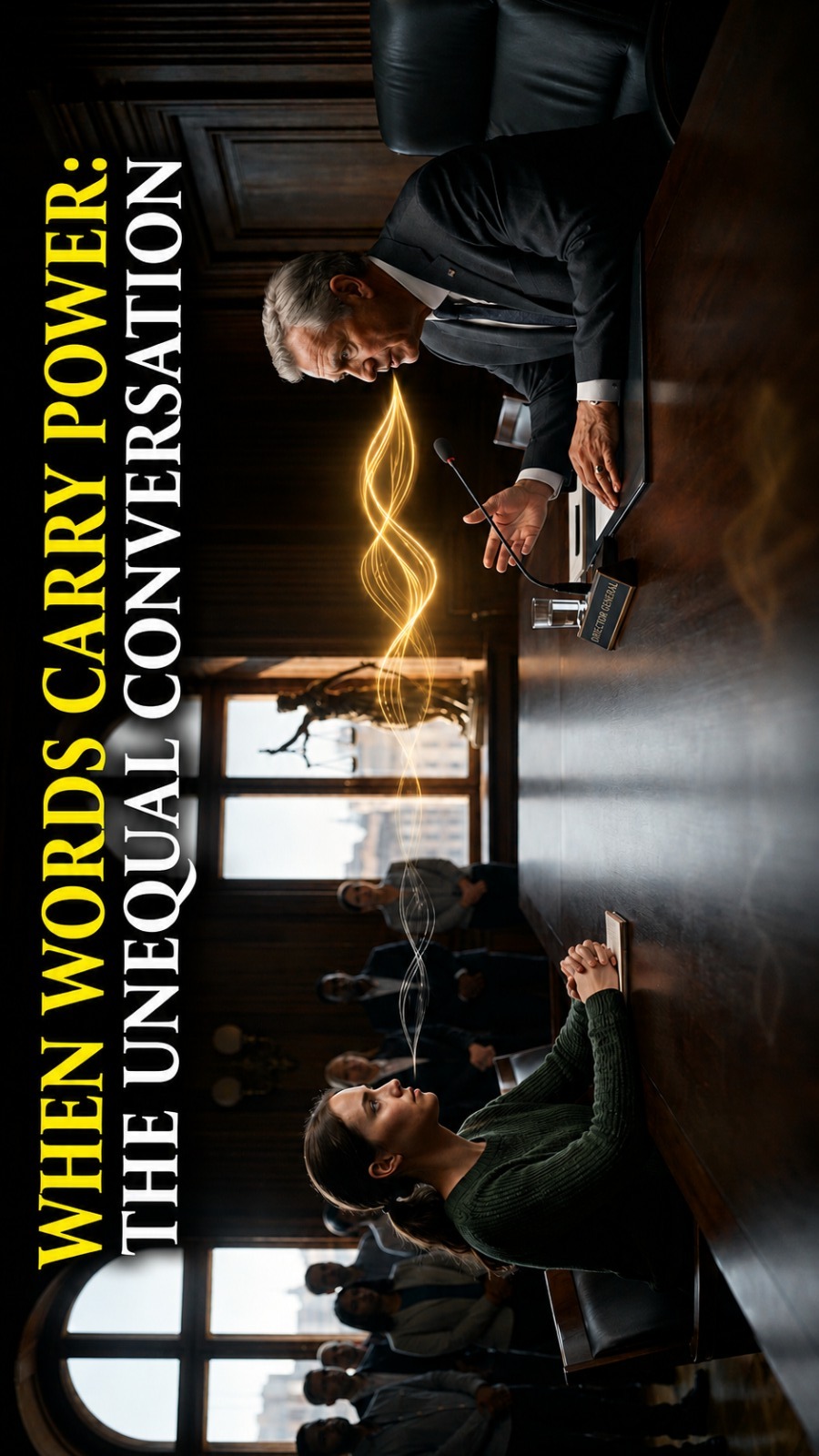
Picture two people in a conversation. One is a senior civil
servant; the other is a young woman from a rural village applying for a
government benefit. They are, technically, in dialogue. Words pass between
them. But are they truly equals in this exchange? The official controls the
outcome. His words carry institutional authority. Her words must be carefully
calibrated to the expectations of a system she did not design and whose
language she was never fully taught. This is not a dialogue between equals. It
is a dialogue between power and its subjects. All dialogue takes place within structures of power. To
ignore this is not to transcend it — it is simply to make those structures
invisible, and thereby more effective. One of the most important contributions
of critical theory to the ethics of dialogue is its insistence that we see
these structures clearly before we can begin to address them honestly.
Michel Foucault, the French philosopher and historian, argued
that power and knowledge are inseparable. Every system of knowledge — whether
it is medicine, law, economics, or religious authority — produces forms of
discourse that define what can be said, who has the authority to say it, and
whose speech will be taken seriously. Power does not simply repress speech; it
shapes it, channels it, and determines whose words count as knowledge. This insight has profound implications for dialogue
ethics. It means that the apparent openness of a conversation can be an
illusion. A discussion that allows everyone to speak but structures the rules,
the vocabulary, and the criteria of legitimate argument in ways that privilege
some participants over others is not genuinely open. It is power dressed up as
dialogue.
Paulo Freire, the Brazilian educator and philosopher, identified
this dynamic with particular clarity in the context of education. What he
called the 'banking model' of education — in which teachers deposit knowledge
into passive student-recipients — is not simply a pedagogical approach. It is a
model of communication that denies the full humanity of the learner by
positioning them as an empty vessel rather than a thinking subject. Genuine
education, Freire argued, must be dialogic — a collaborative process in which
both teacher and student learn, question, and grow together. Freire's critique extends far beyond the classroom. The
same pattern — one party positions itself as the authority, defines the terms,
and expects the other to receive rather than respond — appears in bureaucratic
encounters, political speeches, media coverage, and international negotiations.
Wherever this pattern operates, genuine dialogue is replaced by something that
resembles it while serving the interests of those already in power.
In Pakistan and across South Asia, this dynamic is visible in
multiple registers. Urban and rural voices carry different weights in policy
dialogue. Educated elites and working-class communities do not enter public
discourse on equal footing. Women's voices are systematically marginalized in
spaces — from jirgas to boardrooms — where decisions affecting their lives are
made. Minority communities are asked to participate in dialogues whose
fundamental terms were set without them. None
of this means that dialogue across power differences is impossible or ethically
worthless. It means that ethical dialogue requires explicit attention to these
differences. It requires the more powerful party to recognize that their
comfort in the conversation is partly a function of their power, not merely
their competence. It requires institutional designs that actively create space
for less powerful voices — not as a courtesy, but as a condition of legitimacy.
Education systems that produce graduates capable of navigating
power-laden dialogue — who can identify when rules are being applied unequally,
when their own privilege shapes the conversation, and when the terms of a
debate need to be challenged before the debate can be genuinely joined — are
producing citizens capable of sustaining democratic life.
The connection to peace is not abstract. Conflicts that persist
despite repeated attempts at dialogue often do so not because the parties lack
the will to talk but because the structure of the dialogue itself reproduces
the inequalities that caused the conflict in the first place. A peace process
in which powerful parties set the agenda, control the timing, and define what
counts as a legitimate grievance is not a genuine peace process. It is a
negotiation conducted on the terms of those who already won. Ethical dialogue across power differences requires
several specific commitments transparency about who has what kind of authority
in the conversation; active measures to ensure that less powerful voices are
not just permitted but genuinely heard; willingness of more powerful parties to
be changed by what they hear; and structural accountability when the terms of
dialogue are manipulated.
These are demanding requirements. But they are not impossible
ones. They have been met, imperfectly but genuinely, in truth and
reconciliation processes, in participatory community development, and in
organizations that have built real cultures of voice and accountability. The unequal conversation is everywhere. Recognizing it is
the first step. Refusing to pretend it does not exist is the ethical minimum.
Working actively to transform it is the project of a lifetime — and one of the
most important things any institution committed to justice can undertake.
_6784.jpg)