
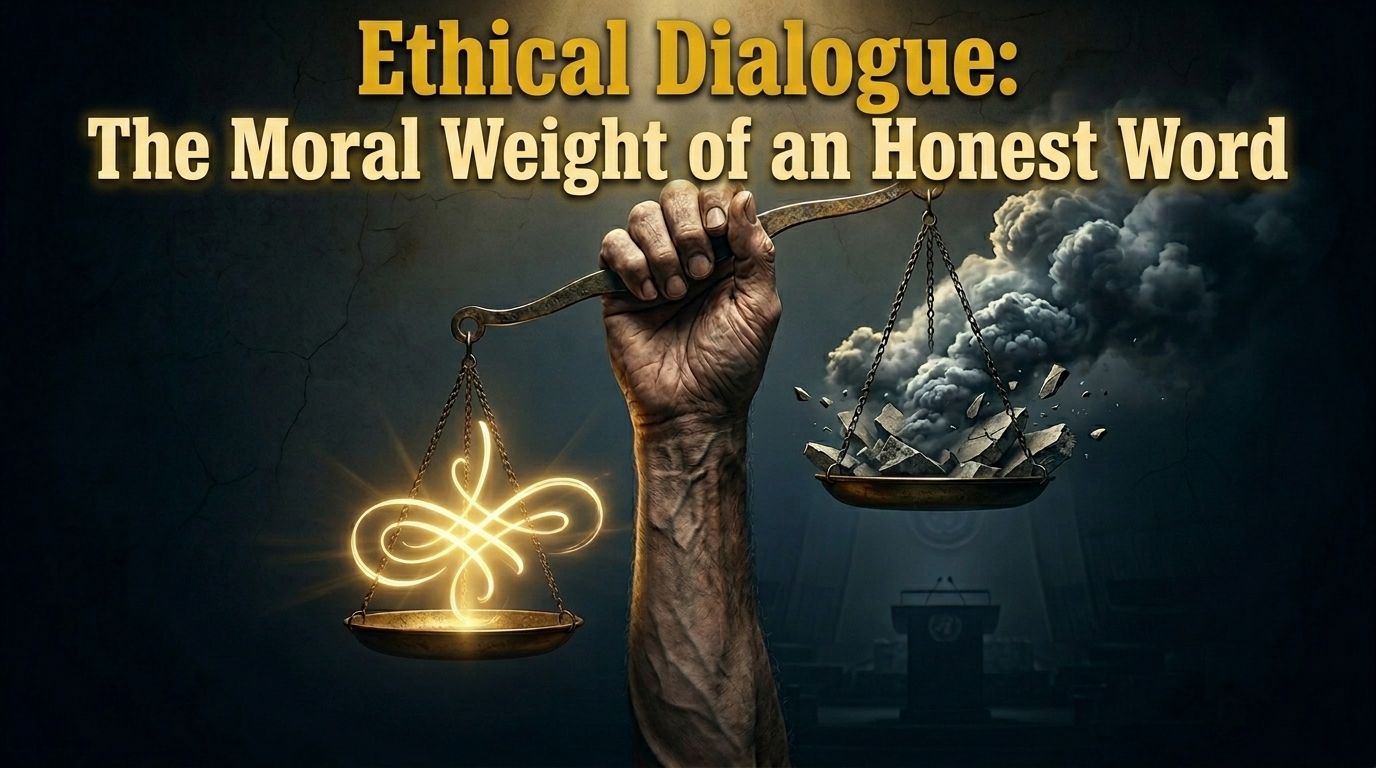
In the spring of 2003, Colin Powell stood
before the United Nations Security Council and delivered a speech that would
become one of the most consequential acts of public communication in recent
history. He presented what he described as irrefutable evidence of weapons of
mass destruction in Iraq. The world watched. Many believed. A war followed. The
weapons were never found. Powell later called the speech a 'blot' on his
record. But the damage — to lives, to nations, to the institution of truth
itself — was irreversible. This is the moral
weight of an honest word. And its opposite: the catastrophic cost of a
dishonest one.
Honesty in dialogue is not merely a social nicety — a
convention we observe to make interactions smooth. It is a foundational ethical
obligation. When we speak to another person, we implicitly make a claim: what I
am telling you reflects my genuine understanding of reality. To violate this
claim is not just impolite. It is a form of harm — to the listener, to the
relationship, and to the shared reality that human community depends upon.
Immanuel Kant argued this with uncompromising
force. For Kant, lying was wrong not because of its consequences — bad as those
often are — but because it violates the very structure of rational human
dignity. To lie to someone is to treat them as a means to your end rather than
as a rational agent capable of making their own decisions based on truth. It
is, in a fundamental sense, to deny their humanity.
In the Islamic ethical tradition, the principle of sidq —
truthfulness — occupies a position of the highest moral importance. The Prophet
Muhammad (peace be upon him) identified dishonesty as one of the defining
characteristics of hypocrisy. The Quran repeatedly pairs truth with justice,
and falsehood with injustice. To speak truly is not merely to be accurate; it
is to be right with God, with others, and with oneself. And yet the ethics of honesty in dialogue are not simple.
Consider the familiar tension: a friend asks if you like their work. You do
not. Do you say so? What if telling the truth will cause unnecessary pain
without producing any practical benefit? What if the timing is wrong? What if
the person is in crisis?
Philosophers distinguish between sincere and performative
assertions. A sincere assertion is a genuine first-person claim that what you
are saying is true. A performative assertion is one that both parties
understand is not a direct expression of belief — as when an actor delivers a
villain's lines, or when a host says 'I'm fine' without meaning it literally.
Most everyday social lubricants — compliments, pleasantries, diplomatic
silences — fall into the performative category and do not constitute genuine
dishonesty. The morally significant question
concerns sincere assertions. When you are making a genuine claim about reality
— about facts, about your intentions, about your beliefs — the obligation to
honesty is near absolute. And this obligation becomes weightier, not lighter,
when the stakes are high: in courtrooms, in medical consultations, in political
speeches, in peace negotiations.
Education plays a critical role in developing what
philosophers call epistemic responsibility — the obligation not only to speak
truthfully but to ensure that what you believe is actually grounded in evidence
and honest reasoning. A person who sincerely asserts a falsehood because they
never bothered to examine their assumptions is not fully excused by their
sincerity. We have a duty to know what we claim to know.
This is why critical thinking — the disciplined
examination of evidence, the questioning of assumptions, the willingness to
follow reasoning wherever it leads — is not just an academic skill but an
ethical one. Educational institutions that produce graduates who can argue
persuasively but cannot evaluate evidence honestly are, in a meaningful sense,
producing people ill-equipped for ethical dialogue. The consequences for peace are direct and measurable.
Conflicts escalate when parties cannot trust each other's words. Negotiations
fail when promises are made insincerely. Communities fracture when public
figures routinely say what is expedient rather than what is true. The long-term
cost of normalizing dishonesty in public dialogue is a society in which no one
believes anyone — a condition that makes collective problem-solving nearly
impossible. Conversely, societies in which
public figures are held to account for the accuracy of their speech — where
institutions enforce truthfulness in legal, medical, and political contexts —
tend to be more stable, more just, and more capable of the kind of trust-based
cooperation that peaceful coexistence requires.
Honesty in dialogue demands something of us. It requires
the courage to say what we actually believe even when it is unwelcome. It
requires the humility to acknowledge uncertainty rather than assert false
confidence. It requires the discipline to examine our own beliefs before
presenting them to others as truth. These
are not easy demands. But they are the moral minimum that genuine dialogue
requires. Every honest word spoken in good faith is a small act of
trust-building. And trust, accumulated word by word across millions of
conversations, is the invisible architecture upon which any decent society is
built.


_6784.jpg)