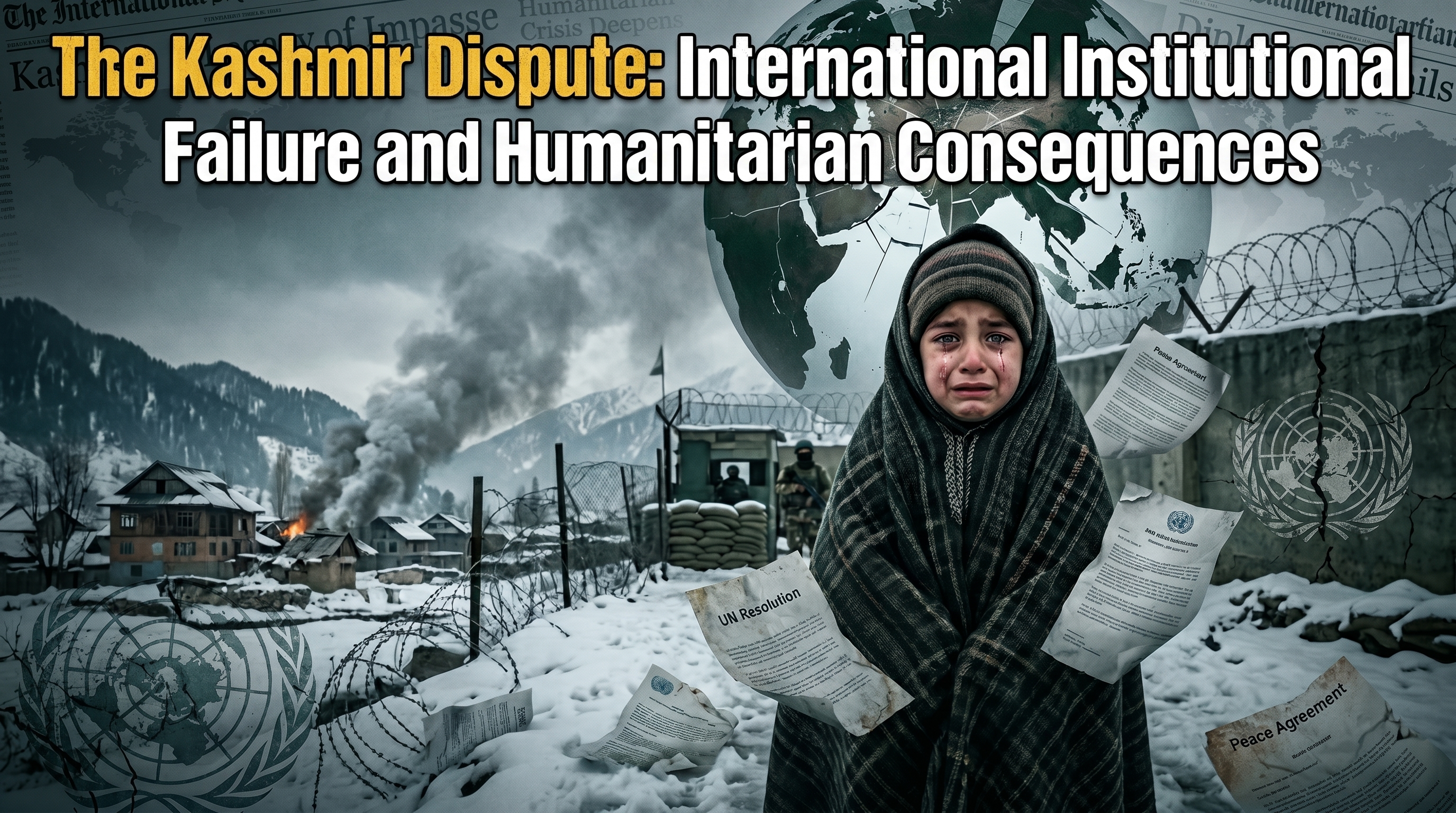

For many years, Kashmir has been a major issue in the world.
This matter could have been resolved many years ago if strict rules had been
followed, but unfortunately, Kashmir’s suffering is not coming to an end and is
not even near an end. This inability of international institutions to
effectively resolve the Kashmir dispute has prolonged the conflict and
contributed to militarization and serious violations of fundamental rights
under international humanitarian law. In 1947, India assumed control over
Kashmir without the consent of the Kashmiri majority and pressured Maharaja Hari
Singh, which initiated this issue. Pakistan then tried for the accession of
Kashmir, calling this occupation fraud, but nothing happened. Kashmir faced
curfews, communication blackouts, closure of schools, offices, and businesses,
health care restrictions, abuse, torture, killings, and much more. The people
who protested were arrested, and extensive force was used against them “Kashmir
Under Lockdown: Reports Cite Curfews, Arrests, and Civilian Hardships".
According to Common Article 3 of the Geneva Convention, in the case of
non-international armed conflict, everyone should be treated as a human being
regardless of whose side they are on.The situation in Kashmir reflects the
limited effectiveness of international institutions in enforcing humanitarian norms.
The situation that Kashmir faced indicates political failure
and humanitarian consequences. The United Nations Commission for India and
Pakistan (UNCIP), UNSC resolutions on Kashmir, and the implementation of a
plebiscite failed because if they had worked, then Kashmir would have been free
till now. International law is not coercive, but there should be strict rules
if international humanitarian law is violated because the main purpose of these
international institutions is to maintain peace and stop civilian suffering. If
this is not happening, then giving speeches and resolutions that cannot be
implemented will not be enough.
Lack of implementation of UN resolutions and the
ineffectiveness of international pressure made Kashmir a protracted conflict,
and protracted conflicts are very difficult to resolve. The veto powers also
played a part in elongating this issue as they used vetoes to prevent resolving
it. This can be due to strategic alliances, which prefer neutrality and
indirectly take the side of India due to economic ties and regional interests.
Kashmir is the region that connects South Asia to Central Asia and China. India
fears that if Kashmir gets separated, then access to Central Asia would become
difficult. Major rivers of the Indus basin originate from here. India is taking
advantage of Kashmir, and major powers are supporting India so they can also
benefit. India demanded a bilateral focus between India and Pakistan only, with
no intervention from a third party. Due to unsuccessful mediation attempts,
sustainable peace initiatives also failed.
With no third-party interference, tensions escalated, due to
which India and Pakistan fought three wars over Kashmir, i.e., 1947–48, 1965,
and 1999 (Kargil War), which caused regional instability and nuclear risks.
India crossed the limits of human rights violations and caused civilian
casualties, missing persons, psychological and social impacts on families,
restrictions on freedom of expression and speech, and arrests of journalists
and activists so that no one could hear the news of abuses of the basic
principles of international humanitarian law “According to a 2016 US State
Department report, more than 90 people were killed during protests in Kashmir,
while over 4,500 civilians and 4,000 security personnel were injured.” They did
this to create fear among Kashmiri people so that they would not even think of
separating from India, or it might be due to religious differences and
extremism.
Article 370 and 35A were also revoked.
The special autonomous status that was given to Jammu and Kashmir was taken
away. It divided Jammu and Kashmir into two union territories, i.e., Jammu and
Kashmir and Ladakh, on which India justified that it did this for national
integration, development, and security concerns. Debates on federalism and
autonomy were held, and petitions were filed in the Supreme Court of India, but
this made no difference. On the other hand, Kashmiris feared demographic
transformation and outsiders purchasing land and settling in Kashmir. This also
increased regional tensions “Reports in August 2019 stated that more than 2,000
people had been detained after the revocation of Article 370, while some
reports estimated detentions at around 4,000 people”. The concerns were there,
but strong international intervention was lacking despite these concerns. This
shows the weakness of international organizations because they are saying that
what is happening is wrong but are not taking any action.
The Kashmir dispute remains one of the longest unresolved
conflicts in modern international politics despite decades of involvement by
the United Nations. The inability of international institutions to implement
resolutions prolonged political instability and humanitarian suffering in
Kashmir. The use of vetoes made this conflict more prolonged and weakened the
effectiveness of the UN Security Council and prevented timely action in
humanitarian crises. To resolve these kinds of conflicts, permanent members
(veto members) should not be allowed to use veto power in cases of crimes
against humanity, war crimes, and large-scale human suffering, and at least two
permanent members should be required to veto a resolution before it is blocked.
Humanitarian protection should be prioritized over geopolitical interests.
_6784.jpg)