Nobody saw it coming. Or rather — everybody who was
paying attention saw it coming, and nobody did anything about it. On May 1,
2026, the United Arab Emirates walked out of OPEC. Fifty-eight years of
membership. Gone. No war forced them out. No sanctions. No dramatic summit
where things fell apart. They just decided they were done, filed the paperwork,
picked a date, and left.
The announcement landed like a quiet bomb. OPEC controls
about 30 percent of global oil supply. The UAE pumps nearly five million barrels
a day. When a country that size walks out of a cartel that powerful, the
question everyone immediately asks is: what do they know that we don't?
The answer, it turns out, is not complicated. They just
did the math.
“This has been a long time coming. The UAE’s national
interests have diverged from the rest of OPEC — and they’re only going to
diverge further.”
— Senior
Emirati Official, Atlantic Council, April 2026
Here is what OPEC actually is, because the name gets
thrown around a lot and most people have only a vague sense of what it does. It
is essentially a price-fixing club. A group of oil-producing countries that all
agree to sell a fixed amount of oil — not because they cannot produce more, but
because if everyone sells as much as they want, prices collapse and nobody
makes money. So they limit supply together. Prices stay high. Everyone earns
more per barrel than they would in a free market. Saudi Arabia runs the whole
thing. Has for decades. The rules sound fair when you read them. They are not
always fair when you live under them.
The UAE joined in 1967. It was not even a proper country
yet — the federation did not officially come together until 1971. It grew up
inside OPEC. Learned the system. Played by the rules for more than half a
century. And then, somewhere in the last decade, it quietly outgrew the room.
By 2026, the UAE had spent billions expanding its oil
production capacity to 4.8 million barrels per day. OPEC said it could sell 3.2
million. That is a gap of 1.6 million barrels. Every. Single. Day. At $80 a
barrel, that gap costs the UAE roughly $130 million in lost revenue every 24
hours. Do the math across a full year. That is over $47 billion. Do it across
five years. The number becomes genuinely difficult to comprehend. And all of it,
every dollar of it, was being left on the table so the UAE could stay inside a
club that Saudi Arabia controls.
“Before the war, the UAE’s production capacity had grown
to 4.8 million barrels per day. Under its OPEC agreement, it was only allowed
to produce 3.2 million.”
— Al Jazeera
Energy Analysis, April 2026
If it had only been the money, maybe they would have
stayed. Countries tolerate expensive memberships all the time when there are
other benefits worth having. But it was not only the money. The relationship
with Saudi Arabia — which is really the relationship that matters inside OPEC,
because Saudi Arabia is OPEC in all the ways that count — had been falling
apart for years. Slowly, then all at once.
The breaking point was Yemen. Saudi forces struck
UAE-backed troops in Yemen’s south. Forced an Emirati withdrawal. It was a
humiliation, and it was public, and it was the kind of thing that does not get
quietly smoothed over at the next diplomatic dinner. What followed was an open
rupture. They stopped agreeing on Yemen. They stopped agreeing on Sudan. They
stopped agreeing on what the Gulf should look like after the Iran war ends. Two
countries that had presented a unified front to the world for a generation
suddenly had very different ideas about what they were actually trying to
build.
OPEC, under those circumstances, stopped being a neutral
forum. It became another arena where the UAE was expected to defer to Riyadh.
And after Yemen, deferring to Riyadh was not something Abu Dhabi was prepared
to keep doing.
“The UAE’s departure is the visible sign of a deep
rupture between Riyadh and Abu Dhabi — two incompatible visions of what Gulf
order should look like.”
— Anas Abdoun,
Energy Consultant, Al Jazeera
Then there is the Russia problem, which is genuinely
strange when you lay it out plainly. OPEC+ — the expanded version of the cartel
that started in 2016 — includes Russia. Russia backs Iran. Iran has been
launching drones and missiles at the UAE throughout the ongoing war. So the UAE
was sitting inside a formal economic cooperation agreement with the country
that arms and funds the force currently shooting at it. That is not a metaphor.
That is the actual situation. The UAE was helping coordinate global oil
strategy with Moscow while Emirati territory was taking Iranian fire. At some
point, someone in Abu Dhabi looked at that and said: this is insane, and we are
leaving.
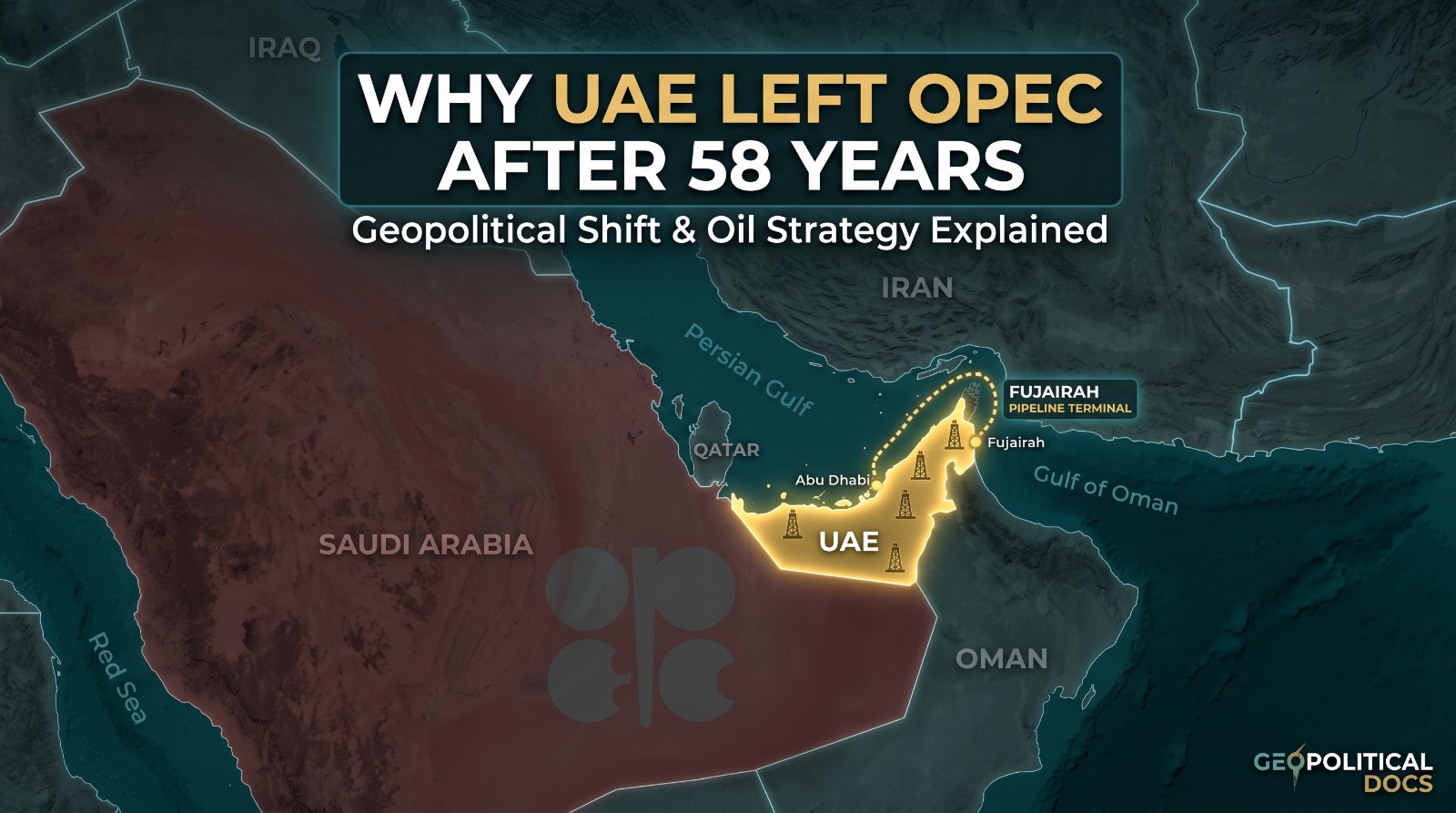
The geography of the exit tells you just how long this
had been planned. The Strait of Hormuz is the narrow waterway — 33 kilometres across
at its tightest point — through which about 20 percent of the world’s oil moves
every day. Iran has been using it as a weapon since the war began, choking off
Gulf exports and sending prices haywire. But the UAE had quietly built a
249-mile pipeline years before any of this started. It runs from the oil fields
straight to the port of Fujairah on the Gulf of Oman, completely bypassing the
strait. While everyone else in the Gulf has been scrambling to find
workarounds, the UAE already had one. In 2025, it shipped 1.7 million barrels a
day through that pipeline alone. It was not enough to satisfy what Abu Dhabi
wanted. But it was enough to prove the plan worked.
“Outside of the cartel, the Emirates will be able to
produce more oil. It makes sense that they would want to break away.”
— Max Pyziur,
Research Director, Energy Policy Research Foundation
Once the war ends and the strait reopens, the UAE wants
to go full capacity. All 4.8 million barrels a day, on the open market, without
asking anyone’s permission. Inside OPEC, a quota wall makes that impossible.
Outside it, nothing stops them. That is the whole calculation. It is not
complicated. It is just expensive to stay and cheap to go — and the longer the
world keeps moving toward electric vehicles and renewable energy, the more
expensive staying becomes.
This is the part of the story that tends to get buried
under the geopolitical drama, but it is probably the most important part. Oil
demand is going to peak. It might already be peaking. The UAE’s leadership
understands this better than most, and they have said so directly. Every barrel
that sits in the ground because of an OPEC quota is a barrel that might be
worth a lot less in ten years. Every year spent under a production cap is a
year of revenue that cannot be recovered. One energy strategist put it as
clearly as it can be put: the UAE is preparing for a world where oil demand is
in structural decline and OPEC’s power to enforce anything will be weaker than
it has ever been. Leaving now is not a retreat. It is a sprint toward the exit
while the exit still pays well.
“They want to be free from OPEC’s constraints. They’re
preparing for a world after the Iran war where oil demand is in decline — and
they want to sell as much as possible before energy markets move on.”
— Kingsmill
Bond, Energy Strategist, Ember Future
The question everyone is now asking is what happens to
OPEC. Qatar left in 2019 and the organisation barely noticed, because Qatar was
never a major producer. The UAE is a different story entirely. It is one of
only three OPEC members — Saudi Arabia and Kuwait are the other two — with real
spare production capacity. That spare capacity is what allows the cartel to
actually do its job: respond to supply shocks, stabilise prices after crises,
punish members who cheat on quotas by threatening to flood the market. When the
UAE takes that capacity outside the tent, OPEC’s ability to enforce anything
gets meaningfully weaker.
Analysts are already watching Iraq. Iraq has been one of
OPEC’s most consistent quota-cheaters for years — countries always cheat when
they need money, and Iraq always needs money. If the UAE can leave and prosper,
Iraq will notice. Other members will notice. The logic of collective action
starts to break down the moment enough members decide that acting alone pays
better than acting together. OPEC has survived a lot. It survived the 2014
price crash. It survived COVID. It has survived decades of internal cheating
and political drama. But it has never had to survive one of its founding
members leaving because the numbers simply did not add up anymore.
Saudi Arabia will hold it together for as long as it
can. Riyadh has the balance sheet and the political will to keep the remaining
eleven members in line. The organisation is not finished. But it is diminished,
and it is diminished in a way that cannot be reversed just by continuing to
hold meetings in Vienna.
“Its absence may, over time, pose an existential risk to
the cartel’s sustainability. If the UAE proves that leaving OPEC is not
harmful, other countries might consider following suit.”
— Council on
Foreign Relations, April 2026
The UAE did not slam the door on the way out. There was
no angry press conference. No accusations. No finger-pointing. Just a filing, a
date, and a statement about national interests. That restraint is itself a
message. This was not an emotional decision made in the heat of a bilateral
argument. It was a strategic decision made over years, accelerated by war and a
broken friendship with Riyadh, and executed at the moment when the costs of
staying finally crossed the threshold of what Abu Dhabi was willing to absorb.
For fifty-eight years, the club served a purpose. The
quotas kept prices stable. The collective weight of the membership gave small
producers leverage they would never have had alone. There were real benefits to
being inside, and the UAE was smart enough to stay as long as those benefits
were real. Then the quotas became a cage. The Saudis became rivals. The
Russians became an embarrassment. The Iranians became a direct threat. And oil
itself began its slow fade toward obsolescence. On May 1, 2026, the UAE looked
at all of that and made a decision that was a long time coming.
The question now is whether OPEC can survive that kind
of thinking spreading. The organization has outlasted empires. It has survived
things that should have finished it. But what it has never had to outlast is
the moment when one of its most capable members — calmly, deliberately, without
drama — decided the math did not work anymore. That moment has arrived. And in
global energy markets, math has a way of being contagious.
_6784.jpg)