
Abstract
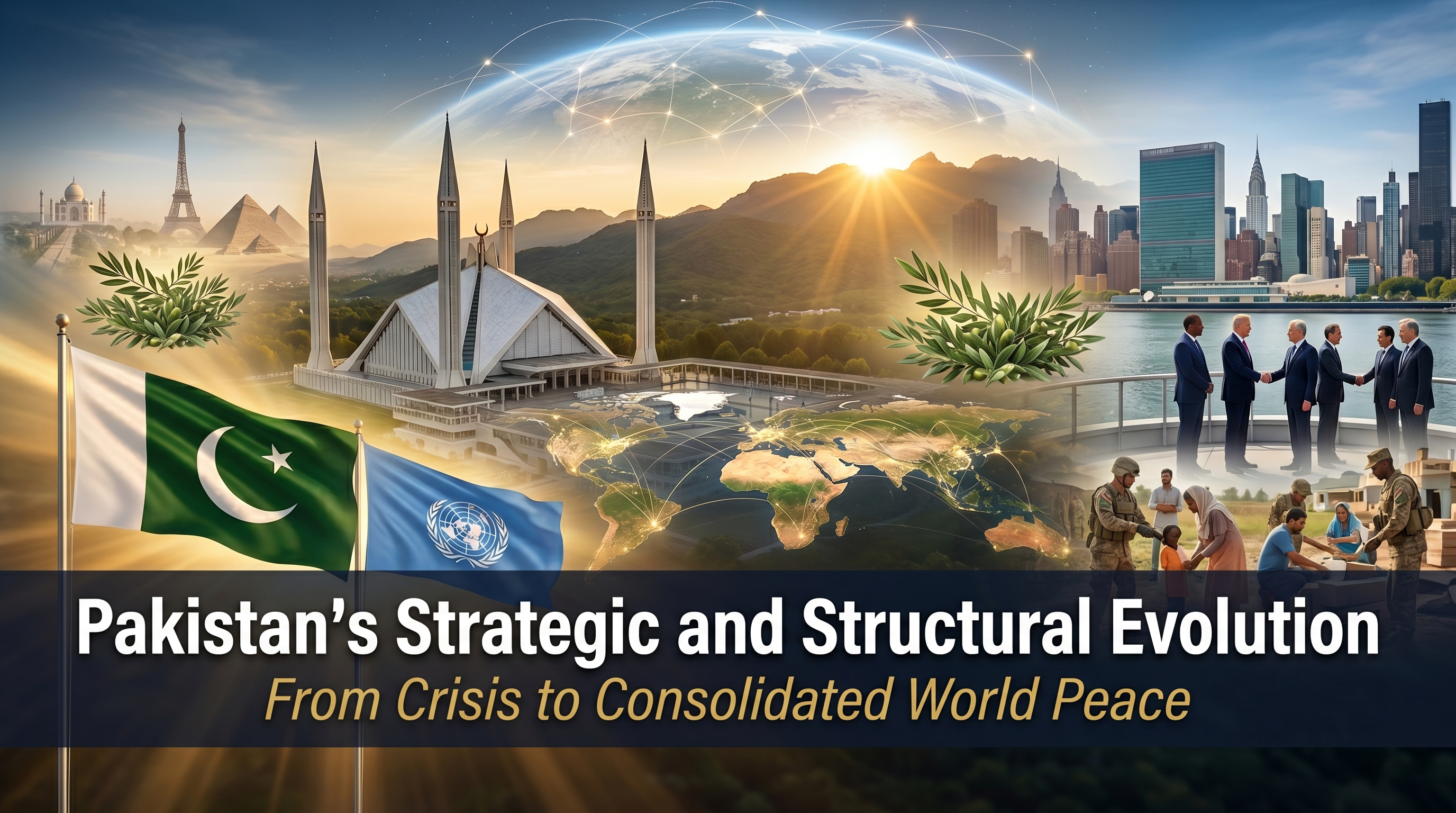
This article examines Pakistan's remarkable geopolitical
transformation between May 2025 and April 2026 — a period marked by acute
regional crises, military confrontation, and extraordinary diplomatic
intervention. Drawing on events ranging from the Pahalgam incident in
Indian-occupied Kashmir to Pakistan's constructive mediation in the Iran-United
States ceasefire, this analysis argues that Pakistan has emerged as an
indispensable actor in the architecture of global peace. The article further
explores Pakistan's expanding strategic partnerships, its decisive military
operations against terrorism, and its consolidating economic trajectory,
collectively positioning the nation as a foundational pillar of
twenty-first-century multilateral stability.
On
22 April 2025, a devastating terrorist attack struck the Pahalgam region of
Indian-occupied Kashmir, claiming the lives of twenty-six tourists and plunging
South Asia into one of its most acute crisis episodes in recent memory. Within
hours of the incident, the Indian government — without presenting any credible
evidentiary basis — levelled direct accusations against Pakistan, alleging
state complicity in what New Delhi characterised as a cross-border act of
terror.
Pakistan's
response was resolute, calibrated, and grounded in the principles of
international law. Islamabad categorically denied any involvement and, in an
act of diplomatic maturity rarely observed in such charged bilateral contexts,
immediately offered a joint, internationally supervised investigation into the
attack. Pakistan's Prime Minister addressed the nation and the global
community, extending an unequivocal commitment to transparency, cooperation,
and accountability — calling upon neutral international observers, including
United Nations monitors, to participate in any inquiry process.
This
offer of investigation was not merely symbolic. It represented a deliberate
strategic choice: to occupy the moral high ground, to expose the absence of
substantive evidence behind India's allegations, and to reinforce Pakistan's
image as a responsible state committed to facts, law, and de-escalation. It was
a posture that resonated strongly with the international community and placed
India in the diplomatically uncomfortable position of rejecting cooperation it
had ostensibly demanded.
Rather
than accepting Pakistan's offer of dialogue and investigation, the Indian
government opted for a course of aggressive unilateralism. New Delhi suspended
the Indus Waters Treaty — a cornerstone of bilateral water-sharing in place
since 1960 — in a move widely condemned by international legal scholars as a
violation of treaty obligations under international law. India simultaneously
closed its airspace to Pakistani commercial aviation, expelled Pakistani
diplomats, and revoked visas for Pakistani nationals, systematically
dismantling the diplomatic architecture that had taken decades to construct.
These
measures were accompanied by a dramatic escalation in military posturing along
the Line of Control, with Indian armed forces conducting large-scale exercises,
repositioning heavy artillery, and issuing increasingly bellicose statements
through official channels. Indian media, amplifying government narratives,
promoted a campaign of disinformation that further inflamed domestic sentiment
and foreclosed the space for rational diplomatic engagement.
International
analysts observed that India's conduct during this period reflected a troubling
departure from the norms of responsible statecraft. Rather than pursuing
verifiable facts, New Delhi appeared to instrumentalise the tragedy for
domestic political purposes — a calculation that would ultimately prove
strategically counterproductive and morally untenable before the eyes of the
world.
In
the early hours of 7 May 2025, India launched a series of missile strikes
against Pakistani territory under the operational designation 'Operation
Sindoor.' The strikes targeted sites across Punjab and Azad Kashmir, resulting
in civilian casualties and substantial infrastructure damage. This constituted
an act of armed aggression against a sovereign nuclear-armed state — an event
of extraordinary gravity that commanded immediate international attention.
Pakistan's
military response was swift, proportionate, and strategically precise. Under
'Operation Bunyan-um-Marsoos,' the Pakistan Air Force executed a series of
retaliatory strikes of considerable operational sophistication. Pakistani
forces neutralised Indian air defence systems, including Russian-supplied S-400
batteries — a feat that astonished military analysts across the world. The
destruction of these advanced systems demonstrated a level of technical and
tactical capability that fundamentally altered assessments of regional military
balance.
Within
four days, the armed confrontation concluded under intense international
pressure, with Pakistan having achieved its stated defensive objectives and
demonstrated unequivocal resolve. The outcome — widely characterised by
independent military analysts as a strategic victory for Pakistan — shattered
the prevailing narrative of Indian military superiority and established
Pakistan's armed forces as among the most operationally effective in the
region.
The
resolution of the May 2025 conflict triggered a significant recalibration in
Pakistan's international standing. Governments across Asia, the Middle East,
Africa, and beyond issued statements acknowledging Pakistan's restraint, its
repeated offers of dialogue, and its right to self-defence under Article 51 of
the United Nations Charter. The Organisation of Islamic Cooperation convened an
emergency session and issued a communiqué that implicitly validated Pakistan's
position.
Crucially,
the United States — which had engaged in urgent back-channel diplomacy
throughout the crisis — acknowledged Pakistan's fundamental role in preventing
further escalation. Washington's assessment, communicated through both official
and unofficial channels, credited Pakistan's military restraint and diplomatic
openness with averting a catastrophic regional war. This recognition marked a
qualitative shift in the bilateral relationship, laying the foundation for a
substantially reinvigorated strategic partnership.
China,
Saudi Arabia, Turkey, and the United Arab Emirates all publicly commended
Pakistan's conduct, while the European Union called for an independent
international investigation into the origins of the Pahalgam attack —
effectively endorsing the position Islamabad had advocated from the outset.
Pakistan's image in global diplomatic circles was transformed: from a state
under pressure to a state commanding respect.
The
aftermath of the India-Pakistan crisis produced a dramatic improvement in
relations between Islamabad and Washington. The Biden-era strains rooted in
competing regional priorities gave way to a substantive re-engagement driven by
mutual strategic interests. American policymakers, reassessing Pakistan's value
as a stabilising force in South and Central Asia, moved swiftly to consolidate
a revitalised bilateral framework.
The
United States approved a significant defence cooperation package for Pakistan,
including advanced avionics upgrades, counter-terrorism intelligence-sharing
mechanisms, and access to critical military hardware previously withheld.
Concurrently, the International Monetary Fund — operating under considerable
American influence — restructured Pakistan's debt obligations in a manner that
provided critical fiscal relief and bolstered macroeconomic confidence.
Beyond
the defence domain, American technology companies — encouraged by a more
permissive policy environment — began exploring significant investment in
Pakistan's rapidly expanding digital economy. The establishment of a joint
US-Pakistan Economic Transformation Initiative provided an institutional framework
for sustained economic engagement, signalling Washington's confidence in
Pakistan's long-term stability and governance trajectory.
Even
as Pakistan navigated its external crises with remarkable composure, it
continued to prosecute a determined internal campaign against terrorist
networks operating within its borders. Operation Azm-e-Istehkam — launched in
mid-2024 and sustained throughout the crisis period — represented the most
comprehensive counter-terrorism initiative in Pakistan's recent history.
The
operation's Afghanistan dimension proved particularly significant. Coordinating
with international partners and utilising precision aerial capabilities,
Pakistan's military targeted high-value Tehrik-i-Taliban Pakistan (TTP) command
infrastructure across the border. These operations, conducted in accordance
with the principles of necessity and proportionality under international law,
succeeded in dismantling several major TTP command and logistics nodes.
The
results were measurable and consequential. Terrorist incidents within Pakistan
declined by over thirty percent in the first quarter of 2026 compared to the
corresponding period of the preceding year. Major urban centres — including
Karachi, Lahore, and Peshawar — recorded their most secure operational
environments in over a decade. This demonstrable improvement in the internal
security landscape not only protected Pakistani citizens but also enhanced
investor confidence and created conditions conducive to sustained economic
growth.
The
catastrophic Israeli military campaign in Gaza, which extended its devastating
reach to Qatar-based Hamas political leadership in late 2025, fundamentally
restructured the political architecture of the Middle East. Traditional Arab
mediators found themselves either compromised by internal political pressures
or constrained by their dependence on American patronage. Into this vacuum,
Pakistan — with its combination of Islamic legitimacy, nuclear capability, and
diplomatic credibility — emerged as a uniquely positioned actor.
Pakistan's
response to the Israeli strikes on Gaza and subsequent operations was measured
yet morally unambiguous. Islamabad condemned civilian casualties in the
strongest terms while simultaneously maintaining open lines of communication
with all relevant parties, including Gulf states, Turkey, Iran, and Western
capitals. This capacity to engage across the full spectrum of the conflict's
stakeholders without being captured by any single camp distinguished Pakistan
as an honest broker of genuine strategic value.
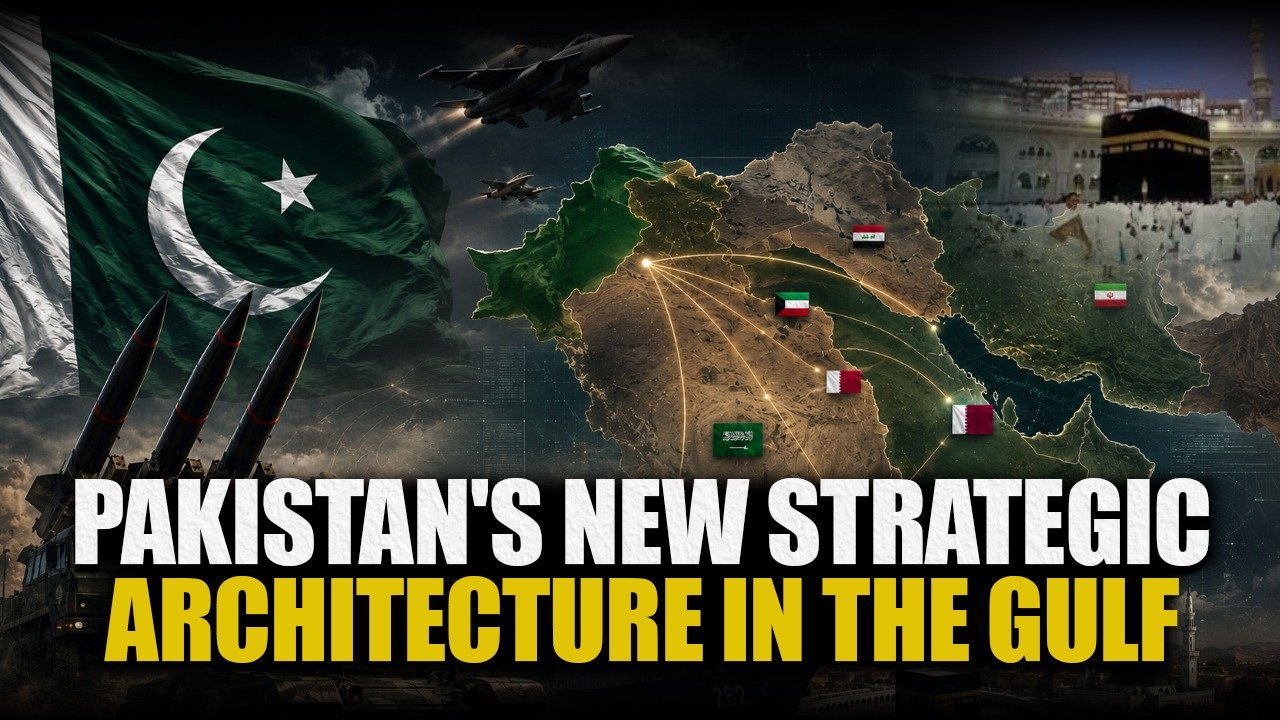
Pakistan's
growing defence cooperation with Saudi Arabia, the UAE, and Qatar — encompassing
military training, joint exercises, and security consultancy arrangements —
provided additional leverage. Pakistani military officers serving as advisors
in Gulf state armed forces constituted an informal but highly effective
diplomatic network that augmented Islamabad's formal foreign policy channels
considerably.
In
February 2026, Pakistan and Saudi Arabia concluded a comprehensive Strategic
Partnership Agreement that stands as one of the most consequential bilateral
arrangements in Pakistan's diplomatic history. The agreement encompasses
defence cooperation, energy security, financial investment, and cultural
exchange — representing a holistic vision of partnership that extends far
beyond traditional transactional relationships.
On
the economic front, Saudi Arabia committed to a thirty-billion-dollar
investment package directed at Pakistan's energy infrastructure, agricultural
modernisation, and Special Economic Zones. The establishment of a Joint
Investment Authority provided institutional continuity and accountability
mechanisms designed to ensure that committed funds translate into tangible
development outcomes rather than remaining on paper.
The
security dimensions of the agreement are equally significant. Saudi Arabia and
Pakistan formalised arrangements for intelligence-sharing on terrorism and
extremism, joint counter-terrorism training programmes, and the pre-positioning
of Pakistani military advisory teams in support of Saudi national security
objectives. For Pakistan, this represents not merely a financial windfall but a
structural elevation of its regional strategic standing — recognition that
Islamabad is now regarded as an indispensable partner in the Gulf's security
architecture.
Analysts
across the strategic community have described the Saudi-Pakistan agreement as a
'force multiplier' for Pakistan's geopolitical position. It simultaneously
deepens Pakistan's integration into Gulf security frameworks, diversifies its
economic relationships away from exclusive dependence on Chinese investment
under CPEC, and signals to the international community that Pakistan is
regarded by one of the world's most consequential states as a reliable and
capable partner.
The
outbreak of direct military hostilities between the United States and Iran in
early 2026 — precipitated by escalating tensions over Iran's nuclear programme
and retaliatory strikes against American assets in the Gulf — presented
Pakistan with both a profound challenge and an extraordinary diplomatic
opportunity. As a state with deep historical ties to both Washington and
Tehran, and as a Muslim-majority nuclear power with credibility across the
ideological divides of the Islamic world, Pakistan occupied a singular position
from which to act.
Pakistan's
Foreign Minister conducted an intensive shuttle diplomacy campaign across
Washington, Tehran, Muscat, and Ankara, facilitating the initial communication
channels that would prove essential to the eventual ceasefire framework.
Islamabad's approach was grounded in three cardinal principles: strict
non-partisanship, respect for international law, and an insistence that
civilian populations on both sides be protected from the consequences of
state-level confrontation.
The
two-week ceasefire brokered in March 2026 — subsequently extended — owes a
substantial and formally acknowledged debt to Pakistan's mediation efforts.
American officials privately credited Pakistan's foreign ministry with
'preventing the collapse of the ceasefire framework on at least two critical
occasions.' Iranian officials, meanwhile, acknowledged that Pakistan's capacity
to convey messages with both fidelity and strategic sensitivity had been
indispensable in maintaining the negotiating channel when direct communication
had broken down entirely.
This
mediating role has yielded dividends that extend far beyond the immediate
crisis. Pakistan has demonstrated — to a sceptical international audience —
that it possesses the diplomatic sophistication, the strategic relationships,
and the moral authority to function as a credible facilitator of peace in
contexts of the highest geopolitical complexity. It is a demonstration that no
future assessment of Pakistan's global role can responsibly ignore.
The
scholarly and policy communities have begun to take serious notice of
Pakistan's transformation. Two assessments are particularly illuminating:
"Pakistan's
conduct over the past twelve months represents a qualitative discontinuity from
its earlier international posture. Islamabad has demonstrated the capacity —
and the institutional will — to engage simultaneously at the highest levels of
regional and global diplomacy while managing acute domestic security
challenges. What we are witnessing is not merely tactical adroitness but a
genuine strategic maturation. Pakistan is no longer a reactive state; it is an
architect of regional order."
— Dr. Raza Ahmad Khan, Professor of
Strategic Studies, Johns Hopkins School of Advanced International Studies
"The
conventional Western narrative of Pakistan as a state perpetually on the edge
of instability has been rendered analytically obsolete by the events of 2025
and 2026. Pakistan's military effectiveness, its diplomatic reach, its capacity
for principled mediation, and its growing economic partnerships collectively
constitute a profile of an ascending middle power. The Saudi-Pakistan agreement
alone represents a structural realignment of Gulf-South Asia relations. Add
Pakistan's role in the Iran-US ceasefire, and you have a state that has, in the
space of a year, repositioned itself at the centre of the international
security conversation."
— Professor Leila Haddad, Chair of
Middle Eastern and South Asian Affairs, Sciences Po Paris
The
period between May 2025 and April 2026 will be recorded in the annals of
Pakistani history — and, increasingly, in the annals of international relations
— as the moment a nation confronted with simultaneous external aggression,
internal insecurity, and economic fragility chose the path of principled
statecraft over the temptations of reactionary unilateralism.
Pakistan's
journey during this period is not a story of effortless triumph. It is a story
of institutional resilience, strategic discipline, and moral clarity exercised
under conditions of extraordinary pressure. From the restraint shown in the
face of Indian aggression, to the effectiveness of counter-terrorism
operations, to the sophistication of diplomatic mediation in the Iran-US
conflict, Pakistan has demonstrated repeatedly that it possesses the attributes
of responsible global leadership.
The
consolidation of the Saudi-Pakistan Strategic Agreement, the reinvigoration of
US-Pakistan relations, and the growing recognition of Pakistan's indispensable
role in Middle Eastern diplomacy collectively signal the emergence of a new
geopolitical reality: Pakistan as a structurally significant force in the
architecture of international peace and security.
Internally,
the improvement in the security environment — measurable and sustained — is
creating the conditions under which Pakistan's considerable economic potential
can finally be realised. Foreign direct investment is returning. Macroeconomic
stabilisation is taking hold. The young, talented, and entrepreneurial
Pakistani population is beginning to receive the institutional support and
international market access it has long deserved.
Pakistan
stands, for the first time in a generation, at a genuine inflection point. The
crises of the past year have not weakened it — they have forged it. As the
world grapples with the fractures of multilateral order, the proliferation of
regional conflicts, and the erosion of trust in traditional international
institutions, Pakistan is positioned to offer something of singular value: a
state that has demonstrated, through action rather than declaration, its
commitment to peace, stability, and the principled resolution of conflict.
The
question before the international community is not whether Pakistan has earned
a seat at the table of global leadership. The evidence presented over the past
twelve months settles that question emphatically. The question, rather, is
whether the existing structures of international order are sufficiently
adaptable to accommodate and harness the constructive potential of Pakistan's
emerging role. The answer to that question will shape the character of the
international system for decades to come.
_6784.jpg)