Education
is widely recognized as a fundamental human right, and it plays a key role in
social and economic development. It helps individuals build knowledge, develop skills,
and contribute positively to society. In Pakistan, the access to education has
improved over time, and awareness about its importance has increased. However,
significant inequalities still exist in terms of resources, access, quality,
and also in terms of outcomes. These hurdles continue to limit both individual
opportunities and national progress.
The
first and foremost issue that we are facing is the large number of children who
are not attending school. According to UNICEF Pakistan (2025) report, around 25.1 million children
aged 5 to 16 are out of school. Similarly, the UNESCO Report 2024/25 gives an estimate of 26.2 million,
placing Pakistan among the countries with the highest number of out-of-school
children. These statistics clearly show that access to education remains uneven
across the country, and many of these children are unable to attend school due
to economic barriers, gender and cultural constraints, and due to
infrastructure and access.
In
addition, being enrolled in school does not always mean that children are
learning effectively. There is a concept of “learning poverty,” introduced by the World Bank, UNESCO, and
UNICEF (2022), which refers to children who cannot read and understand a simple
text by the age of 10. Many students in Pakistan fall into this category,
showing a serious gap between schooling and the actual learning outcomes.
The
next main cause behind these inequalities is limited public investment.
Pakistan only spends about 1.5–2% of its GDP on education, which is far below
the 4–6% recommended by UNESCO. This low level of funding affects the
availability of schools, trained teachers, learning materials, and especially
infrastructure in remote areas. As a result, many institutions lack basic
facilities, and the quality of education differs widely across regions. Then
comes the problems in policy implementation which further increase these
challenges. The Pakistan
Institute of Development Economics (PIDE) reports that several education policies have
been introduced, but their execution is often weak. Due to poor governance,
lack of monitoring, and limited accountability, the implementation process is
affected. Issues such as inconsistent teacher training and teacher absenteeism,
especially in rural areas, continue to affect the system even more.
Regional
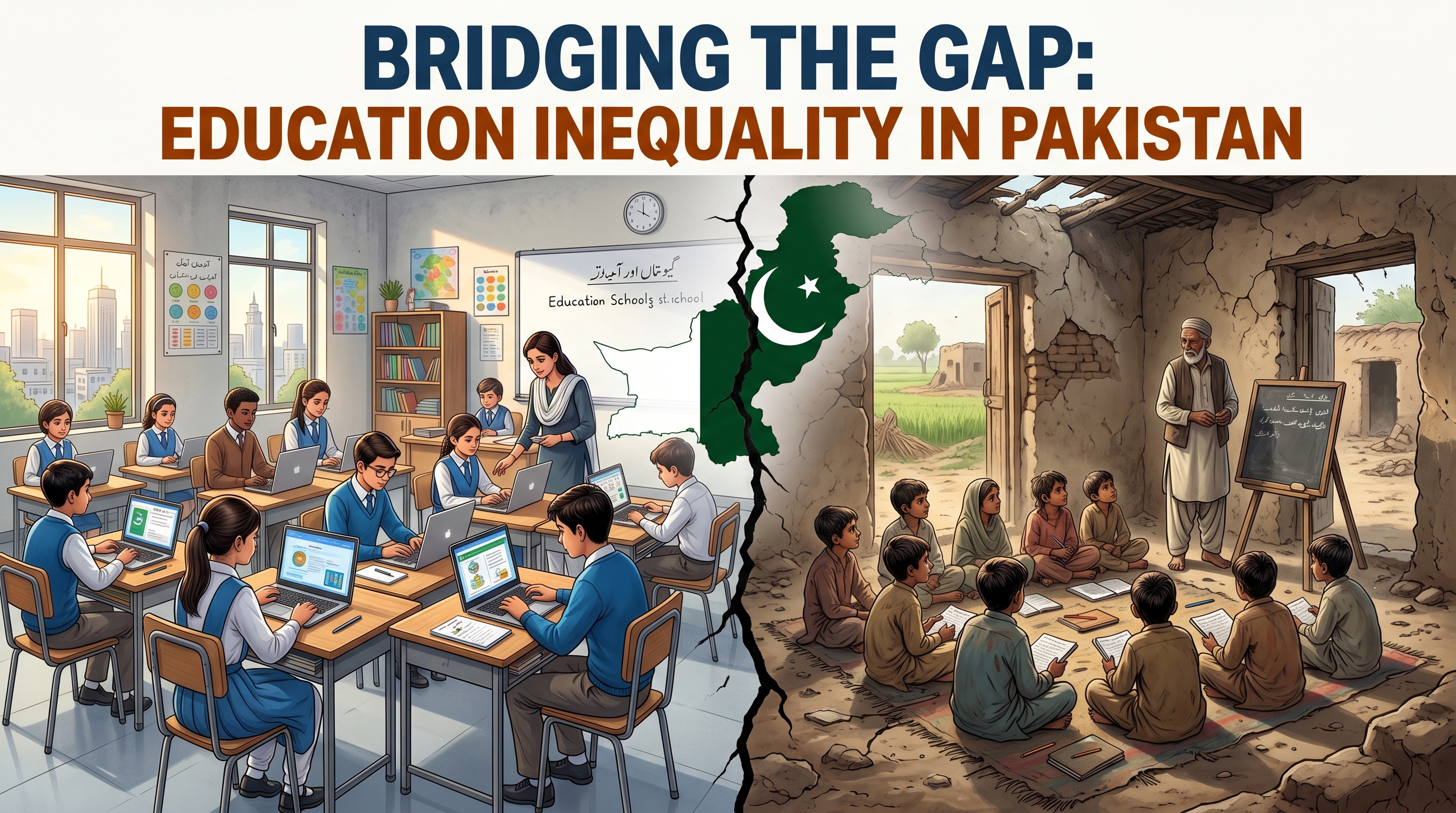
differences also play an important role. Children living in rural areas,
particularly in Balochistan and Khyber Pakhtunkhwa, face more difficulties in
accessing education compared to those in cities. These areas often have lower
enrollment rates and, on the other hand, higher dropout levels. In our country,
gender inequality is another serious concern. According to a UNESCO
report, around 3.3 million girls are out of school only at the primary level in
Pakistan today, and the country is progressing at the very slowest rate in
South & West Asia. This is because girls face additional barriers due to
cultural expectations, safety issues, and household responsibilities, which
restrict their chances of continuing education.
Also,
many schools rely on rote memorization instead of encouraging critical thinking
and problem-solving, and this affects quality education. According to the World
Bank’s learning framework, students need strong reading and numeracy skills for
future success. Without improving teaching practices, students may complete
their education without gaining useful skills. It also affects the country’s overall
development. For instance, a workforce
without proper skills can slow economic growth and reduce productivity. That’s
why in Pakistan unequal access to education leads to fewer opportunities,
higher unemployment, and limited social mobility. This makes it more
significant to address these issues at a national level.
A
comprehensive approach is necessary to overcome these challenges. Increasing
education spending can improve infrastructure, teacher availability, and
learning resources. Better training programs can help teachers deliver more
effective lessons and use diverse teaching methods according to students’
needs. Strong monitoring systems are needed to ensure that policies are
properly implemented. In addition, different opportunities and targeted support
such as scholarships, safe transport, and community awareness can help children
from disadvantaged backgrounds, especially girls, continue their education.
In
conclusion, education inequality remains a serious issue in Pakistan, affecting
millions of children and influencing the country’s future. Statistics from
major organizations and institutions show that problems related to access,
quality, and outcomes must be addressed together. A clear strategy, supported
by proper investment and inclusive policies, is essential to provide equal
learning opportunities for all and to support long-term national development.
Disclaimer: The views expressed in this article are solely those of the author and do not necessarily reflect the position of ICEP.


_6784.jpg)