By: Asif Sandhu
In the deep reaches of a crisis-riven night made darker still by the smoke
of military posturing and escalating rhetoric those who still carried the
instinct for de-escalation found themselves in a desperate race against time.
Across the world, television screens flashed ultimatums, analysts spoke in
urgent tones, and a single question echoed through every diplomatic corridor:
Is war now inevitable? With every passing hour, the clouds of fear grew
heavier. Telephone lines buzzed between capitals. Diplomats whispered in
urgency. And decision-makers on both sides searched frantically for even the
faintest thread they might pull to prevent catastrophe. Then — almost
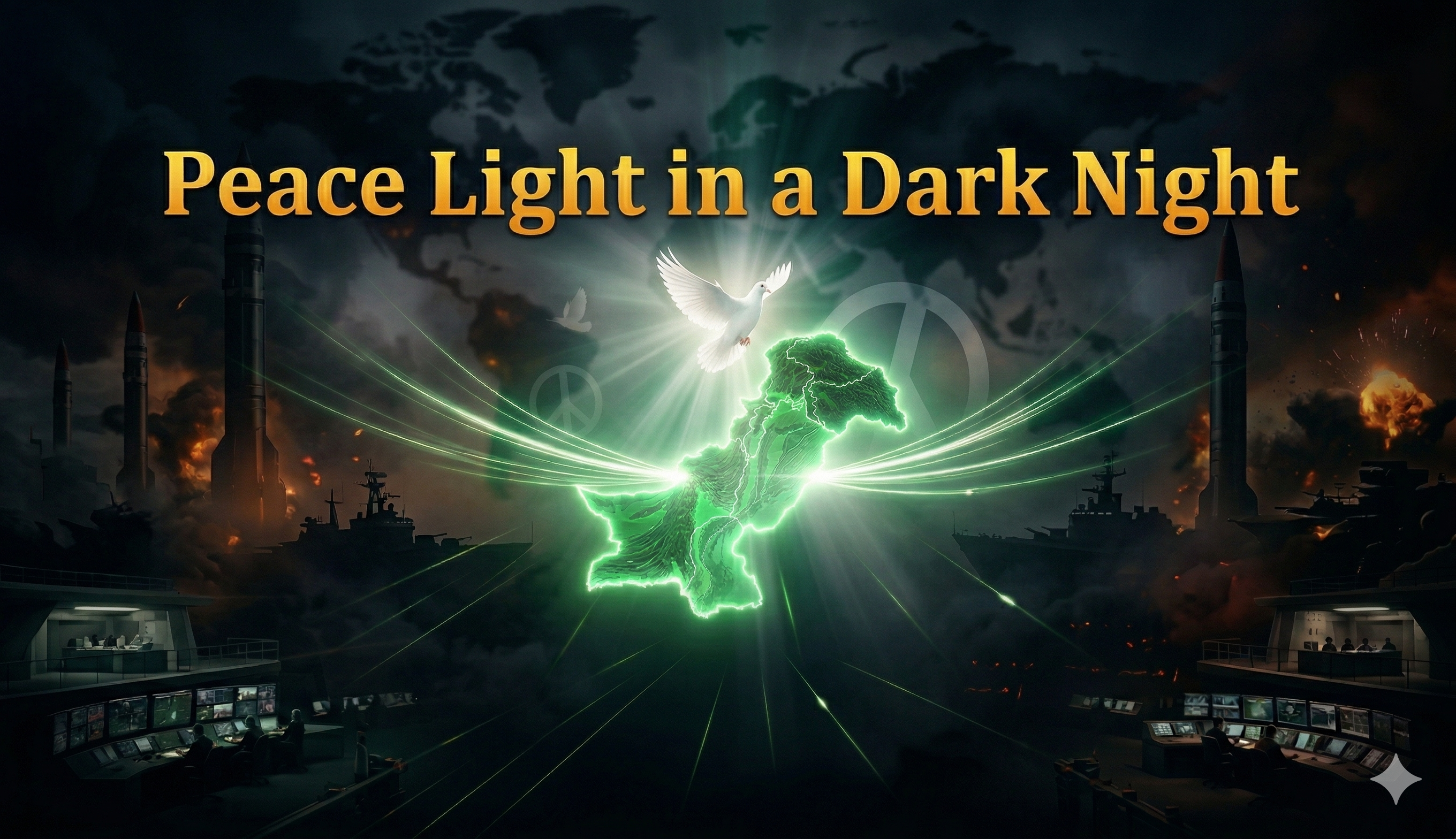
unexpectedly — Islamabad stepped forward. True to the spirit of its name,
Pakistan's capital emerged once again as a bearer of calm. The fear gripping
the international community began, slowly, to soften into cautious hope.
The crisis between the United States and Iran had escalated to a level
where a single miscalculation could trigger catastrophe. Military movements
intensified across the region. Strategic assets were repositioned. The rhetoric
emanating from Washington signaled a readiness for action that alarmed even
America's closest allies.
Iran, resolute and defiant, refused to yield under mounting pressure —
while simultaneously preparing for any possible confrontation. The Strait of
Hormuz, through which nearly a fifth of the world's oil supply passes daily,
became the most dangerous symbol of the standoff. A disruption there would not
merely cripple energy supplies; it would shake the foundations of the global
economy. Markets reacted instantly. Oil prices surged. The fear of a wider
regional conflagration moved from speculation toward approaching reality.
What made the situation particularly alarming was the growing perception
that conventional diplomacy had exhausted its options. The United States hinted
at military contingencies with increasing frequency. Warships were positioned.
Strategies were war-gamed. The world watched as the possibility of direct
confrontation ceased to feel remote. On the other side, Iran demanded respect
for its sovereignty, relief from crippling sanctions, and binding security
guarantees. The deep-rooted mistrust between the two nations — decades in the
making, reinforced by every failed negotiation — stood like a wall that no
single diplomat could scale alone. The gap was not merely political. It was
existential.
Yet, precisely when the world appeared to be moving irreversibly toward conflict,
something changed. Instead of missiles, there were meetings. Instead of
threats, there were careful, considered conversations. Quietly without grand
announcements or theatrical press conferences Islamabad became the center of a
new possibility. Pakistan opened its doors as a neutral and trusted venue where
two long-standing adversaries could engage without the corrosive weight of
mutual suspicion. This was not merely a diplomatic maneuver. It was a turning
point one that may define the region's trajectory for years to come. At the
heart of this transformation stood Pakistan. Often underestimated in the
calculations of global diplomacy, Islamabad demonstrated a rare and valuable
capacity: the ability to navigate one of the most complex geopolitical crises
of the modern era without becoming a party to it. Pakistan's unique strategic
positioning allowed it to act as a genuine bridge. It maintains deep
historical, cultural, and economic ties with Iran — including a shared border
and longstanding bilateral energy frameworks. Simultaneously, it sustains a long-standing,
if complex, strategic partnership with the United States rooted in security
cooperation and decades of mutual engagement. Rather than choosing sides,
Pakistan chose balance.
Behind the scenes, Pakistani diplomats and senior leadership worked with
quiet determination — facilitating communication, absorbing tension, and
ensuring that the fragile thread of dialogue did not snap under the weight of
distrust. Pakistan did not impose solutions. It created the conditions in which
solutions became possible. "Diplomacy at its finest is not loud. It is not
theatrical. It is the patient, relentless work of keeping doors open when every
instinct says to close them."
Despite the significance of recent progress, the reality remains acutely
complex. The structural differences between the United States and Iran are
profound and long-standing — encompassing questions of sanctions relief,
nuclear ambitions, regional influence, and ironclad security guarantees. The
involvement of other regional actors, particularly Israel, further complicates
any durable resolution.
The peace talks, therefore, are not a resolution. They are a beginning —
and a precarious one. A single misstep, a misinterpreted military movement, or
a sudden shift in domestic political calculation in Washington or Tehran could
unravel everything built with such painstaking care. Hope exists. But it is
fragile, and it demands protection. What is unfolding in Islamabad is not
simply a bilateral development between two hostile nations. It is a moment of
genuine global importance — and a challenge to a troubling trend: the growing
international reliance on force over dialogue as the default response to
geopolitical crisis.
By preventing immediate escalation, these talks have materially reduced the
risk of a wider war — one that could have drawn in multiple nations and
destabilized an already volatile region. The security of vital trade routes,
particularly through the Strait of Hormuz, remains a matter of profound
consequence for the global economy. Pakistan's role offers an alternative to
the prevailing narrative: that even in the most hostile of environments,
diplomacy — patient, principled, and persistent — can still prevail. The
darkness has not fully lifted. The threats have not disappeared. The road ahead
remains long and uncertain. But in the midst of fear, a light has appeared —
small, flickering, yet meaningful. It is a reminder, in a period when such
reminders are desperately needed, that peace is still possible.
Pakistan's role in this moment reflects something larger than a single act
of mediation. It signals a broader transformation — one in which the country is
no longer perceived solely through the lens of its own security challenges, but
increasingly recognized as a contributor to global stability. The challenge now
is not only to create peace, but to sustain it. Because in a world overshadowed
by conflict, even a single light — if protected can illuminate the path forward
for all.
_6784.jpg)