
In the Greco-Persian
wars of ancient times, the Athenians successfully overpowered the Persian large
fleets with superior tactics and terrain manipulation. The technological
advancements of Persians were unmatched at that time however, the Athenians
clinched victory and outnumbered the enemy. Tactical superiority doesn’t
guarantee political success, as Vietnam and Afghanistan proved, a string of
victories can still culminate into a strategic defeat.
“War is an act of
violence”, said Clausewitz “intended to compel enemy to do our will”. War has
never been an end in itself. However, it is a rational extension of the
political objectives. On February 28 Israel launched a military campaign on the
middle-eastern country Iran aiming to change the regime, annihilating Iran’s
missile program and permanently limiting its capability to develop a nuclear
bomb. Among the air-campaign numerous missiles hit the office of Iranian Supreme leader
assassinating him and several other top leaders.
Donald Trump, through a
video statement announced that they have conducted “major combat operations”
around several parts of Iran as it has posed an “imminent threat” to United
States and it was only “two weeks away” from developing a nuclear bomb.
However, the secretary of state, Marco Rubio called it a necessary
step
as Israel initiated the attack and the US has to jump in. Surprisingly, the
objectives of Israel are to eliminate the growing military capability of Iran
and on the other hand, as per US officials it was a pre-emptive strike.
US-Israel led alliance
may have achieved a complete air dominance over Iran by carpet bombing the
civilian and military infrastructures. Yet the strategic equation remains
unresolved and somewhat getting more complicated. The opening days of war were
decisive in military terms but what this alliance will achieve politically is
yet to be unfolded.
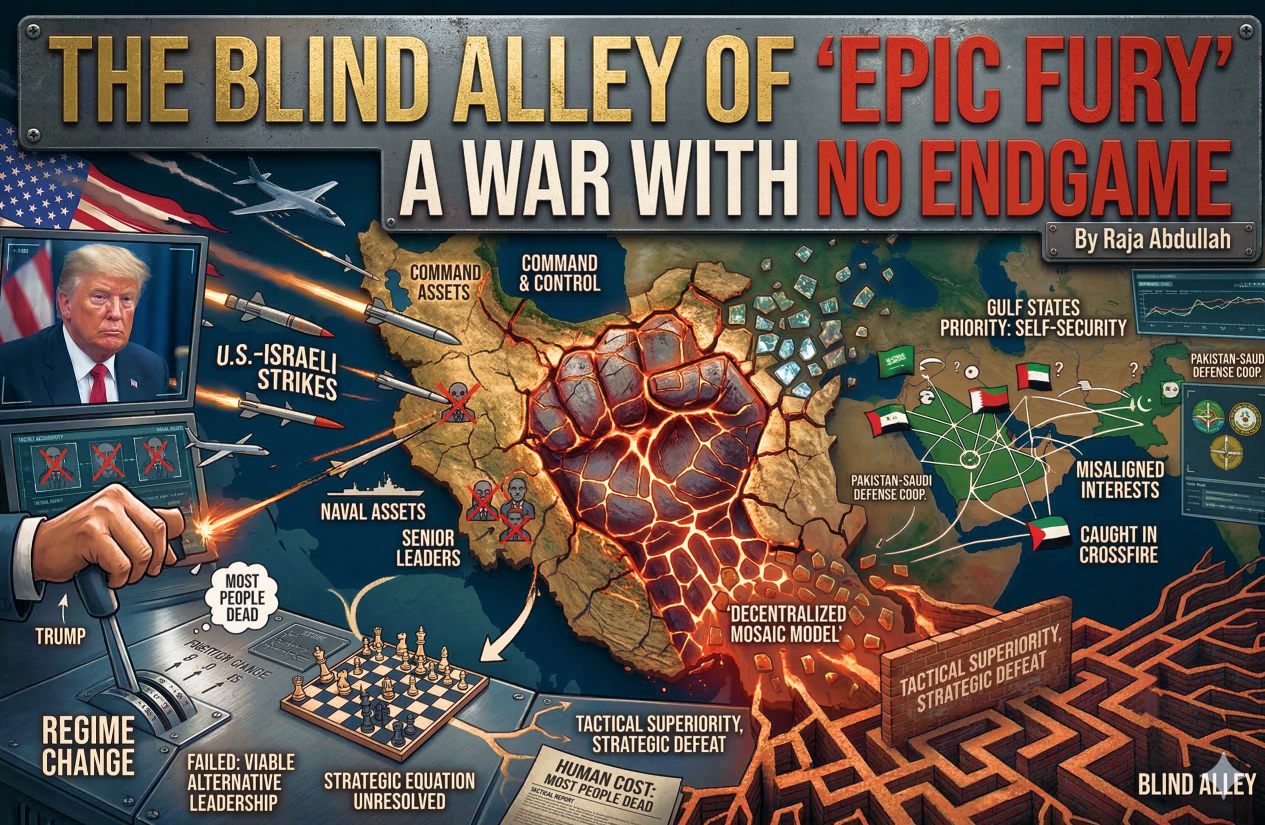
US-Israeli targets in
Iran were structural in nature; targeting command and control systems, naval
assets and decapitating core leadership. These strategies proved to be
counterproductive as it doesn’t yield the desired outcome; an uprising. After
the decapitation, US was expecting a strong response, in the form of protest
and rebellion, from general public of Iran. As Trump called out Iranian
people, “to take control of the government”. The public
outrage against the government was nowhere to be found. Despite massive military
strikes the Iranians escalated and targeted the US assets, despite severe
aerial attacks, in the middle east which no Arab country was expecting at this
time.
After the decapitation,
the Iranian model which officials called “Decentralized Mosaic Model” has been
operational where the authority diffuses at lower level without the approval of
higher leadership. In such a way, Iran has preserved its operational response
capability. Currently, the IRGC and Iranian government are functioning and
responding to attacks and there is no indication of systematic collapse that
USA and Israel were expecting after the decapitation strikes.
The foremost priorities
of US-Israel joint strikes are; firstly, to change the regime. The annihilation
of Iranian missile capacity stands at second. Thirdly, they intend to
permanently limit the Iranian capacity to develop a nuclear bomb. The future of
the war, of course would be determined by the ability and strategic opportunity
for allies to achieve these goals. Otherwise, it would be another catastrophic
way of inflicting significant damage to civilian infrastructure and further
creating a rift between Arab states and Israel.
US President responded in
a joint media appearance with German Chancellor, when confronted with the question
of who would possibly be the best choice for a pro-Israeli-American leader,
“most of the people we had in mind are dead.” This indicates that the US on
strategic level is missing out its objectives and currently, unaware of the
fact that the regime change requires more than carpet bombings of the capital.
Even the allied forces have inflicted human and infrastructural cost to Iran
but if they are unable to shift leadership, all of the other objectives would
be unachievable.
Launching limited military
strikes and striking a political deal has been in Trump’s playbook for a long
time. He wants the same in Iran and secure a complete surrender from regime or
earn a framework for future that validates his claim to be a peacemaker. In
case of Iran now, there seems no point of return as Iranian Foreign Minister
and clerical leadership are making clear that, for now, there would be no
talks.
It is clear that Israel
wanted to drag USA in war with Iran from Biden’s era. Nate
Swanson, director of Iran at the National Security Council
and part of negotiating team of Trump’s administration with Iran, has said,
they somehow “avoided” a prolonged war with Iran. The peacemaker personality of
Trump made him launch a military strike on Iran and now he wants a clean exit
but the escalatory response from Iran would cost him much more.
Strategically the threat
of Iran was there, but not an existential one. Iran has been preparing for this
doomsday for long time. The chief goal of Iranian regime is to survive and
inflict financial and economic damage to not only USA but its allies. For
trump, he needs a quick deal with his flashier demands, his motives are unclear
and continuously shifting. He didn’t want to prolong the war; earlier he said
for few days then for weeks and now he is unclear how long the war may last.
Tehran now, has targeted
the gulf states and above all put halt to the global energy route by closing
strait of Hormuz. The war is not going anywhere but towards the changing power
dynamics of the middle east. The desire of eliminating Iran as a threat is
turning into a quagmire for US and Israel. The financial burden Iran has posed
on US and Israel is unfathomable. The Arab countries are rethinking their
defense partnerships and in future more pacts like Pakistan-Saudi defense
agreements could be expected.
There is a growing sense
of detachment in the Middle East as Gulf countries prioritise their national
security over the expectations of the Trump administration, a reality that has
left U.S. lawmakers—Lindsay
Graham—questioning the strength of their partnerships with
the Arabs.
The Gulf states are
increasingly prioritizing their own economic security, recognizing that the
defense frameworks they previously adopted were designed more to serve U.S.
strategic interests than their own national protection. Moreover, the US assets
in the middle east have become a strategic target for the Iranians, so, making
it a liability for the Arabs.
There could be pressure
mounting on the gulf states to get involved militarily with Iran, resultantly
USA's direct involvement fade away leaving the Arabs and Persians at war. Even
this situation could help Washington and Tel aviv to achieve their objectives
without getting directly involved.
It is a classic case of
misaligned stakes where the Arab world is caught in the crossfire of a war they
didn't ask for. Israeli state feels it must keep fighting to avoid a total loss
and leave no one powerful enough to challenge its monopoly in the middle east.
While Iran is playing a high stakes game where the only goal is staying alive.
In this environment, cooperation has become a secondary concern to basic
survival. The traditional alliances once so strong, will break up gradually.
Israel’s strategy of
externally manifesting its power throughout the middle-eastern region is quite
threatening for the Arab states. It has neither desired de-escalation since its
inception, nor is anticipating this time. Israel’s objective of ruling middle
eastern region as a unipolar state has put itself into a constant state of
crisis. With Iran its objectives kept changing; it doesn’t exhibit a
self-sustaining military capability to destabilize Tehran so, it heavily relies
on pressuring American establishment for support. The current posture suggests
that Israel’s goal is not to weaken Iran but a vacuum where no centralized Persian
or Arab state can exist. For Iran the goal is clear; to survive.
There are no precedents
in history that a regime change has been possible with aerial strikes and, with
‘boots on ground’ it would be another Libya or Iraq. Even for the sake of argument,
though the strategy of US-Israel doesn’t seem to produce the outcome, the
regime changes; the probability of pro-American regime remains low given the
institutional structure of Iran. Furthermore, there is no plausible evidence
that the new regime will give up missile arsenal and completely shut down the
Iranian nuclear program, given the conditions. Trump getting backlash at home
and is eager to find a novel face-saving deal to declare victory over Iran.
Netanyahu and specifically, Trump are stuck between rock and a hard place.
Though the final outcome is uncertain, the US and Israel has boxed themselves
into a corner where military victory offers no political solution.
Disclaimer: The views expressed in this article are solely those of the author and do not necessarily reflect the position of ICEP.

Raja Abdullah, MPhil Scholar at National Defense University and Lecturer Political Science Higher Education Department, AJK. His areas of interest include International Relations Theory, Geopolitics, and Religion & international affairs. He can be reached at: rajaabdullah796@gmail.com

_6784.jpg)