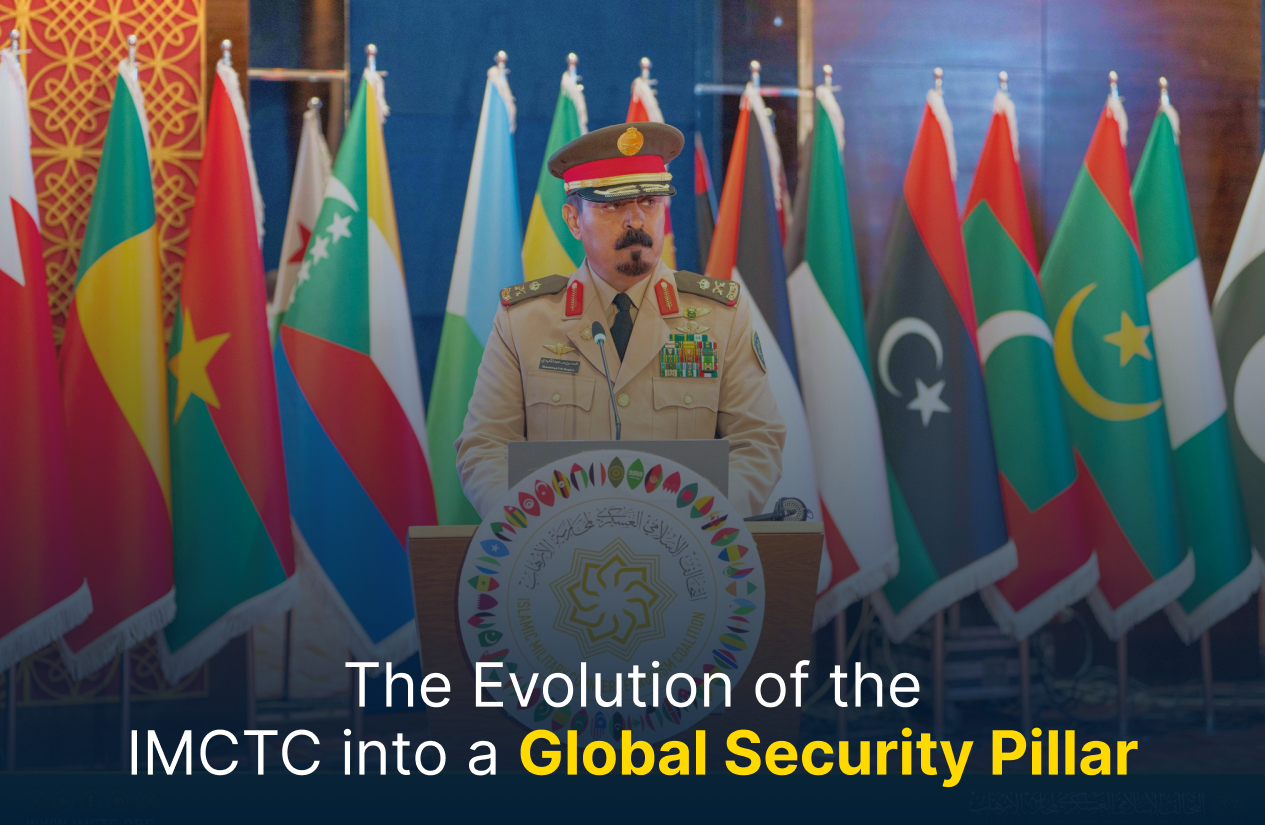

When the Islamic Military Counter Terrorism Coalition (IMCTC)
was first announced in 2015, skeptics dismissed it as a "paper
alliance", a symbolic gesture in the wake of the Syrian and Iraqi crises.
However, as of early 2026, the landscape has shifted. With 43 member states and a formal partnership with the
United Nations, the IMCTC has transitioned from a theoretical initiative into a
functional coordination hub.
Headquartered in Riyadh, Saudi Arabia, the IMCTC represents a
paradigm shift: the idea that Muslim-majority nations must take the lead in addressing
security crises within their own borders, reducing dependence on Western
intervention.
The Institutional Framework: The Four Pillars
The IMCTC does not operate as a traditional standing army.
Instead, it operates through a decentralized, four-pillar strategy designed to
tackle the "lifecycle" of terrorism, from radicalization to financing
and field combat.
|
Pillar |
Focus Area |
2025-2026 Key Activity |
|
Ideology |
Intellectual immunity and
moderate Islam. |
The "Reintegration"
program for former extremists. |
|
Communications |
Digital counter-narratives. |
The "Peace
Journalists" initiative for conflict zones. |
|
Finance (CTF) |
Tracking and freezing illicit
funds. |
Specialized training for
Yemeni and West African banks. |
|
Military |
Capacity building and
intelligence. |
The "Competence"
(Efficiency) field training programs. |
The 2026 "Competence"
Initiative
The hallmark of the IMCTC’s current era is the "Competence" (Efficiency) Initiative. Moving
away from high-level summits in Riyadh, the coalition has begun deploying
specialized training teams to its most vulnerable member states.
·
Tactical Readiness: In late 2025, the
IMCTC conducted large-scale training for Explosive Ordnance Disposal
(EOD) in Sierra Leone and The Gambia, addressing the rise of IEDs in
the Sahel region.
·
The Cyber Frontier: Recognizing that the
next "Caliphate" may be digital, the coalition launched a specialized
Cyber-Terrorism Defense program in the Maldives. This
initiative helps smaller nations secure their digital infrastructure against
extremist hacking and recruitment.
·
Global Legitimacy: The February 2025
Memorandum of Understanding with the United Nations Office of
Counter-Terrorism (UNOCT) has solidified the IMCTC’s role. It is no
longer a regional project; it is now an integrated part of the global security
architecture.
A Genuine Organization or a Political Tool?
The debate surrounding the IMCTC’s "true nature"
remains a central theme for analysts. Critics often point to the absence
of Iran, Iraq, and Syria as evidence that the IMCTC is a
sectarian bloc rather than a universal Islamic coalition. Conversely,
the IMCTC’s supporters argue that the organization provides a unique
"Middle Way." Many African and Southeast Asian member states are wary
of direct Western military footprints, which can sometimes fuel local
radicalization. The IMCTC offers Sovereign Security:
aid, training, and intelligence provided by fellow Muslim nations, which
carries significantly less political baggage.
The Verdict
In 2026, the IMCTC is best described as a "Hybrid Security Service Provider." It does
not invade; it enables. It does not dictate; it coordinates. While it may never
fully escape the shadow of regional geopolitics, its move toward standardized
military training (interoperability) and its success in bringing 43 diverse
nations under one roof suggest it has outgrown the "initiative"
label. The IMCTC is now a permanent fixture in the fight against global
extremism, proving that the most effective counter-narrative to radicalism is a
unified, professional response from within the Islamic world itself.
By: Abdullah Syyaf
_6784.jpg)