
Pakistan and Libya have renewed
military engagement, which was underlined by the recent visit of Pakistan's
Chief of Defense Forces and Chief of Army Staff, Field Marshal Syed Asim Munir,
to Libya. This engagement was an important development in the two country's
bilateral defense relationship and a reflection of Pakistan's increasingly
using military diplomacy in expanding strategic partnerships beyond South Asia.
According to analysts, this engagement forms part of a mix of security
cooperation exports of defense, and geopolitical positioning in North Africa.
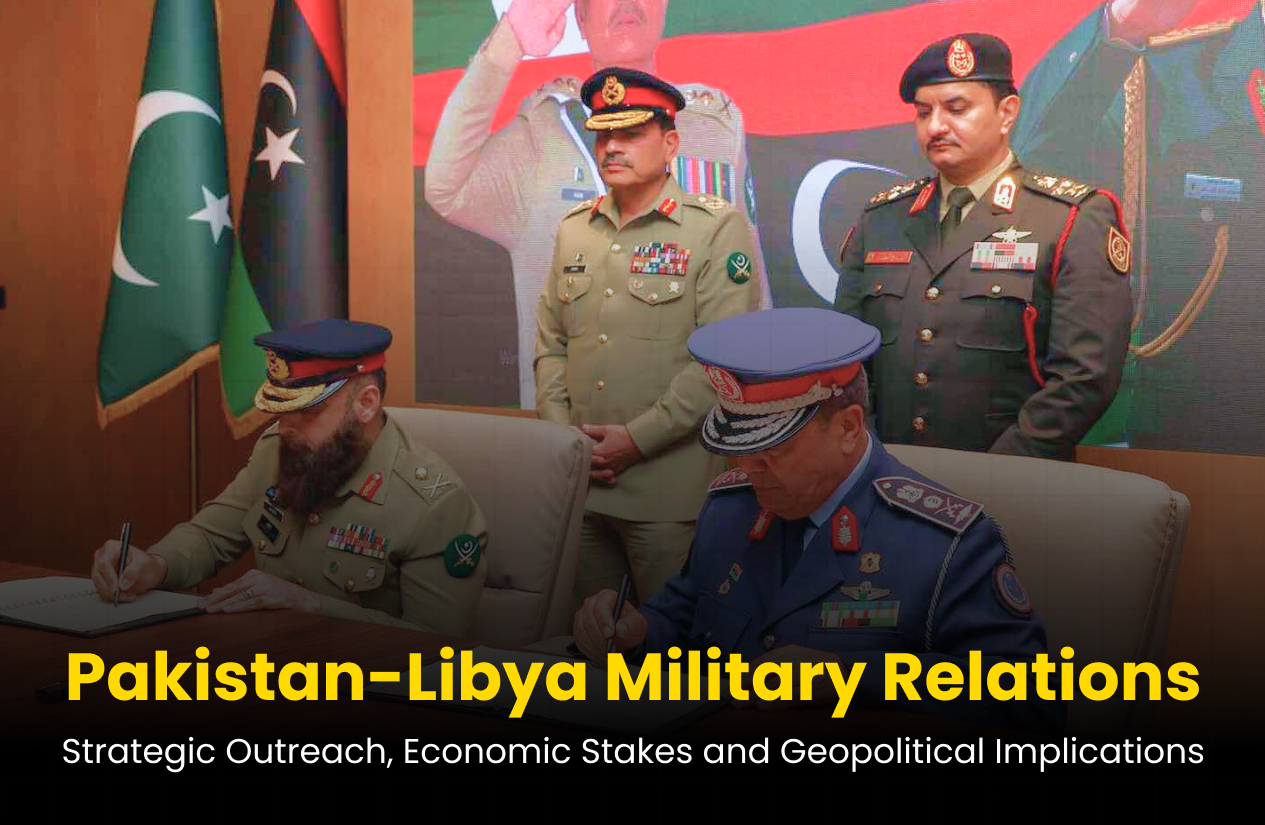
Field Marshal Asim Munir held
meetings with senior Libyan military leadership, including Field Marshal
Khalifa Belqasim Haftar Commander-in-Chief of the Libyan Arab Armed Forces,
along with other top officials during his official visit. The deliberations
aimed at enhancing military-to-military relationship, professional exchanges,
and future cooperation in defense-related fields.
The visit was symbolically
important, reflecting mutual respect and a disposition to deepen institutional
ties. For Pakistan, this underlined an effort toward diversification of defense
relationships and to project its armed forces as a professional and reliable
partner. For Libya, the engagement signified interest in structured military
cooperation at a time when the country remains wracked by internal security and
institutional challenges.
Several key
points arose from the high-level meetings:
·
As
such, both parties agreed on the enhancement of cooperation in areas such as
military training, professional education, counter-terrorism, and capacity
building.
·
Discussions
included prospects for defense industrial cooperation-a testament to Pakistan's
ambition in expanding its exports of defense and technical capabilities abroad.
·
The
talks underlined the continuing dialogue on regional and international security
developments-a pointer to sustained military engagement rather than a one-off
contact.
Background of
Pakistan Libya Military Relations
Soon after the independence of
Pakistan, there came about the establishment of diplomatic relations between
Pakistan and Libya. Essentially, the past history of defense cooperation
between the two countries has remained limited but cordial, mainly restricted
to training and advisory support. Libyan officers have attended professional
courses in Pakistani military institutions; Pakistan has built up a reputation
as a provider of disciplined, cost-effective military training.
Following the internal Libyan
conflict after 2011, formal defense relations significantly slowed down.
Pakistan maintained its cautious and neutral stance, calling for the unity and
stability of Libya through diplomatic support. The recent engagement thus constitutes
restoration rather than the initiation of military relations.
Economic and Defense Export
Dimensions
Of the most notable aspects of
renewed engagement, it comes in the form of a reportedly multi-billion-dollar defense
deal, which if fully implemented would rank among Pakistan's largest arms
export agreements. The deal reportedly covers aircraft, training platforms, and
other military hardware, alongside commitments for training and technical support.
Support defense manufacturing and
employment domestically. The objective of this initiative should be to enhance
Pakistan's profile as an emerging defense exporter in Africa and the Middle
East. As Pakistan aims to go for export-oriented growth, its defense production
is increasingly being seen as a strategic economic sector.
For South Asia Pakistan's outreach
to Libya reflects a broader shift in its foreign and defense policy. By
expanding military cooperation beyond its immediate region, Pakistan seeks to, this
approach might contribute to building Pakistan's bargaining position and
reinforcing its image as a capable military actor at the global level.
The implications, however, are
more complex in North Africa. Libya remains politically divided, and military
cooperation with any single faction carries regional and international
sensitivities. Analysts caution that increased defense engagement could Influence
internal power dynamics in Libya. Draw international scrutiny due to the
existing arms-control frameworks. If not carefully managed, can affect broader
regional stability. At the same time, proponents claim that structured military
cooperation might contribute to institution-building insofar as this
cooperation is integrated into broader stabilization efforts.
Analysts with supportive views
view the engagement as pragmatic use of defense diplomacy, benefiting Pakistan
economically, with an expanded strategic footprint. They say that because of
its experience in counter-terrorism and military training, Pakistan is a prized
partner for any country looking for institutional development.
More critically, other observers
warn that Libya’s fragile political environment and international legal
constraints create risks. They urged careful calibration of defense cooperation
to avoid reputational damage or unintended escalation. Notwithstanding
divergent views, most analysts concur that this visit reflects a considered,
functional change in Pakistan's external military engagement.
In conclusion Field Marshal Asim
Munir's visit marked the fresh momentum in military relations between Pakistan
and Libya, signaling a new strategic chapter in bilateral ties. Combining
defense diplomacy, economic interests, and geopolitical outreach, the
engagement has brought to light the evolving role of Pakistan as both a
security partner and a defense exporter. With high reward comes, however, high
risks: it is also a partnership linked to the internal dynamics of Libya, as
well as to international sensitivities. Ultimately, how both sides manage these
challenges will dictate whether the relationship develops into a sustainable
strategic partnership or becomes a mere limited tactical engagement with
broader regional implications.
_6784.jpg)