Top Stories
Building Bridges Through Words Understanding Militant Ideologies in Modern Contexts Security: Beyond Walls and Weapons Upcoming Events: Connecting Ideas and People Previous Milestones: Reflecting on Our Journey Fatwas: Reclaiming the Spirit of Ethical Guidance Role of NATO in Conflict Resolution Washington Peace Deal Between Congo and Rwanda Social Justice and Equality in the Qur’ān: Implications for Global Peace The Qurʾānic Concept of Human Equality: An Analysis against Racism and Ethnic Discrimination in Contemporary Societies Reinterpreting Dhimmitude: A Reconsideration of Its Social and Political Functions in the Modern Context How China Is Playing the Long Economic War Ukraine Peace Efforts Advance Cautiously Despite Partial Alignment Among Parties How Pakistan-Libya Military Relations Strategic Outreach, Economic Stakes and Geopolitical Implications Aleppo Clashes as Syria and Kurdish-Led SDF Agree to Ceasefire Across the Border, Pakistani Ulema Stand Against Afghan Girls\' Education Ban Pakistan announce 500 fully-funded scholarships for Bangladeshi students in 8 programs How theTaliban regime threat for reginal peace Women Left Behind in Khyber Pakhtunkhwa’s Education System Sudan’s Civil War: Anatomy of the World’s Largest Humanitarian Crisis Changing Security Architecture in Central Asia Pakistan Leads India on Economic and Peace Indicators in 2026 : Gallup Survey Submerged Classrooms, Long-Term Learning Loss Pakistan Security Report 2025: Terrorism Trends and the Peace Deficit HEC’s MAKTAB Initiative Signals a New Era for Higher Education Southern Yemen Faces Tensions and Urgent Need for Peace IUT Strengthens Education Integrity in Bangladesh Pakistan’s Arms Sales Contracts (2024–25) and the Peace Dimension Pakistan\'s Contribution to UN Peacekeeping Operations for Global Peace Pakistan Enhances Educational Cooperation with Sri Lanka through Scholarship The Growing Defense and Economic Nexus of the Muslim World Charter of Trump’s Board of Peace Pakistan & Myanmar Prioritize Education Strategic Saudi defense agreements are redefining the Middle East\'s security architecture What would be the consequences of the U.S.–Iran Conflict on Pakistan? How Indian Cricket Politics Affect Regional Peace The Kashmir issue remains a central peace and stability in South Asia American Weapons in Afghanistan Are Destabilizing Pakistan Global Education Coalition sixth annual meeting A New Chapter for Pakistan’s Universities: Leadership, Stability, and Vision under the New HEC Chairman The Evolution of the IMCTC into a Global Security Pillar Reintegration Initiative: Analyzing the 2026 IMCTC Engagement in Pakistan Psychosocial Warfare and the IMCTC Peace Journalists Initiative (2026) The Concept of ‘Ummah’ in the Qurʾān: Transcending Race, Tribe, and Ethnicity HEC Reforms Regulation, Defends Academic Freedom Pakistan’s Evolving Role in Fostering Peace and Security on the African Continent Recontextualizing Pakistan’s Role in the Board of Peace War in the Middle East: Measuring the Cost The Silent Bridge: Pakistan’s Strategic Neutrality and the Quest for Middle Eastern Stability The Geography of Escalation: Living in an Age of Permanent Crisis Mapping the Educational Crisis in the Middle East Conflict The Blind Alley of “Epic Fury”; A War with no End game A Pakistani Voice Against Digital Islamophobia: A Landmark Academic Contribution World Eye on Pakistan for Middle East Peace Leading with Truth, ICEP’s Analysis Outlasted the Skeptics on Middle East Crisis World Powers Push for Deal U.S. Presents 15-Point Plan and Iran Responds with 5 Conditions Pakistan and Türkiye Open New Chapter in Academic Cooperation with Strategic Initiatives Pakistan at the Crossroads of Global Trade as a Logistics Revolution Unfolds Why Ethical Dialogue necessary in a Diverse Pakistan for a Peacebuilding Initiative Pakistan\\\'s Game-Changer Role for World Peace Entrepreneurship Education Is Shaping Pakistan\\\'s Economic Future Dr. Jamil Akhtar Featured in Prestigious Brill Encyclopaedia (2026) A Milestone in Global Interfaith Scholarship Peace Light in a Dark Night WAR RESHAPES PAKISTAN’S ECONOMY AND OPEN DOORS FOR INTERPRENEURS From Gaza to Lebanon: ICC, UN, and the Unanswered Duty to Prosecute Can Pakistan turn a temporary ceasefire into lasting middle east peace? Bridging the Gap: Confronting Education Inequality in Pakistan Hierarchical Culture In Pakistani Organizations \"How It Kills Innovation — and What Leaders Can Do About It\" Can Diplomacy Survive the Iran Crisis? Peace Efforts in an Age of Permanent Escalation Why are Peace Talks a US strategic priority? Features of Intellectual Property in the Age of Artificial Intelligence (In the Context of World Intellectual Property Day) A Global Forum for Peace, Governance, and a Better World (France\'s Landmark Contribution to International Dialogue) IS UAE WANT A \\\'CURRENCY SWAP\\\' WITH THE USA Energy War by Sea: The Hormuz Blockade Proves Oil is Still a Weapon The End of Strategic Dependence In Europe? Pakistan\'s Strategic and Structural Evolution from Crisis to Consolidated World Peace Silent Deterrence: Hangor-Class SSP-2800 and Undersea Strategy of Pakistan Inside the $9 Billion Prediction Market Revolution Pakistan at the Crossroads: Between Fragile Stability and the Weight of Structural Crisis WHY DIALOGUE FAILS IN CONFLICT ZONES; A LESSON FOR POLICY MAKERS The Crisis of American Legitimacy in the Post-Unipolar Era THE OIL CLUB UAE JUST QUIT Inside OPEC’s Biggest Defection in Decades — and What It Means for the World The Kashmir Dispute: International Institutional Failure and Humanitarian Consequences The $100 Billion Event the World Refuses to Understand How is Eid-ul-Adha A School of Peace? 250 Million Children Classrooms Zero Learning Ethical Dialogue: The Art of Speaking with Intention Ethical Dialogue: The Moral Weight of an Honest Word Skills in Their Hands, Books in Their Bags Ethical Dialogue : Honoring the Voice of the Other HEC Honors Top Pakistani Scientists and NRPU Grant Recipients at Punjab University What\'s the 14 Point of Peace deal that will be signed in Geneva When Words Carry Power: The Unequal Conversation Why Humanitarian Crises Gain Attention Only When Politicized : An International Law Perspective The Ethics of Saying Nothing
Dialogue

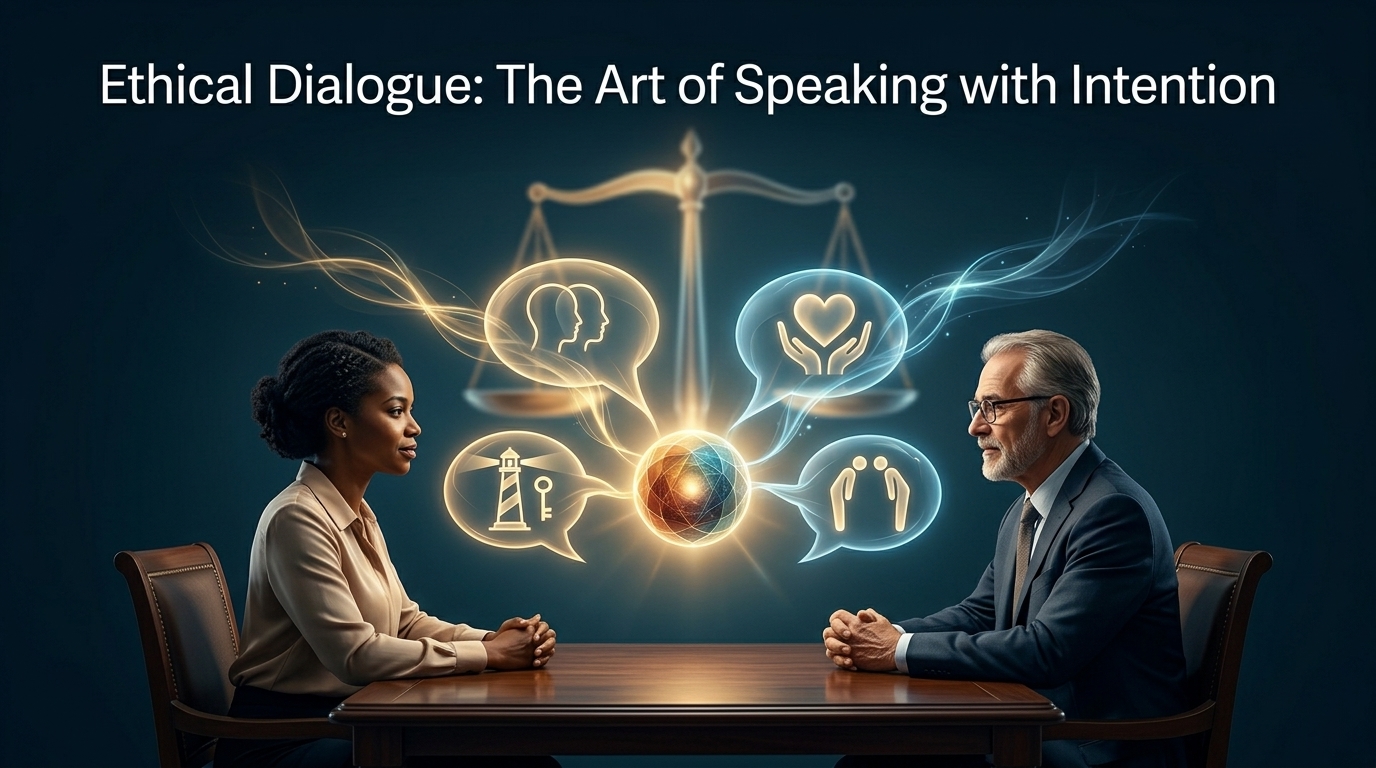
Ethical Dialogue: The Art of Speaking with Intention

A man hasn't spoken for three days, and a negotiator sits across from him. The room is tense. There's someone prepared with an argument. But the video won't miss a beat, because the experienced negotiator doesn't say a word. He waits. And in that conscious absence, a change occurs. The other man begins to speak. No arguing, but explaining. To be understood, not to beat. This is where exchange is real dialogue. Today we are surrounded by words. Communication is ubiquitous, with political speeches, social media threads, television debates, and meetings in offices all being considerable sources of communication. But, as the conversation goes on, there's a disturbing thought: are we really communicating? Is this just a case of taking turns and broadcasting?

This is a significant difference. The mechanical view of communication is the transfer of information from one place to another. Dialogue — in its full ethicalness — is something more challenging and more transformative. It needs to be between two people who are not only listening, but are willing to be changed by what they hear. It is an insight that has been among the most telling in the history of philosophy, one that the German philosopher Martin Buber made. He said that he described two basic ways that people relate: the I–It mode, where individuals treat the other as an object, or an instrument, or an obstacle; and the I–Thou mode in which they treat the other as a person, a whole person, an irreducible and unique, a truly present person. Most of what we do talk to each other, Buber said, is I–It encounters presented in the guise of dialogue. In the real presence but not real availability.

Hans-Georg Gadamer, a twentieth-century author, added one more crucial element. He said, "Dialogue is a 'fusion of horizons': a time when both my way of seeing the world and your way of seeing the world really meet, and a way of seeing the world neither of us had before. This is not a compromise. It is transformation. Both walk out of the discussion having learned something they were unable to learn without the other. Hence, the ethics of dialogue start with a question of intention rather than a rule of what to say. Why am I speaking? Do I speak to win or to dominate or to be competent or to fill silence? Am I speaking in order to bridge the gap between my experience and yours?

The idea of dialogue in Islam known as hiwar has a rich intellectual heritage. The Quran is organized as a dialogic text with arguments, responding to objections, and urging reflection; it does not ask for uncritical acceptance. The Prophet Muhammad (peace be upon him) was known for his ability to listen, then ask and then speak. This is not just a communication strategy! It is a moral and spiritual exercise.

Education is of course a crucial lever for developing this practice. The vast majority of formal education teaches students to give the right answer – to speak the right way, to write the right way, to argue the right way. However, few learning systems instruct pupils to speak with intent. The difference is profound. An educated student is armed. A student who has been trained to have a real conversation is civilized — that's the real meaning of the word.

The impact is far reaching, beyond the classroom. The quality of civic life improves measurably when these public voices speak with purpose; when a politician attempts to dialogue, not as a means to grandstanding, but as a moral act; when a scholar does so to further the good of the community; when a journalist does so to serve her public; when a community leader does so to advance a common good. The differences which could otherwise lead to confrontation are settled in true exchange. Honest discussion is what can melt away misunderstandings that could become prejudice.

On the other hand, an environment where people's discourse is largely characterized by performative language – i.e. a language that aims at humiliating an opponent, motivating a base, and attracting attention rather than providing information – weakens the social trust fabric. This isn't just a cultural note. The political and moral emergency. At the very basic level, the conditions that underlie peaceful coexistence rely on whether the individuals who make up a society can communicate with one another with sincerity. This is very critical in the case of Pakistan and other South Asian countries. Ethnic, linguistic, sectarian, and class diversity is a hallmark of societies and the ability to communicate effectively is essential for peaceful functioning. The other option — dialogue turning into slogan, conversation into declaration — is to the very same sorts of divisions that weaken national unity.

Intentioned speech is no luxury. It's not a philosophical or diplomatic nicety. It's an ethical practice that can be done every day by any person in any conversation. It just takes the sincerity to be present, to be open, and to say what is meant. Over the next 25 articles in this series, we'll explore dialogue from all perspectives — its good and bad qualities, its formal and personal expressions, its ancient origins and its future in digital times. But it all starts here: The act of speaking on purpose, the act of speaking on demand, the act of speaking on revolution.

In your last major conversation, did you actually converse with the individual before you? Or did you talk to the version of them that you already believed that they were?