Top Stories
Building Bridges Through Words Understanding Militant Ideologies in Modern Contexts Security: Beyond Walls and Weapons Upcoming Events: Connecting Ideas and People Previous Milestones: Reflecting on Our Journey Fatwas: Reclaiming the Spirit of Ethical Guidance Role of NATO in Conflict Resolution Washington Peace Deal Between Congo and Rwanda Social Justice and Equality in the Qur’ān: Implications for Global Peace The Qurʾānic Concept of Human Equality: An Analysis against Racism and Ethnic Discrimination in Contemporary Societies Reinterpreting Dhimmitude: A Reconsideration of Its Social and Political Functions in the Modern Context How China Is Playing the Long Economic War Ukraine Peace Efforts Advance Cautiously Despite Partial Alignment Among Parties How Pakistan-Libya Military Relations Strategic Outreach, Economic Stakes and Geopolitical Implications Aleppo Clashes as Syria and Kurdish-Led SDF Agree to Ceasefire Across the Border, Pakistani Ulema Stand Against Afghan Girls\' Education Ban Pakistan announce 500 fully-funded scholarships for Bangladeshi students in 8 programs How theTaliban regime threat for reginal peace Women Left Behind in Khyber Pakhtunkhwa’s Education System Sudan’s Civil War: Anatomy of the World’s Largest Humanitarian Crisis Changing Security Architecture in Central Asia Pakistan Leads India on Economic and Peace Indicators in 2026 : Gallup Survey Submerged Classrooms, Long-Term Learning Loss Pakistan Security Report 2025: Terrorism Trends and the Peace Deficit HEC’s MAKTAB Initiative Signals a New Era for Higher Education Southern Yemen Faces Tensions and Urgent Need for Peace IUT Strengthens Education Integrity in Bangladesh Pakistan’s Arms Sales Contracts (2024–25) and the Peace Dimension Pakistan\'s Contribution to UN Peacekeeping Operations for Global Peace Pakistan Enhances Educational Cooperation with Sri Lanka through Scholarship The Growing Defense and Economic Nexus of the Muslim World Charter of Trump’s Board of Peace Pakistan & Myanmar Prioritize Education Strategic Saudi defense agreements are redefining the Middle East\'s security architecture What would be the consequences of the U.S.–Iran Conflict on Pakistan? How Indian Cricket Politics Affect Regional Peace The Kashmir issue remains a central peace and stability in South Asia American Weapons in Afghanistan Are Destabilizing Pakistan Global Education Coalition sixth annual meeting A New Chapter for Pakistan’s Universities: Leadership, Stability, and Vision under the New HEC Chairman The Evolution of the IMCTC into a Global Security Pillar Reintegration Initiative: Analyzing the 2026 IMCTC Engagement in Pakistan Psychosocial Warfare and the IMCTC Peace Journalists Initiative (2026) The Concept of ‘Ummah’ in the Qurʾān: Transcending Race, Tribe, and Ethnicity HEC Reforms Regulation, Defends Academic Freedom Pakistan’s Evolving Role in Fostering Peace and Security on the African Continent Recontextualizing Pakistan’s Role in the Board of Peace War in the Middle East: Measuring the Cost The Silent Bridge: Pakistan’s Strategic Neutrality and the Quest for Middle Eastern Stability The Geography of Escalation: Living in an Age of Permanent Crisis Mapping the Educational Crisis in the Middle East Conflict The Blind Alley of “Epic Fury”; A War with no End game A Pakistani Voice Against Digital Islamophobia: A Landmark Academic Contribution World Eye on Pakistan for Middle East Peace Leading with Truth, ICEP’s Analysis Outlasted the Skeptics on Middle East Crisis World Powers Push for Deal U.S. Presents 15-Point Plan and Iran Responds with 5 Conditions Pakistan and Türkiye Open New Chapter in Academic Cooperation with Strategic Initiatives Pakistan at the Crossroads of Global Trade as a Logistics Revolution Unfolds Why Ethical Dialogue necessary in a Diverse Pakistan for a Peacebuilding Initiative Pakistan\\\'s Game-Changer Role for World Peace Entrepreneurship Education Is Shaping Pakistan\\\'s Economic Future Dr. Jamil Akhtar Featured in Prestigious Brill Encyclopaedia (2026) A Milestone in Global Interfaith Scholarship Peace Light in a Dark Night WAR RESHAPES PAKISTAN’S ECONOMY AND OPEN DOORS FOR INTERPRENEURS From Gaza to Lebanon: ICC, UN, and the Unanswered Duty to Prosecute Can Pakistan turn a temporary ceasefire into lasting middle east peace? Bridging the Gap: Confronting Education Inequality in Pakistan Hierarchical Culture In Pakistani Organizations \"How It Kills Innovation — and What Leaders Can Do About It\" Can Diplomacy Survive the Iran Crisis? Peace Efforts in an Age of Permanent Escalation Why are Peace Talks a US strategic priority? Features of Intellectual Property in the Age of Artificial Intelligence (In the Context of World Intellectual Property Day) A Global Forum for Peace, Governance, and a Better World (France\'s Landmark Contribution to International Dialogue) IS UAE WANT A \\\'CURRENCY SWAP\\\' WITH THE USA Energy War by Sea: The Hormuz Blockade Proves Oil is Still a Weapon The End of Strategic Dependence In Europe? Pakistan\'s Strategic and Structural Evolution from Crisis to Consolidated World Peace Silent Deterrence: Hangor-Class SSP-2800 and Undersea Strategy of Pakistan Inside the $9 Billion Prediction Market Revolution Pakistan at the Crossroads: Between Fragile Stability and the Weight of Structural Crisis WHY DIALOGUE FAILS IN CONFLICT ZONES; A LESSON FOR POLICY MAKERS The Crisis of American Legitimacy in the Post-Unipolar Era THE OIL CLUB UAE JUST QUIT Inside OPEC’s Biggest Defection in Decades — and What It Means for the World The Kashmir Dispute: International Institutional Failure and Humanitarian Consequences The $100 Billion Event the World Refuses to Understand How is Eid-ul-Adha A School of Peace? 250 Million Children Classrooms Zero Learning Ethical Dialogue: The Art of Speaking with Intention Ethical Dialogue: The Moral Weight of an Honest Word Skills in Their Hands, Books in Their Bags Ethical Dialogue : Honoring the Voice of the Other HEC Honors Top Pakistani Scientists and NRPU Grant Recipients at Punjab University What\'s the 14 Point of Peace deal that will be signed in Geneva When Words Carry Power: The Unequal Conversation Why Humanitarian Crises Gain Attention Only When Politicized : An International Law Perspective The Ethics of Saying Nothing
Education

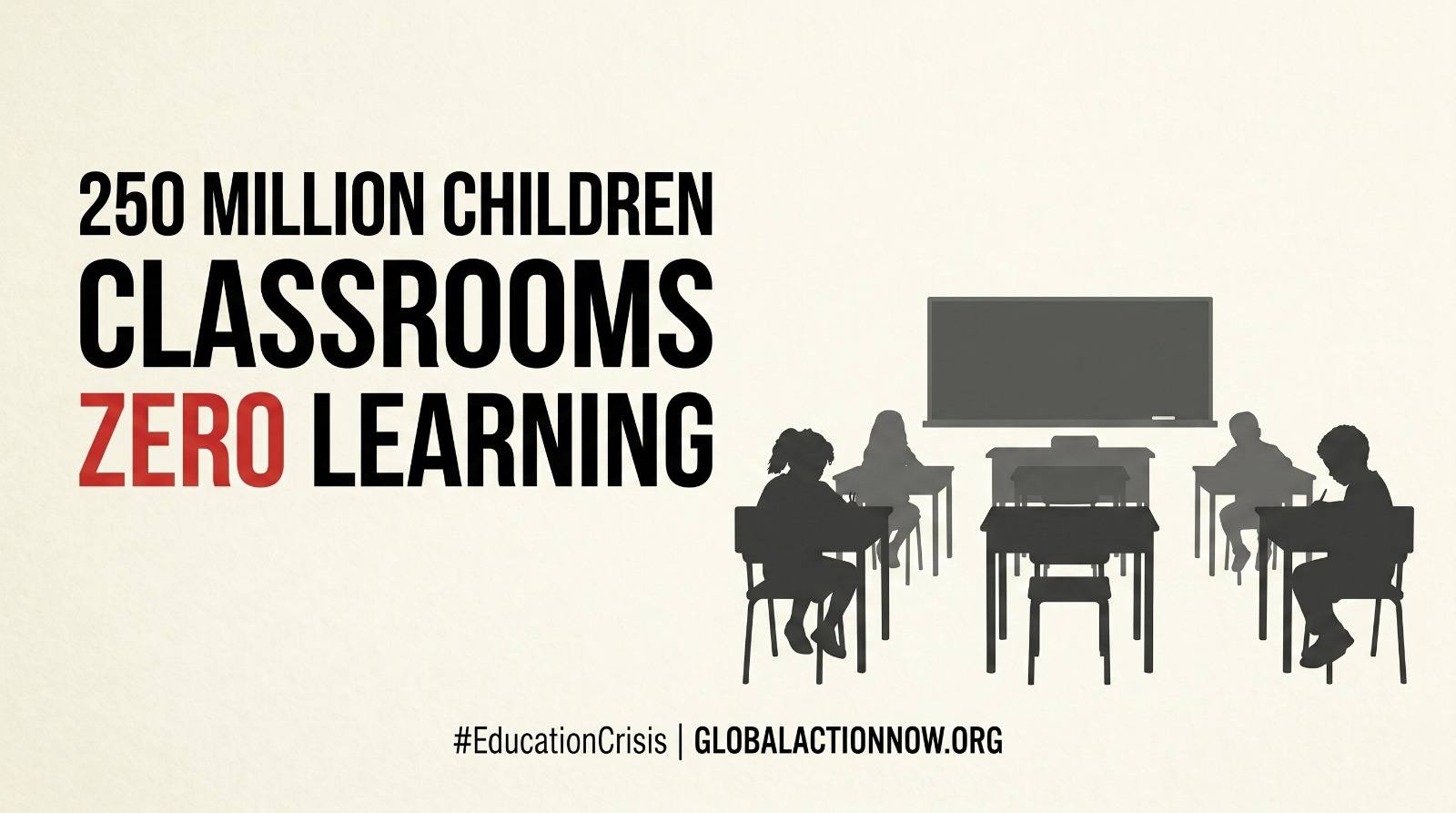
250 Million Children Classrooms Zero Learning

Inside the LEGO Foundation's $200,000 Fellowship — and Why the World's Most Urgent Questions About Children's Learning Are Still Unanswered

There are 250 million children enrolled in schools around the world who cannot read a single sentence. They are not absent. They are sitting in classrooms, in uniform, on time — and learning almost nothing. The world does not have a school-attendance problem. It has a learning problem. And the people best positioned to solve it are researchers who have never had enough time, money, or institutional support to finish the job. The LEGO Foundation has decided to change that.

On May 15, 2026, the LEGO Foundation opened applications for its 2027 Education Research Fellowship — $200,000 over two years for early- and mid-career researchers working on the questions that matter most for children. Applications close July 31, 2026. The fellowship runs 2027 to 2029. The question is not whether this money matters. The question is whether the right people apply.

"The most important education systems in the world are not failing because of a lack of goodwill. They are failing because of a lack of evidence."

— LEGO Foundation Education Research Initiative, 2026

What It Is Actually Offering

Here is how it works. The foundation selects a small cohort of researchers — PhD holders, employed by a university or research institute, doctorate received within the last ten years — and gives them two years of full funding. The four priority areas for 2027 are: inclusive education in conflict and fragile settings; approaches to reducing severe learning inequality; child wellbeing and the social and emotional foundations of learning; and the impact of artificial intelligence on children's development.

The money is real. But the larger offering is freedom — two years without writing grant applications, without justifying the work to committees who do not understand it, without choosing between rigour and speed. For researchers working in the hardest settings on the hardest questions, that freedom is rarer than $200,000.

The Crisis Behind the Fellowship

Nearly half of the world's out-of-school children live in countries affected by conflict. The vast majority of all education research comes from stable, well-resourced classrooms in wealthy countries. That gap — between where the research is done and where the problems are worst — is what the fellowship exists to close. A curriculum improvement that works in Finland tells you almost nothing about what works when the school was a refugee tent last year.

Artificial intelligence has made the urgency sharper. Students in Lagos are using ChatGPT to write essays. Teachers in Jakarta are generating lesson plans with AI tools. The technology arrived in classrooms before anyone had studied what it does to a child who is still learning to think. The fellowship is one of the few funding mechanisms in the world explicitly asking researchers to go find out.

"We are running the largest uncontrolled experiment in the history of childhood development, and we have not agreed on what we are trying to measure."

— Yanna Krupnikov — Stony Brook University

Islamabad Center for Education and Peace

According to the Islamabad Center for Education and Peace (ICEP), the LEGO Foundation Fellowship 2027 represents a critical investment in the kind of research that developing countries most urgently need — but least often produce.

ICEP believes the fellowship's emphasis on conflict-affected settings, educational inequality, and AI's impact on children is directly relevant to Pakistan and the wider region. With more than 22 million out-of-school children, Pakistan has researchers asking precisely these questions. What is missing is not the curiosity. It is the institutional backing to turn that curiosity into findings that reach policymakers.

In the view of ICEP, global fellowships like this one are not supplementary. They are essential. They are how researchers working in the countries most affected by learning crises gain the platform, the time, and the credibility to make their work matter beyond the academic journal it is published in.

The LEGO Foundation has distributed more than one billion dollars to education initiatives since 2017. The Fellowship is where it places its highest-stakes bet — not on programmes or platforms, but on people. Researchers who have the questions. Who are working where the need is real. Who need two years of room to find the answers.

Applications are open. The deadline is July 31, 2026. The work is already waiting.

"When research reaches a child, it has done its job. Until then, it is only paper."

— LEGO Foundation Education Research Fellows Programme, 2026


The LEGO Foundation Fellowship 2027 offers $200,000 over two years to researchers tackling education's hardest problems — inclusion in conflict zones, deep learning inequality, child wellbeing, and AI in classrooms. The fellowship is less a grant than a platform: two years of freedom to produce evidence that can actually reach the systems that need it. For scholars in countries like Pakistan, where the problems are largest and the institutional support thinnest, it is an opportunity that closes on July 31, 2026.