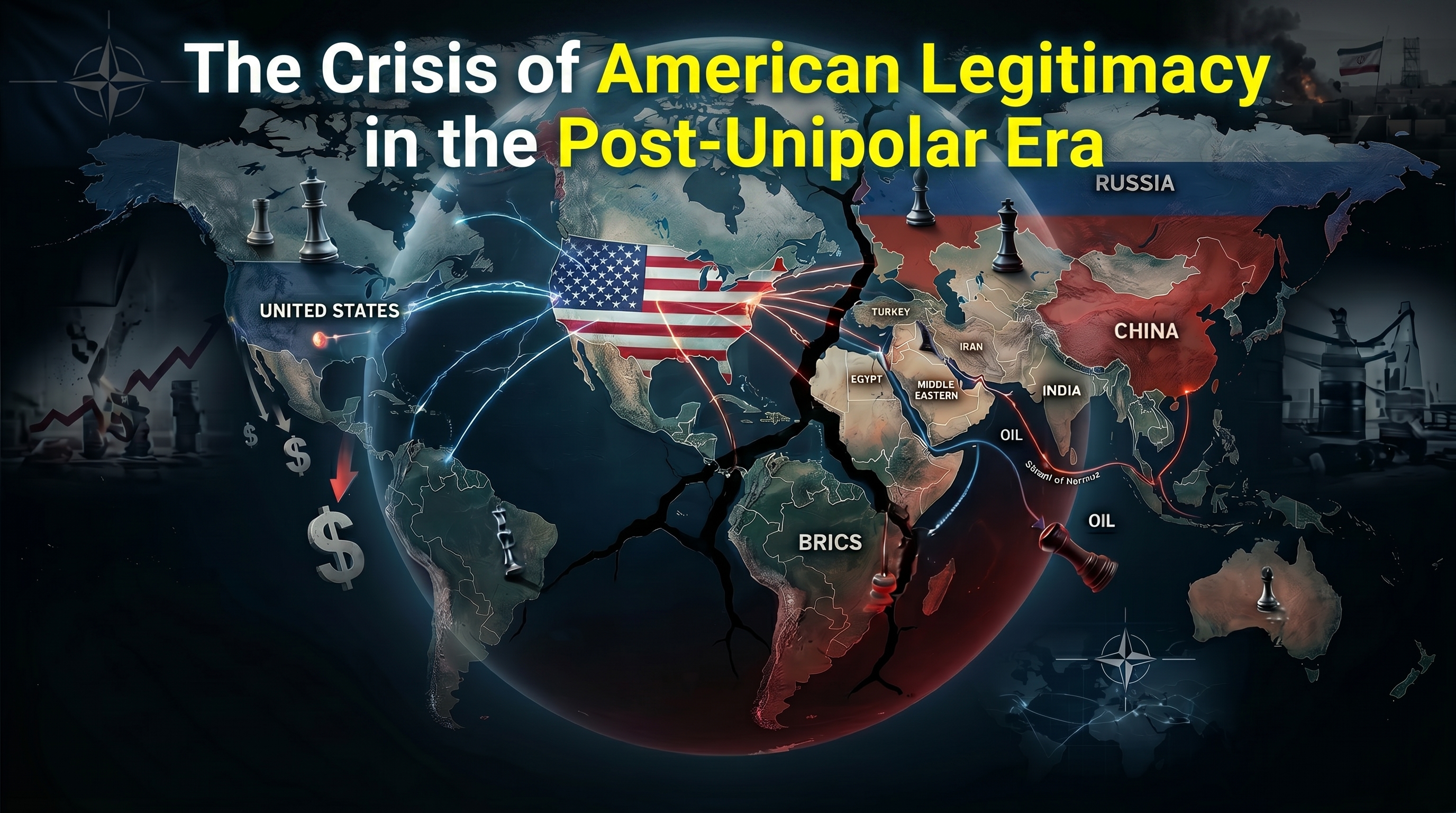

Amid the transitional phase of the world from the
unipolar order led by the US to an increasingly multipolar world, the
US-Israel-Iran war has intensified the doubts over the credibility, leadership,
and legitimacy of the United States. In today’s world, where the influence of a
state depends mainly on attraction rather than coercion, the soft power of the
US is increasingly eroding at a time when it is needed the most, as the global
opinion shifts due to double standards, hypocrisy, and unilateral actions of
the US. While the rising powers seek to assert themselves and the traditional
allies re-evaluate their alignment, the US's declining soft power not only
calls into question its moral authority but also challenges its ability to lead
in a world that is no longer unipolar.
Soft power, a concept coined by Joseph
Nye,
derives from a state’s culture, ideology, and foreign policy. Following WWII,
the foreign policy of the US was largely shaped by the emerging neoliberal
order, which promoted democracy, human rights, and liberal values. This vision
appealed globally and provided Washington with a legitimate rivalry foundation
with the USSR during the Cold War. After the collapse of the Soviet Union in
1991, Washington justified its intervention in Afghanistan in 2001 and Iraq in
2003 under the banner of ‘war on terrorism’. However, in the contemporary era,
the US clearly lacks a widely accepted justification for its actions that are
against international norms and laws, fostering mistrust among its Middle East
and European allies, and diminishing the weight of its voice in future
international discourse.
In the current era, the United States seems to be
caught between strategic withdrawal and continued global interventions. Though
the National
Security Strategy 2025 acknowledged the prolonged military
commitments of the US as a reason for its domestic weakening, and called for
prioritizing the US’s national borders, economic and industrial growth, the US's
continued intervention in the Iran-Israel war explicitly contradicts the stated
restraint and the actual policy behavior. This inconsistency uncovers Trump’s
weak long-term planning and a tendency to achieve immediate political gains,
rather than a sustained strategic vision. This unpredictability raises a
question among its allies: if strategy changes with time and pressure, can it
still guide a superpower?
This framework must be seen through Robert Keohane’s
theory of after
hegemony, according to which even
when a superpower persists materially, its ability to structure consent
declines once its institutional legitimacy weakens. This is precisely what is
visible today, i.e., the US’s leadership is merely accepted now out of
necessity, not attraction. This is evident from BRICS expansion, Saudi Arabia’s
simultaneous engagement with Washington, Beijing, and Moscow, and Europe’s pursuit
of its strategic autonomy. This risks the international system being in a
‘systematic drift’ where order is replaced by managed instability. In this way,
the US’s leadership no longer operates by default, but as an option among many
in the global market of fragmented power, which can soon be replaced.
In the Iran-Israel war, the United States is facing an
unintentional but self-created strategic dilemma. The main purpose of the war was
to demolish Iran’s nuclear capabilities, but it turned out to be the demise of
the US-led global order. The initial stage of war exposed the fragility of its
security guarantees among NATO and Middle Eastern allies. At the same time, the
accelerating geo-economic shift, particularly de-dollarization, and alternative
currency arrangements (Petro yuan) at choke points like the Strait of Hormuz,
pose serious challenges to the dollar's reserve currency status, a main
structural pillar of the US. In this context, the Strait of Hormuz -not Iran’s
nuclear program- is becoming a final litmus test for the US’s hegemonic durability,
creating a space where even partial loss of control would signal not just a
global setback but the complete erosion of the US’s soft power.
In the contemporary international system, superpower
status is increasingly determined not by coercive power alone but by the
ability to sustain trust with middle powers and the Global South. In this way,
the legitimacy, soft power, and influence are now shaped by the broader range
of actors that shape the outcomes through alignment, geographical importance,
and interdependence. In this context, the United States has lost its
credibility and trust among the middle powers and has given leverage to China
to capitalize on this, and has allowed Beijing to position itself as a more
reliable partner through its non-intervention posture, as states now
increasingly evaluate power not through military capabilities, but through
economic utility and policy consistency. In this sense, the future hierarchy of
global influence hinges more on the soft power factor, mainly among the global
South and middle powers, which now shape the systemic legitimacy.
The erosion of soft power doesn’t remain confined to
Washington alone; it is gradually restructuring the broader architecture of the
global system into a more fragmented order. While there’s a shift from
rule-based order towards the interest-driven bargain, the institutions are
losing their legitimacy, which allows the states to do selective compliance. This
makes alliances more transactional, commitments more conditional, and
international norms more flexible than binding. It will eventually result in a
diffused authority rather than an orderly transition, where no single actor
possesses the potential to universalize its vision of order. This system will
drift towards a managed instability rather than cohesive leadership.
_6784.jpg)