
If the second US – IRAN
dialogue too fails, what comes next? Dialogue has come forth as an important terminology in global politics,
as the international community increasingly identifies its value as a conflict
resolution method. Dialogue is a tool for initiating change and a means of maintaining
order and stability. The United Nations
has championed dialogue, designating 2001 as the "Year of Civilizational
Dialogue," with then-Secretary-General Kofi Annan emphasizing its
importance for achieving lasting peace and prosperity.
Dialogue isn’t designed for all
circumstances and it isn’t just about talk. It can often lead to transformative
actions. However rather than resolving conflicts, many dialogues merely
manage them temporarily, postponing the phase of stability. Between 1946 and
2005 only 13.5 percent of formal conflicts ended in a peace agreement. The
repeated collapse of peace efforts from DOHA TALKS to OSLO ACCORDS exhibits
that failure is not accidental but structural.
Dialogue often fails not because of its irrelevance
but due to structural, political and psychological barriers that policy makers
consistently underestimate.
IR theories have varying views about failure of
dialogue. Realists view dialogue as a zero-sum game especially in situations of
power disparity, thus resulting in failure. Constructivists argue that the lack
of common perception of social reality leads to failure of dialogue between
rival nations. On the contrary liberals believe in dialogue through
institutions but the failure of dialogue can also be caused due to weak
institutions or economic interdependence misused as leverage. With regard to
fundamentals a dialogic approach to IR often fails.
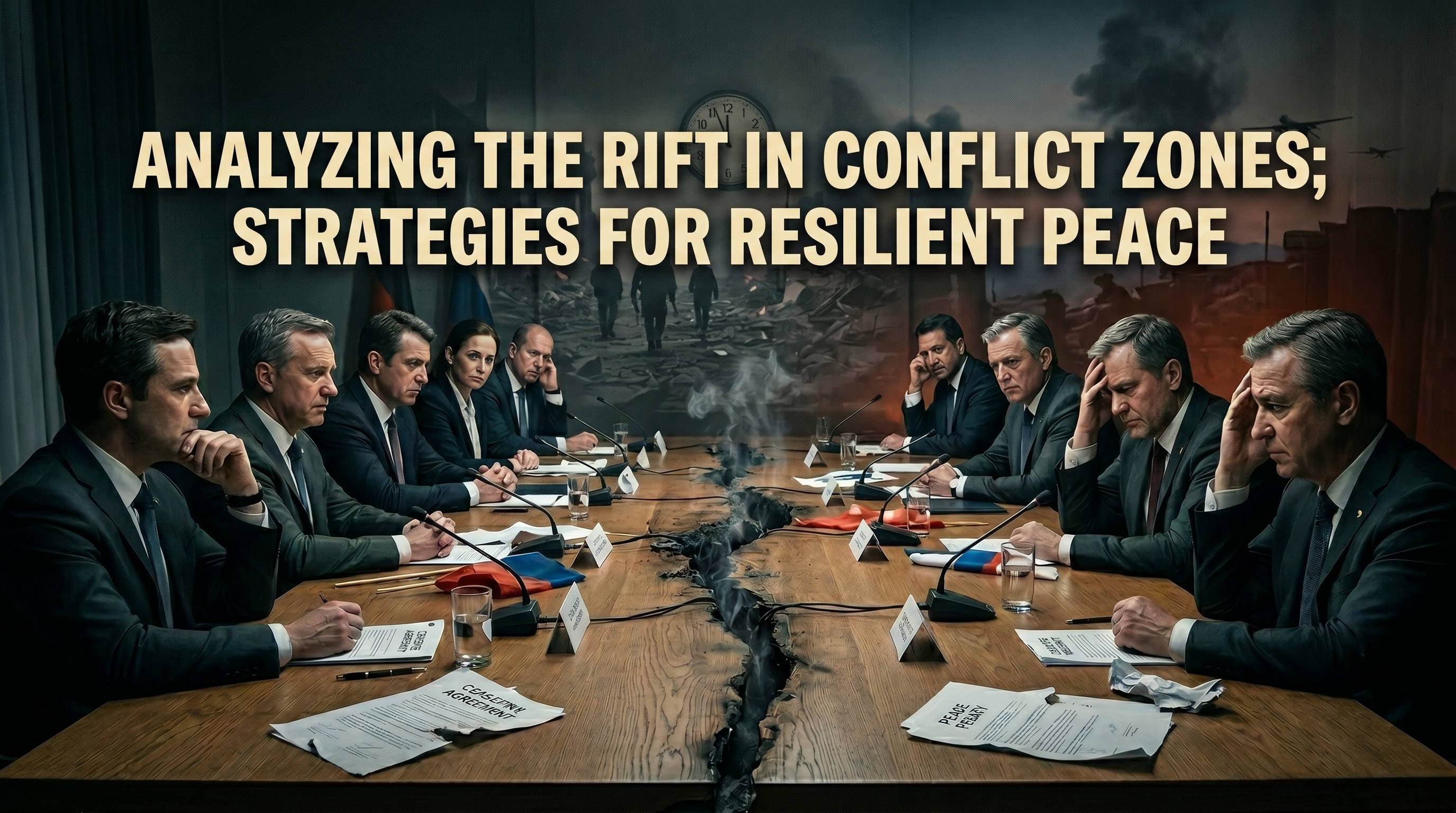
Why do intra-state peace negotiations seem to fail so often? The
recurring failure of dialogue in conflict zones is not by chance. It displays a
set of constraints that continuously undermine peace processes. In order to
seek sustainable solutions the policy makers have to understand the ongoing
dynamics at the background. A closer examination reveals the patterns of
failure emerge in a repeated manner. A central reason for failure of dialogues
in conflict zones is the asymmetry of power among rival states. The stronger
state doesn’t feel the urge to make a peace deal and dialogue becomes a forced
participation for the weak one. Lack of relative balance leads to failure of
dialogue. The ongoing trend of multi-polarity creates a multi-layered struggle
causing difficulty to find a unified partner for negotiation. This proliferation
leads to development of mistrust; negotiations are viewed with suspicion with
actors doubting the intentions. Furthermore the absence of credible enforcement
weakens the application of peace treaty in practical world. Dialogues in the
presence of spoilers – actors who benefit from conflict, not peace are already
a fragile matter. Equally significant is the lack of inclusivity and exclusion
of stakeholders, making the dialogue unstable. Peace talks being used as a tool
for weaponization as in the case of ISREAL – GAZA conflict is an open threat to
the complete peace process. Along with this the sole focus on peripheral issues
can never eliminate the root cause, giving rise to conflict in the future as
well as the meantime. Taken together these factors clarify that the failure of
dialogue is rarely incidental.
In 2014, Yemen was
referred to as one of the success stories of the Arab Spring, today, it is
dubbed “the world’s newest failed state”. The
conflict in YEMEN provides a complete scenario of repeated dialogue failures.
Experts say that the transitional process failed due to gap in policymakers
understanding of YEMEN. Applying the pre-conditions, all the dialogues between
1962 and 2013 have only interrupted rather than ended civil war in Yemen.
Efforts such as STOCKHOLM AGGREEMNT were aimed to establish a ceasefire but
couldn’t produce lasting peace. A key reason was the distorted nature of conflict
involving multiple spoiler actors. The absence of strong enforcement weakened
conformity. External involvement turned the conflict into war. These factors
combined with mistrust and lack of cohesion made sure that the dialogue remains
ineffective.
As seen in Yemen the failure of dialogue has metamorphosed war into a
humanitarian crises. The inability of peace processes to succeed showcases the
consequences; the war may resume or even intensify leading to continued
suffering making it harder to initiate the peace process again. It results in
the benefit of spoilers and the conflict spilling to a global level.
The perennial failure of table talks offers critical lessons for
policymakers. The existing approaches to peacebuilding must be re-observed. Parties cannot negotiate
what they refuse to acknowledge exists. Mutual recognition does not require agreement. It demands
acknowledgment that the other side holds views sincerely. The credible
commitment mechanisms must be looked over; parties that have been betrayed
before, enter new negotiations expecting deception. Violence must be treated as
a symptom and the treaty should focus on addressing the root causes. Exclusive
processes create spoilers so inclusive design, hearing of marginalized voices
and bridging the gap between elites and
the bottom-up must be kept in sight.
The challenge is not to abandon dialogue but to transform it. For policymakers the imperative is clear. Eventually the dialogue in conflict zones cannot make the grade in the absence of inclusivity, deep-rooted trust and genuine participation. Without these it will be a tool to sustain conflict, rather than resolving it – a lesson the policymakers can no longer ignore.


_6784.jpg)