Top Stories
Building Bridges Through Words Understanding Militant Ideologies in Modern Contexts Security: Beyond Walls and Weapons Upcoming Events: Connecting Ideas and People Previous Milestones: Reflecting on Our Journey Fatwas: Reclaiming the Spirit of Ethical Guidance Role of NATO in Conflict Resolution Washington Peace Deal Between Congo and Rwanda Social Justice and Equality in the Qur’ān: Implications for Global Peace The Qurʾānic Concept of Human Equality: An Analysis against Racism and Ethnic Discrimination in Contemporary Societies Reinterpreting Dhimmitude: A Reconsideration of Its Social and Political Functions in the Modern Context How China Is Playing the Long Economic War Ukraine Peace Efforts Advance Cautiously Despite Partial Alignment Among Parties How Pakistan-Libya Military Relations Strategic Outreach, Economic Stakes and Geopolitical Implications Aleppo Clashes as Syria and Kurdish-Led SDF Agree to Ceasefire Across the Border, Pakistani Ulema Stand Against Afghan Girls\' Education Ban Pakistan announce 500 fully-funded scholarships for Bangladeshi students in 8 programs How theTaliban regime threat for reginal peace Women Left Behind in Khyber Pakhtunkhwa’s Education System Sudan’s Civil War: Anatomy of the World’s Largest Humanitarian Crisis Changing Security Architecture in Central Asia Pakistan Leads India on Economic and Peace Indicators in 2026 : Gallup Survey Submerged Classrooms, Long-Term Learning Loss Pakistan Security Report 2025: Terrorism Trends and the Peace Deficit HEC’s MAKTAB Initiative Signals a New Era for Higher Education Southern Yemen Faces Tensions and Urgent Need for Peace IUT Strengthens Education Integrity in Bangladesh Pakistan’s Arms Sales Contracts (2024–25) and the Peace Dimension Pakistan\'s Contribution to UN Peacekeeping Operations for Global Peace Pakistan Enhances Educational Cooperation with Sri Lanka through Scholarship The Growing Defense and Economic Nexus of the Muslim World Charter of Trump’s Board of Peace Pakistan & Myanmar Prioritize Education Strategic Saudi defense agreements are redefining the Middle East\'s security architecture What would be the consequences of the U.S.–Iran Conflict on Pakistan? How Indian Cricket Politics Affect Regional Peace The Kashmir issue remains a central peace and stability in South Asia American Weapons in Afghanistan Are Destabilizing Pakistan Global Education Coalition sixth annual meeting A New Chapter for Pakistan’s Universities: Leadership, Stability, and Vision under the New HEC Chairman The Evolution of the IMCTC into a Global Security Pillar Reintegration Initiative: Analyzing the 2026 IMCTC Engagement in Pakistan Psychosocial Warfare and the IMCTC Peace Journalists Initiative (2026) The Concept of ‘Ummah’ in the Qurʾān: Transcending Race, Tribe, and Ethnicity HEC Reforms Regulation, Defends Academic Freedom Pakistan’s Evolving Role in Fostering Peace and Security on the African Continent Recontextualizing Pakistan’s Role in the Board of Peace War in the Middle East: Measuring the Cost The Silent Bridge: Pakistan’s Strategic Neutrality and the Quest for Middle Eastern Stability The Geography of Escalation: Living in an Age of Permanent Crisis Mapping the Educational Crisis in the Middle East Conflict The Blind Alley of “Epic Fury”; A War with no End game A Pakistani Voice Against Digital Islamophobia: A Landmark Academic Contribution World Eye on Pakistan for Middle East Peace Leading with Truth, ICEP’s Analysis Outlasted the Skeptics on Middle East Crisis World Powers Push for Deal U.S. Presents 15-Point Plan and Iran Responds with 5 Conditions Pakistan and Türkiye Open New Chapter in Academic Cooperation with Strategic Initiatives Pakistan at the Crossroads of Global Trade as a Logistics Revolution Unfolds Why Ethical Dialogue necessary in a Diverse Pakistan for a Peacebuilding Initiative Pakistan\\\'s Game-Changer Role for World Peace Entrepreneurship Education Is Shaping Pakistan\'s Economic Future Dr. Jamil Akhtar Featured in Prestigious Brill Encyclopaedia (2026) A Milestone in Global Interfaith Scholarship Peace Light in a Dark Night WAR RESHAPES PAKISTAN’S ECONOMY AND OPEN DOORS FOR INTERPRENEURS From Gaza to Lebanon: ICC, UN, and the Unanswered Duty to Prosecute Can Pakistan turn a temporary ceasefire into lasting middle east peace? Bridging the Gap: Confronting Education Inequality in Pakistan Hierarchical Culture In Pakistani Organizations \"How It Kills Innovation — and What Leaders Can Do About It\" Can Diplomacy Survive the Iran Crisis? Peace Efforts in an Age of Permanent Escalation Why are Peace Talks a US strategic priority? Features of Intellectual Property in the Age of Artificial Intelligence (In the Context of World Intellectual Property Day) A Global Forum for Peace, Governance, and a Better World (France\'s Landmark Contribution to International Dialogue) IS UAE WANT A \\\'CURRENCY SWAP\\\' WITH THE USA Energy War by Sea: The Hormuz Blockade Proves Oil is Still a Weapon The End of Strategic Dependence In Europe? Pakistan\'s Strategic and Structural Evolution from Crisis to Consolidated World Peace Silent Deterrence: Hangor-Class SSP-2800 and Undersea Strategy of Pakistan Inside the $9 Billion Prediction Market Revolution Pakistan at the Crossroads: Between Fragile Stability and the Weight of Structural Crisis WHY DIALOGUE FAILS IN CONFLICT ZONES; A LESSON FOR POLICY MAKERS The Crisis of American Legitimacy in the Post-Unipolar Era THE OIL CLUB UAE JUST QUIT Inside OPEC’s Biggest Defection in Decades — and What It Means for the World The Kashmir Dispute: International Institutional Failure and Humanitarian Consequences
Dialogue

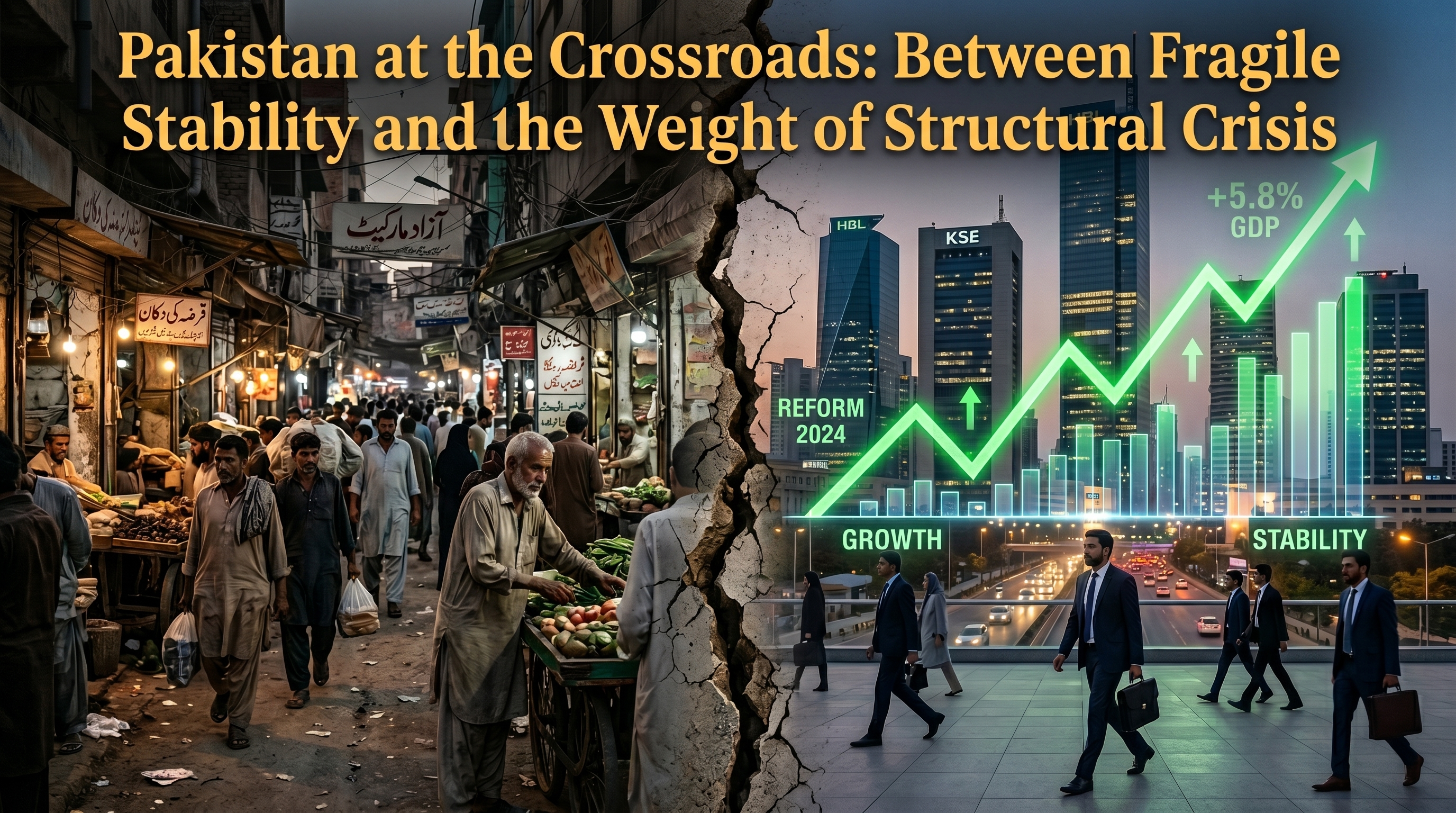
Pakistan at the Crossroads: Between Fragile Stability and the Weight of Structural Crisis

Presently, Pakistan is at a turning point in its economic history; how it resolves this current crisis will shape the future of its economy. Years of mismanaged economic and regulatory policies, overreliance on borrowing/debt, and weak implementation have caused Pakistan's economy to enter this crisis. According to the World Bank "Reclaiming Momentum Towards Prosperity" report, it is estimated that the Poverty rate will rise from 21.9% in 2018-19 and to 25.3% in 2024-25 — an increase of close to 13 million individuals living below the international poverty line. The three leading contributing factors to this increase include COVID-19, the impact of the unprecedented floods in 2022, and economic instability.

Pakistan's cumulative foreign debt stood at $134.5 billion by the end of September 2025, which is an increase of $3.5 billion in comparison to the external debt reported in the prior article of $131 billion. Pakistan's external debt service target for the 2025 fiscal year was $26 billion.

On the subject of inflation, the Pakistan Bureau of Statistics (PBS) reported that inflation decreased from its peak of 38% in May 2023 to 0.3% in April 2025. In addition, the latest inflation figure has increased to 7.3% as of March 2026, which is the highest since August 2024 and is outside of the SBP’s targeted inflation range of 5%-7%. Rising transportation costs, as well as increased electricity and gas prices, have contributed to this increase.

The employment situation is concerning as well. Per the World Bank, more than 85% of jobs held in Pakistan are "informal," meaning that they do not have any formal employer-employee relationship (for example, contract or trade union). Women and youth comprise a significant portion of the excluded workforce. The good news about remittances is that according to recent data from the State Bank of Pakistan, remittances set an all-time high of $38.3 billion (about $10.5 billion higher than the previous year) from fiscal year 2024-25, representing a substantial 27% increase from $30.25 billion the previous fiscal year. This amount exceeds all of Pakistan's exports combined for the entire last year and is now the most significant source of foreign exchange for the country.

The International Monetary Fund reports that the value of the Pakistan economy will have increased by 3.1% by 2025, making it impossible to provide enough jobs for the 255 million people living in Pakistan because no more than 3.1% should be generated from GDP growth. According to the World Bank, since there has been slow and unequal structural transformation in Pakistan, it has prevented job creation, creating new industries, and increasing productivity.

The International Monetary Fund (IMF) has successfully negotiated a staff-level agreement with Pakistan as of March 2026 to conduct the third review of the US$7 billion Extended Fund Facility (EFF). A total of US$1.2 billion will be disbursed under this agreement. Pakistan has reached its highest current account surplus in 22 years due to combined remittances and the IME's Extended Fund Facility (EFF) programme; thus, the country has experienced a stable exchange rate, improved foreign reserves and an improved fiscal balance.

Per the World Bank, Pakistan's history of weak policymaking and institutions has limited and consistently limited its potential for economic growth. While periods of economic growth occurred, they were extremely short-lived and unstable; this is largely attributable to their reliance on unsustainable debt levels or external sources of funding. Unless the tax base (which generates revenue for the government) is expanded; there are substantial increases in exports in real terms; and corruption is eliminated, there is little opportunity for Pakistan's economic success to be sustained over time.


Disclaimer: The views expressed in this article are solely those of the author and do not necessarily reflect the position of ICEP.