
Concentrate on
deterrence, survivability and regional naval competition.
The
South Asian strategic environment is increasingly being extended to the
maritime domain where underwater capabilities are increasingly becoming the key
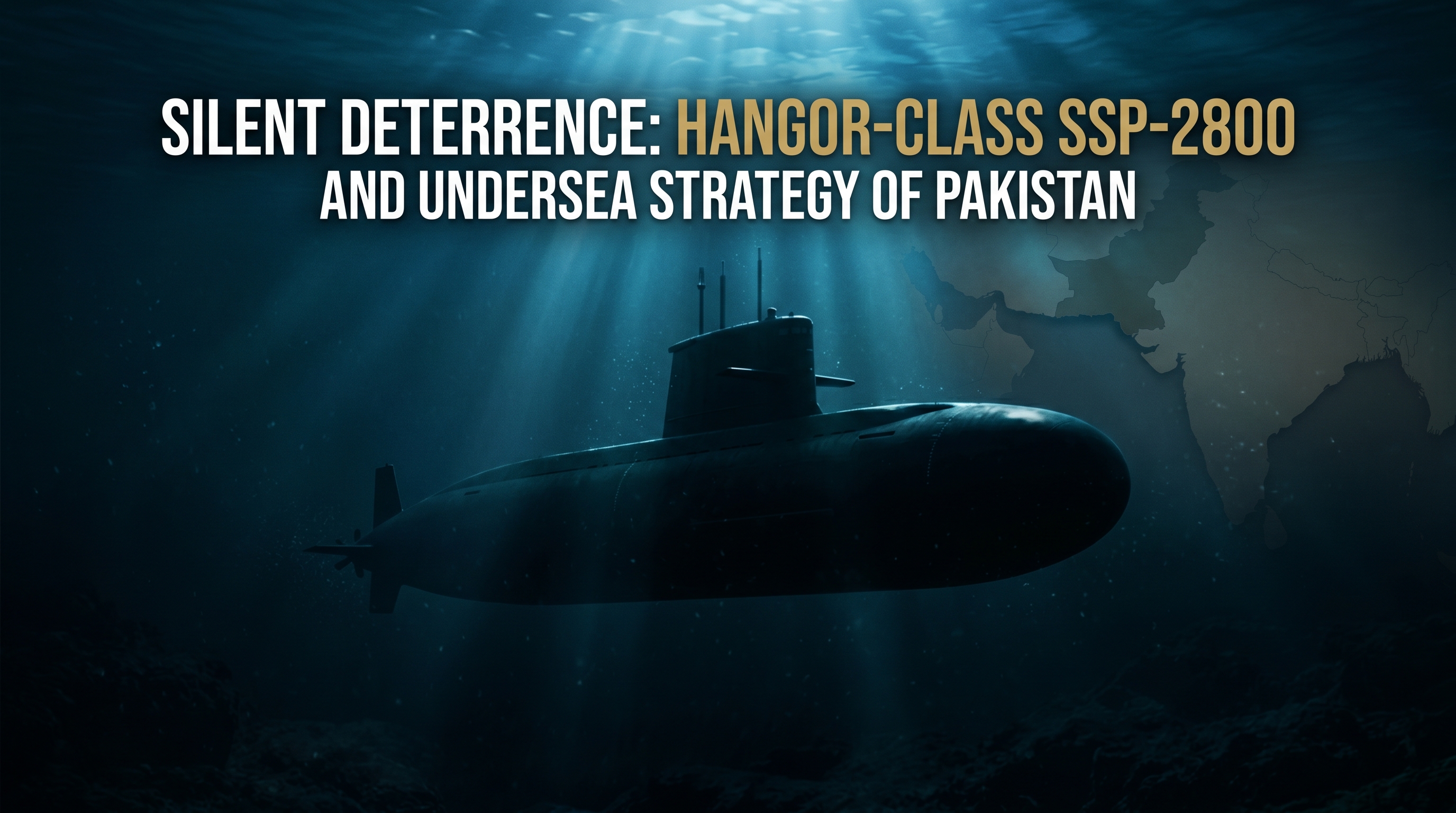
in shaping deterrence and security politics. In this respect, the development
of the Hangor-class SSP-2800 submarines by Pakistan is a limited step towards
improving its undersea capabilities rather than the conventional development of
its naval capabilities. The modern concept of deterrence and survivability is
centered on submarines instead of visible military platforms that operate on
the principle of stealth and ambiguity. This is a move to enhance the
second-strike capability, complicate the enemy planning as well as maintain the
balance of strategic capabilities in the Indian Ocean region, where the rivalry
among the navies is evolving.
Deterrence
is a concept that has been of great interest in strategic studies particularly
in regions where there are long-term rivalries. The availability of military
capabilities is not only important but also the perception and decision-making
of the potential adversaries is based on these capabilities. To some degree,
submarines are advantaged in this respect because they can remain undetected
during a long period of time. This creates uncertainty, which is one of the key
elements of credible deterrence. The analytic work of such organizations as the
UNIDR (United Nations Institute of Disarmament Research) emphasizes that
sea-based capabilities can be used to strengthen deterrence by surviving and
keeping the option of retaliation in the worst conditions. In this way, the
implementation of the Hangor-class submarines assists in possessing a stronger
deterrence stance, since it will be less vulnerable to preemptive
measures.
At
the same time, the notion of survivability has become an element of the
contemporary military approach, particularly in the sea. The problem of the
naval forces has been augmented by the development of surveillance systems,
including satellite systems, and anti-submarine warfare systems. However,
submarines still have a certain level of operational flexibility that can
barely be compared with surface platforms. They may be applied in the contested
environments since they can be strategic and cannot be detected by their
ability to work below the surface. Reporting and analysis by leading media
houses such as Al Jazeera and defense oriented think tanks have found that
undersea platforms have become a promising way of maintaining a strategic
balance especially in those states that have to contend with technologically
advanced opponents. The increasing Indian maritime power like aircraft
carriers, nuclear-powered submarines and advanced reconnaissance systems have
contributed to the balance in the Indian ocean. This has been shifting and this
has led to the question whether there will be increased competition at sea.
However, this issue can be addressed through critical moderation. New
acquisitions can be a component of the competitive process, but they can also
be stabilizing since they can enhance deterrence. In the event that the
opposing states have feasible retaliation capabilities, research by
institutions such as the Stockholm International Peace Research Institute
indicates that the possibility of direct conflict may diminish due to the exorbitant
escalation costs.
Further,
the Hangor-class program belongs to a bigger program by Pakistan to develop its
defense production and technology foundation. The local aspects of construction
and technological transfer that are involved in this program suggest a long
term approach in modernizing the navy. This follows the global trends whereby
states are seeking to become more self-reliant in their strategic sectors of
defense, yet they still maintain selective international relationships.
Nevertheless, the accumulation of domestic experience over time could be one of
the reasons why naval capabilities could become more sustainable in the future
to continue and modernize them.
The
maritime realm is an important component of the economic stability and global
trade, besides the traditional security issues. The Indian Ocean is a major
route to international trade particularly in the energy deliveries. The safety
of these sea routes is therefore a national and international issue. Despite
being primarily associated with deterring, submarines can also be deployed to
promote maritime security by providing surveillance and protection of the major
maritime routes against threats. International bodies and maritime security
studies tend to cite the need to have competent naval forces to help in
ensuring stability in such strategic areas.
Despite these advantages, the general impacts of military modernization,
particularly in the developing countries, must be considered. Pakistan, like
most other states has economic and social problems that require resourceful
allocation of resources. Other organizations such as Amnesty International and
Human Rights Watch have also come up with reports that point out that there is
need to balance human development and governance with defense spending. Despite
the legitimacy of the state agenda of increasing security capacities, the
long-term stability is also anchored on the necessity to consider
socio-economic needs and sustainable development.
In
conclusion, the introduction of the Hangor-class SSP-2800 submarines is a
significant pointer in the evolving undersea policy of Pakistan. These
platforms exhibit a more nuanced approach to security in the maritime domain by
enhancing deterrence, survivability, and contributing to the balance in the
area. At the same time, they are to be viewed in a broader context that
includes regional competition, economic reality and dynamism of warfare. As the
Indian Ocean continues to be strategically important, undersea capabilities
will be at the core of the strategy, and innovations such as this one will be
relevant and significant.

_6784.jpg)