Top Stories
Building Bridges Through Words Understanding Militant Ideologies in Modern Contexts Security: Beyond Walls and Weapons Upcoming Events: Connecting Ideas and People Previous Milestones: Reflecting on Our Journey Fatwas: Reclaiming the Spirit of Ethical Guidance Role of NATO in Conflict Resolution Washington Peace Deal Between Congo and Rwanda Social Justice and Equality in the Qur’ān: Implications for Global Peace The Qurʾānic Concept of Human Equality: An Analysis against Racism and Ethnic Discrimination in Contemporary Societies Reinterpreting Dhimmitude: A Reconsideration of Its Social and Political Functions in the Modern Context How China Is Playing the Long Economic War Ukraine Peace Efforts Advance Cautiously Despite Partial Alignment Among Parties How Pakistan-Libya Military Relations Strategic Outreach, Economic Stakes and Geopolitical Implications Aleppo Clashes as Syria and Kurdish-Led SDF Agree to Ceasefire Across the Border, Pakistani Ulema Stand Against Afghan Girls\' Education Ban Pakistan announce 500 fully-funded scholarships for Bangladeshi students in 8 programs How theTaliban regime threat for reginal peace Women Left Behind in Khyber Pakhtunkhwa’s Education System Sudan’s Civil War: Anatomy of the World’s Largest Humanitarian Crisis Changing Security Architecture in Central Asia Pakistan Leads India on Economic and Peace Indicators in 2026 : Gallup Survey Submerged Classrooms, Long-Term Learning Loss Pakistan Security Report 2025: Terrorism Trends and the Peace Deficit HEC’s MAKTAB Initiative Signals a New Era for Higher Education Southern Yemen Faces Tensions and Urgent Need for Peace IUT Strengthens Education Integrity in Bangladesh Pakistan’s Arms Sales Contracts (2024–25) and the Peace Dimension Pakistan\'s Contribution to UN Peacekeeping Operations for Global Peace Pakistan Enhances Educational Cooperation with Sri Lanka through Scholarship The Growing Defense and Economic Nexus of the Muslim World Charter of Trump’s Board of Peace Pakistan & Myanmar Prioritize Education Strategic Saudi defense agreements are redefining the Middle East\'s security architecture What would be the consequences of the U.S.–Iran Conflict on Pakistan? How Indian Cricket Politics Affect Regional Peace The Kashmir issue remains a central peace and stability in South Asia American Weapons in Afghanistan Are Destabilizing Pakistan Global Education Coalition sixth annual meeting A New Chapter for Pakistan’s Universities: Leadership, Stability, and Vision under the New HEC Chairman The Evolution of the IMCTC into a Global Security Pillar Reintegration Initiative: Analyzing the 2026 IMCTC Engagement in Pakistan Psychosocial Warfare and the IMCTC Peace Journalists Initiative (2026) The Concept of ‘Ummah’ in the Qurʾān: Transcending Race, Tribe, and Ethnicity HEC Reforms Regulation, Defends Academic Freedom Pakistan’s Evolving Role in Fostering Peace and Security on the African Continent Recontextualizing Pakistan’s Role in the Board of Peace War in the Middle East: Measuring the Cost The Silent Bridge: Pakistan’s Strategic Neutrality and the Quest for Middle Eastern Stability The Geography of Escalation: Living in an Age of Permanent Crisis Mapping the Educational Crisis in the Middle East Conflict The Blind Alley of “Epic Fury”; A War with no End game A Pakistani Voice Against Digital Islamophobia: A Landmark Academic Contribution World Eye on Pakistan for Middle East Peace Leading with Truth, ICEP’s Analysis Outlasted the Skeptics on Middle East Crisis World Powers Push for Deal U.S. Presents 15-Point Plan and Iran Responds with 5 Conditions Pakistan and Türkiye Open New Chapter in Academic Cooperation with Strategic Initiatives Pakistan at the Crossroads of Global Trade as a Logistics Revolution Unfolds Why Ethical Dialogue necessary in a Diverse Pakistan for a Peacebuilding Initiative Pakistan\\\'s Game-Changer Role for World Peace Entrepreneurship Education Is Shaping Pakistan\'s Economic Future Dr. Jamil Akhtar Featured in Prestigious Brill Encyclopaedia (2026) A Milestone in Global Interfaith Scholarship Peace Light in a Dark Night WAR RESHAPES PAKISTAN’S ECONOMY AND OPEN DOORS FOR INTERPRENEURS From Gaza to Lebanon: ICC, UN, and the Unanswered Duty to Prosecute Can Pakistan turn a temporary ceasefire into lasting middle east peace? Bridging the Gap: Confronting Education Inequality in Pakistan Hierarchical Culture In Pakistani Organizations \"How It Kills Innovation — and What Leaders Can Do About It\" Can Diplomacy Survive the Iran Crisis? Peace Efforts in an Age of Permanent Escalation Why are Peace Talks a US strategic priority? Features of Intellectual Property in the Age of Artificial Intelligence (In the Context of World Intellectual Property Day) A Global Forum for Peace, Governance, and a Better World (France\'s Landmark Contribution to International Dialogue) IS UAE WANT A \\\'CURRENCY SWAP\\\' WITH THE USA
Upcoming

IS UAE WANT A \\\'CURRENCY SWAP\\\' WITH THE USA

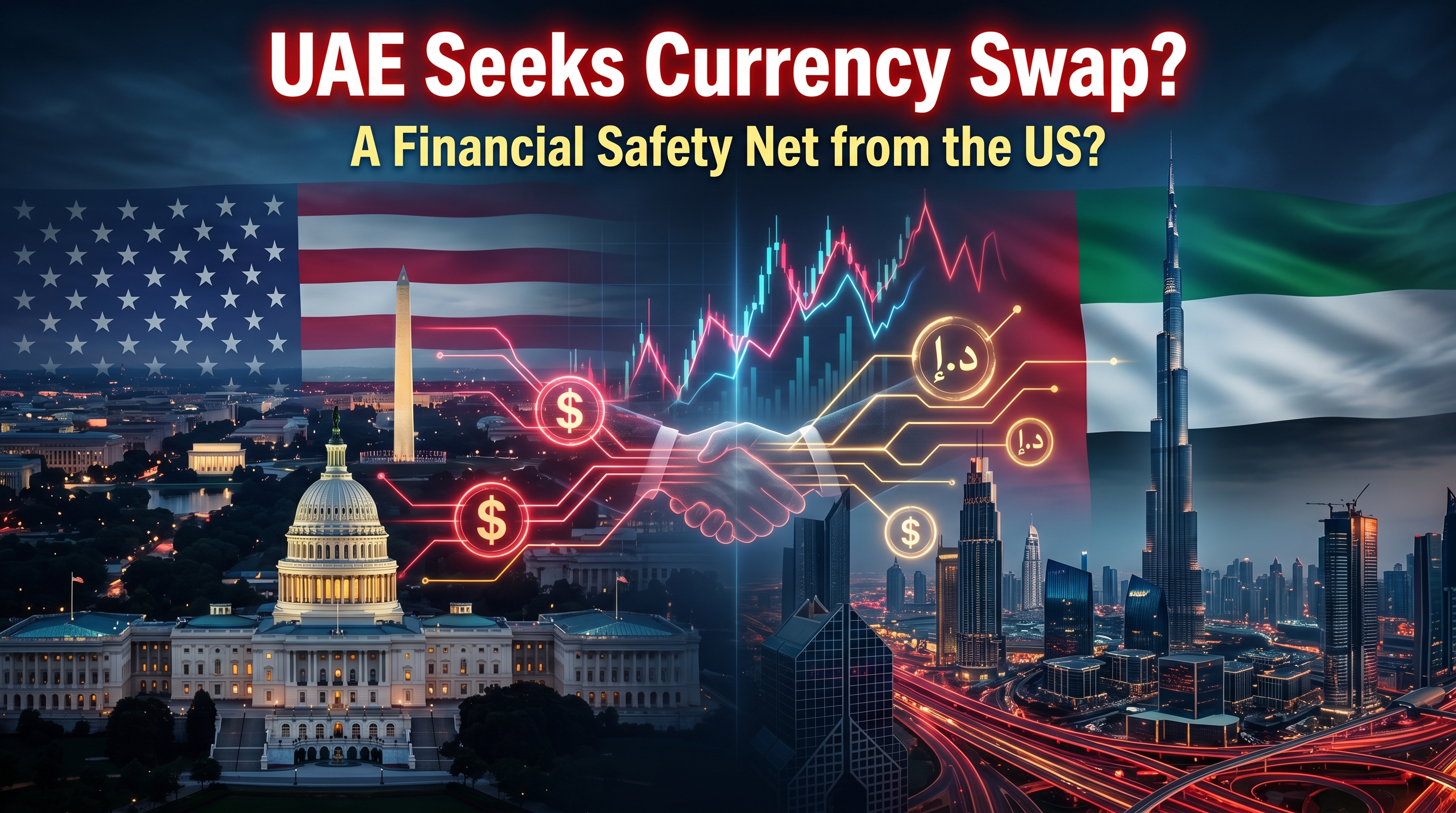
On April 20, 2026, the Governor of the UAE Central Bank met with senior officials from the U.S. Treasury and the Federal Reserve in Washington. The topic was a currency swap — a financial backstop framed in the careful language of monetary policy. First, reported by The Wall Street Journal, the meeting immediately unsettled global markets. Why would a country with more than $2 trillion in sovereign wealth funds require access to emergency dollar liquidity? The answer reveals far more about modern geopolitics, monetary architecture, and the quiet fragility of the petrodollar system than almost any other development arising from the 2026 Iran war.

A currency swap is not a loan. It is a bilateral agreement between two central banks to exchange fixed amounts of their currencies for a defined period, with a binding commitment to reverse the transaction at the same exchange rate. No assets change hands permanently, no credit markets are tested, and no public bond issuance signals distress. Each central bank lends its own currency, receives the other as collateral, and unwinds the swap at maturity. The arrangement provides immediate dollar liquidity without the stigma or market volatility associated with conventional borrowing. The Federal Reserve maintains permanent swap lines with only five central banks: the Bank of Canada, the Bank of England, the Bank of Japan, the European Central Bank, and the Swiss National Bank. Even during the COVID-19 crisis — when temporary lines were extended to nine additional institutions — none were in the Arab world. A swap line with the UAE would therefore mark a historic shift. 

The Iran War and Its Impact on the UAE Economy

The conflict began on February 28, 2026, when U.S. and Israeli forces launched coordinated strikes on Iran. Tehran’s retaliation was as economic as it was military: disrupt shipping through the Strait of Hormuz, target Gulf energy infrastructure, and raise the costs of war for Washington’s regional partners. Commercial shipping traffic collapsed by over 90 percent. The International Energy Agency described the disruption as the largest oil supply shock in modern history—two to three times larger than the 1973 Arab oil embargo. Oil prices surged from $60 to $91 per barrel within weeks. The economic shock quickly spread beyond energy markets. On March 16, Iranian drones struck Dubai International Airport, temporarily halting regional aviation and rattling investor confidence. By April, Rystad Energy estimated the cost of repairing damaged regional infrastructure at $58 billion—doubles its initial projections.


27%

Global oil through Strait

~90%

Shipping traffic drop

$60→$91/bbl

Oil price surge

$58 Billion

Regional repair cost

 The damage was not purely physical. The UAE had deliberately diversified away from oil — non-oil foreign trade reached 2.53 trillion dirhams in the first nine months of 2025. But that diversification made it more exposed to the war's disruptions. Shipping insurance spiked. Tourism froze. Aviation suspended. The sectors that reduced the UAE's oil dependence were themselves tied to the open global trading system that the Strait closure had severed.

The Swap Talks — Who Wants It and Why?

UAE Central Bank Governor Khaled Mohamed Balama raised the swap idea with Treasury Secretary Bessent and Fed officials during IMF Spring Meetings in mid-April. The White House initially said no formal request had been made. Within hours Trump told CNBC he would help the UAE if possible. Bessent then confirmed before the Senate that multiple Gulf and Asian allies had requested swap facilities. The UAE framed its position carefully — not as a request for help but as a signal of confidence. Bloomberg Economics' Ziad Daoud was direct: the UAE wants to join the club of central banks with standing Fed swap lines. Status matters more than dollars.

There is a second message in the request — directed at Beijing, not Washington. The Wall Street Journal reported UAE officials warned they may have to settle oil trades in Chinese yuan if dollar access is disrupted. This is the petrodollar threat: fifty years of Gulf oil priced in dollars, recycled into U.S. Treasuries, sustaining American financial supremacy. If the UAE drifts toward the yuan, that architecture fractures. By raising the swap simultaneously with the yuan warning, Abu Dhabi was practising monetary diplomacy — reminding Washington that its partnership in the dollar system is not unconditional.

"The UAE wants to join the club of central banks that hold standing swap lines with the Fed. Status matters more than dollars."

— Ziad Daoud, Chief Emerging Markets Economist, Bloomberg Economics

For the U.S., the swap is strategically attractive but politically dangerous. It would preserve the dirham peg, keep oil settled in dollars, and prevent the UAE from liquidating its U.S. Treasury holdings in a distressed market — which could itself destabilise American bond markets. But Democrats attacked it as a bailout of a wealthy monarchy while American consumers fund a war costing over a billion dollars a day. The Federal Reserve, which holds final authority, has never extended a swap line to an Arab central bank, making any agreement a genuine policy innovation.

Why Ask for a Swap With $2 Trillion in Assets?


$2+ Trillion

Sovereign Wealth Assets

$300+ Billion

Central Bank FX Reserves

$1.5 Trillion

Banking Deposits

$1+ Trillion

UAE Investment in U.S.

  1.  Wealth is not the same as liquidity. Sovereign funds — ADIA, Mubadala, ADQ — are long-term portfolios in equities, infrastructure, and private assets. Liquidating them under wartime pressure means selling into distressed markets at a loss while broadcasting financial stress. A swap line delivers the same dollar liquidity at a fraction of the cost, with no asset sales and no vulnerability signal.
  2. The dirham peg is non-negotiable. Fixed at 3.6725 per dollar since 1997, it is the structural foundation of the UAE's identity as a stable financial centre. A swap line guarantees the dollar supply needed to maintain that peg when oil revenue — the natural source of dollar inflows — is disrupted by a Strait closure, without touching long-term strategic assets.
  3. A long war changes the arithmetic. The UAE entered this conflict with over $300 billion in FX reserves and liquidity coverage above 146 percent. But six to eighteen months of combined pressure — lost oil revenue, frozen tourism, spiked insurance, reduced investment — can erode even strong buffers. A swap line is insurance bought before it is needed, when it is still cheap.
  4. Status and the petrodollar are the real stakes. Being added to the Fed's swap line list means Washington formally considers the UAE systemically important — not just a wealthy ally. In a region where China's financial reach grows daily, that signal matters enormously. And if the UAE begins settling oil in yuan because dollar access fails during a crisis Washington initiated, fifty years of petrodollar architecture begin to fracture. A swap line is not charity. It is maintenance on a financial infrastructure that serves American interests as much as Emirati ones.

The UAE-US currency swap story is not about a rich country asking for money it does not need. It is about how modern geopolitics operates through monetary policy — how a single financial request can simultaneously serve as a liquidity backstop, a diplomatic signal, a warning to China, and a bid for institutional status. Whether the Federal Reserve extends a facility it has never offered to an Arab central bank will define not just this moment but the architecture of dollar dominance in the Gulf for the generation ahead.