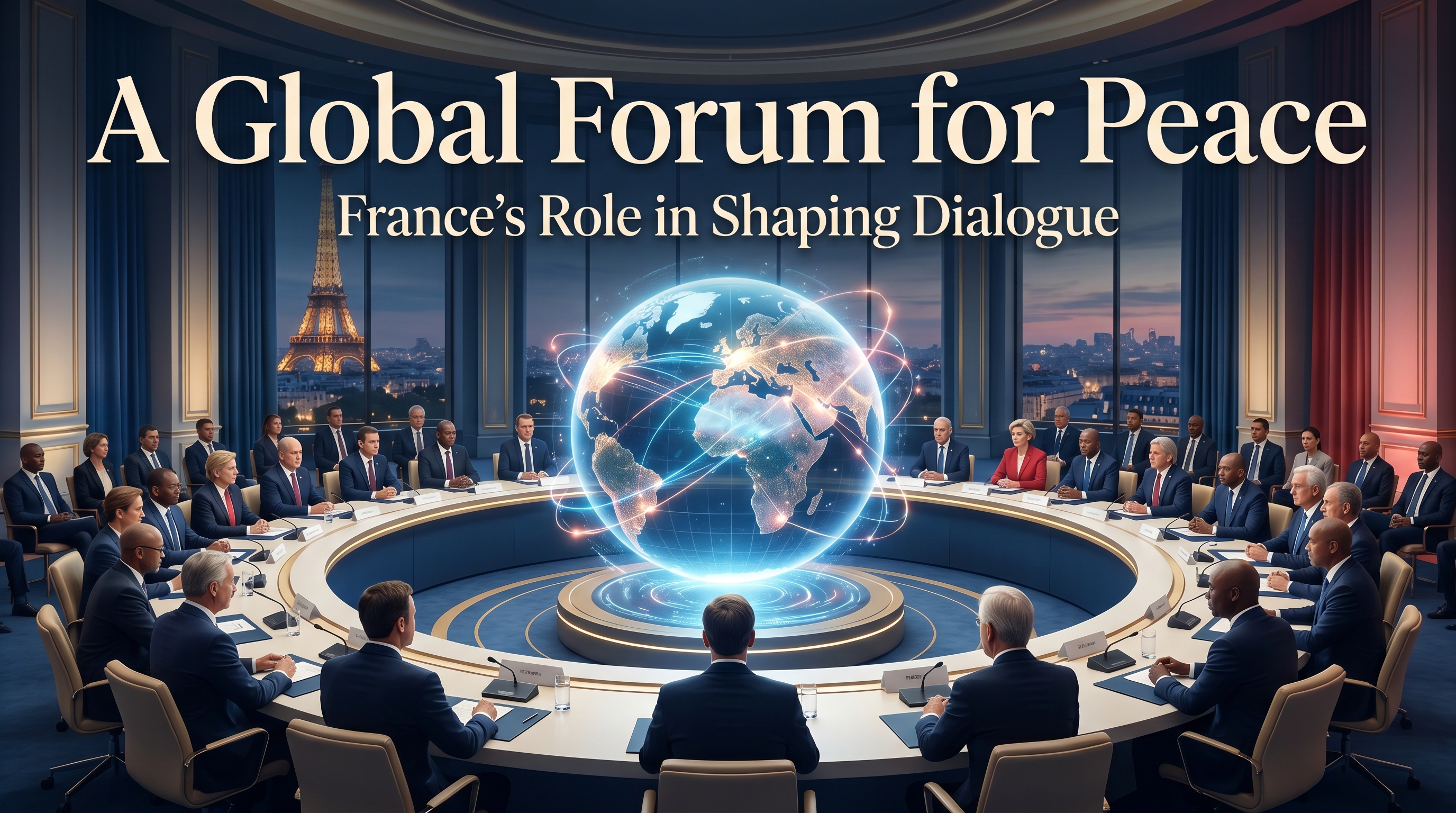
In a world increasingly marked by geopolitical rivalries, fractured alliances and ever-present threats of conflict, the World Policy Conference (WPC) is one of the most significant annual conferences focused on the study of Peace, not just as an aspiration but as a real achievable objective based on dialogue, governance and cooperation. Thanks to an intellectual French leadership, the WPC is a global gathering of ideas on the most important issues of the day - discussed with honesty, courage, and a desire for a more just world.
Peace is more than the absence of conflict. It is the existence of justice, the proper functioning of institutions, and the ability of nations to respect each other. The World Policy Conference represents this wider vision of Peace, and as such, is not a conference, but a movement. Thierry de Manubrial, the Chairman and Founder of the French Institute of International Relations , first conceived the World Policy Conference in 2008. The first one was held in Evian, France - a city with a rich history of international diplomacy - from October 6 to 8, 2008, at the very onset of the global financial crisis, which was about to shake the world's most important economies. This was no coincidence.
The WPC was designed for such times: to offer a platform for leaders, thinkers and diplomats to pause for thought and reflect on the underlying trends that shape human society. The conference was built on a simple set of three principles: that multilateralism must be reformed to meet 21st-century challenges; that the Peace and prosperity of nations cannot be guaranteed by states alone; and that civil dialogue, built on mutual respect, across the political, cultural and ideological spectrum is the only way forward. The WPC has since become one of the most prestigious think-tank-associated conferences in the world. It was listed as the 3rd best Think Tank Conference in the world by the Think Tanks and Civil Societies Program at the Lauder Institute in 2017. Past participants include a who's who of international leaders - heads of state, government ministers, Nobel prize winners, central bank governors and journalists.
France was the natural home of the WPC. France has always been a leader in championing world Peace and multilateralism. From the Peace of Westphalia to Versailles, from the creation of UNESCO in Paris to the adoption of the Paris Climate Change Agreement in 2015, France has been the site where some of the world's most important conversations are had. The World Policy Conference is part of this legacy. In creating the WPC through the French Institute of International Relations (IFRI), Thierry de Manubrial anchored the conference in the French tradition of intellectual and diplomatic thought that sees Peace as the highest political goal, and one that can be achieved through reason, dialogue, and the progressive construction of institutions rather than domination. The annual editions of the WPC have been held in many prestigious cities around the world, such as Evian, Monaco, Vienna, Seoul, Montreux, Marrakech, Doha and Abu Dhabi, demonstrating its global nature. But its spirit is grounded in France's dedication to an open, multipolar world in which Peace is the ultimate political goal.
The Architecture of Peace
The World Policy Conference focuses on a specific set of themes that reflect the times. The 17th edition in Abu Dhabi focused on issues closely related to Peace and global stability, such as:
• Post-Ukraine War Europe - a discussion of how diplomacy and conflict resolution can bring Peace to Europe.
• The War and Peace in the Middle East - a sober reflection on how to end the cycles of violence and establish a Peace in the region that has been the epicenter of conflict in the world.
• The Global Economy in a Polarized World - understanding that economic inequality and instability are a major threat to Peace.
• The Geopolitics of Climate Change - recognizing that environmental challenges are a catalyst for conflict, displacement and instability, and that achieving Peace is impossible without tackling climate change.
• The Age of AI: Assessing the role of disruptive technologies in enhancing or eroding global Peace, through their governance and application.
These themes are not abstract. They are the very real challenges faced by leaders. The WPC offers a unique forum to talk about these challenges with candors, without the trappings of diplomacy. Peace Through Dialogue The World Policy Conference is designed to be a small conference. The year-long event is capped to allow us to build personal connections and have meaningful dialogues. The Conference's plenary meetings, workshops, lunches and dinners all offer different opportunities for open and honest engagement. Speakers have the same opportunity to speak, regardless of their country's size and power. This ethos - that every voice is important, that Peace means listening as well as speaking - is at the very core of the conference structure. The head of state of a small Pacific Island is accorded the same stage as the foreign minister of a great power. The discussions are broadcast - in video, text, and via social media - so that the insights and breakthroughs made in the room can be shared beyond it. In this sense, the WPC is a public good, a resource for citizens, academics, policy makers, and journalists around the world who are seeking Peace in their communities.
Peace Must Be at the Heart of Global Policy
The World Policy Conference is dedicated to Peace because the founders of the WPC know a simple truth: everything else we might do everything we might achieve in terms of economic growth, technological advancement, cultural enrichment, sustainable environmental management rests upon a foundation of Peace. Peace is not simply a goal, but a prerequisite for all other human pursuits. Without Peace, hospitals are attacked, schools are shut, economies are destroyed, and the poor suffer. The WPC is designed to remind world leaders of this reality, and to offer them the ideas, networks and tools they need to preserve and enhance Peace where it exists, and to restore it where it has been destroyed. The conference's guiding principle that the world can and must be "more open, more prosperous, and fairer" is also a vision of Peace: a world where the differences between nations are settled by negotiation, rather than violence; where institutions are sufficiently robust to respectfully manage differences; and where all people benefit from the fruits of human advancement. The WPC has convened a who's who of world leaders committed to Peace and good governance over its 17 editions. The WPC has invited former United Nations Secretary-General Ban Ki-moon, former US Secretary of Defense Robert Gates, Presidents and Prime Ministers from all five continents, and intellectual leaders like Harvard's Joseph Nye to participate in the WPC's discussions. Their presence is a testament to its unique character: the powerful trust it as an honest forum, and the independent trust it as an independent forum. It is independent because it is in the service of Peace.
The Enduring Mission At a time of deep uncertainty - with multiple conflicts raging around the world, the international rules-based system in flux, and emerging technologies with implications for the nature of power - the World Policy Conference is more important than ever. France's role in supporting global Peace by hosting and nurturing this forum is an example of the power of ideas, discussion and intellectual bravery. WPC reminds us that Peace is not a given, but must be created and defended through the kind of robust, high-level, sustained conversation that the conference facilitates.
_6784.jpg)