Top Stories
Building Bridges Through Words Understanding Militant Ideologies in Modern Contexts Security: Beyond Walls and Weapons Upcoming Events: Connecting Ideas and People Previous Milestones: Reflecting on Our Journey Fatwas: Reclaiming the Spirit of Ethical Guidance Role of NATO in Conflict Resolution Washington Peace Deal Between Congo and Rwanda Social Justice and Equality in the Qur’ān: Implications for Global Peace The Qurʾānic Concept of Human Equality: An Analysis against Racism and Ethnic Discrimination in Contemporary Societies Reinterpreting Dhimmitude: A Reconsideration of Its Social and Political Functions in the Modern Context How China Is Playing the Long Economic War Ukraine Peace Efforts Advance Cautiously Despite Partial Alignment Among Parties How Pakistan-Libya Military Relations Strategic Outreach, Economic Stakes and Geopolitical Implications Aleppo Clashes as Syria and Kurdish-Led SDF Agree to Ceasefire Across the Border, Pakistani Ulema Stand Against Afghan Girls\' Education Ban Pakistan announce 500 fully-funded scholarships for Bangladeshi students in 8 programs How theTaliban regime threat for reginal peace Women Left Behind in Khyber Pakhtunkhwa’s Education System Sudan’s Civil War: Anatomy of the World’s Largest Humanitarian Crisis Changing Security Architecture in Central Asia Pakistan Leads India on Economic and Peace Indicators in 2026 : Gallup Survey Submerged Classrooms, Long-Term Learning Loss Pakistan Security Report 2025: Terrorism Trends and the Peace Deficit HEC’s MAKTAB Initiative Signals a New Era for Higher Education Southern Yemen Faces Tensions and Urgent Need for Peace IUT Strengthens Education Integrity in Bangladesh Pakistan’s Arms Sales Contracts (2024–25) and the Peace Dimension Pakistan\'s Contribution to UN Peacekeeping Operations for Global Peace Pakistan Enhances Educational Cooperation with Sri Lanka through Scholarship The Growing Defense and Economic Nexus of the Muslim World Charter of Trump’s Board of Peace Pakistan & Myanmar Prioritize Education Strategic Saudi defense agreements are redefining the Middle East\'s security architecture What would be the consequences of the U.S.–Iran Conflict on Pakistan? How Indian Cricket Politics Affect Regional Peace The Kashmir issue remains a central peace and stability in South Asia American Weapons in Afghanistan Are Destabilizing Pakistan Global Education Coalition sixth annual meeting A New Chapter for Pakistan’s Universities: Leadership, Stability, and Vision under the New HEC Chairman The Evolution of the IMCTC into a Global Security Pillar Reintegration Initiative: Analyzing the 2026 IMCTC Engagement in Pakistan Psychosocial Warfare and the IMCTC Peace Journalists Initiative (2026) The Concept of ‘Ummah’ in the Qurʾān: Transcending Race, Tribe, and Ethnicity HEC Reforms Regulation, Defends Academic Freedom Pakistan’s Evolving Role in Fostering Peace and Security on the African Continent Recontextualizing Pakistan’s Role in the Board of Peace War in the Middle East: Measuring the Cost The Silent Bridge: Pakistan’s Strategic Neutrality and the Quest for Middle Eastern Stability The Geography of Escalation: Living in an Age of Permanent Crisis Mapping the Educational Crisis in the Middle East Conflict The Blind Alley of “Epic Fury”; A War with no End game A Pakistani Voice Against Digital Islamophobia: A Landmark Academic Contribution World Eye on Pakistan for Middle East Peace Leading with Truth, ICEP’s Analysis Outlasted the Skeptics on Middle East Crisis World Powers Push for Deal U.S. Presents 15-Point Plan and Iran Responds with 5 Conditions Pakistan and Türkiye Open New Chapter in Academic Cooperation with Strategic Initiatives Pakistan at the Crossroads of Global Trade as a Logistics Revolution Unfolds Why Ethical Dialogue necessary in a Diverse Pakistan for a Peacebuilding Initiative Pakistan\\\'s Game-Changer Role for World Peace Entrepreneurship Education Is Shaping Pakistan\'s Economic Future Dr. Jamil Akhtar Featured in Prestigious Brill Encyclopaedia (2026) A Milestone in Global Interfaith Scholarship Peace Light in a Dark Night WAR RESHAPES PAKISTAN’S ECONOMY AND OPEN DOORS FOR INTERPRENEURS From Gaza to Lebanon: ICC, UN, and the Unanswered Duty to Prosecute Can Pakistan turn a temporary ceasefire into lasting middle east peace? Bridging the Gap: Confronting Education Inequality in Pakistan Hierarchical Culture In Pakistani Organizations \"How It Kills Innovation — and What Leaders Can Do About It\" Can Diplomacy Survive the Iran Crisis? Peace Efforts in an Age of Permanent Escalation Why are Peace Talks a US strategic priority? Features of Intellectual Property in the Age of Artificial Intelligence (In the Context of World Intellectual Property Day) A Global Forum for Peace, Governance, and a Better World (France\'s Landmark Contribution to International Dialogue) IS UAE WANT A \\\'CURRENCY SWAP\\\' WITH THE USA Energy War by Sea: The Hormuz Blockade Proves Oil is Still a Weapon The End of Strategic Dependence In Europe? Pakistan\'s Strategic and Structural Evolution from Crisis to Consolidated World Peace Silent Deterrence: Hangor-Class SSP-2800 and Undersea Strategy of Pakistan Inside the $9 Billion Prediction Market Revolution Pakistan at the Crossroads: Between Fragile Stability and the Weight of Structural Crisis WHY DIALOGUE FAILS IN CONFLICT ZONES; A LESSON FOR POLICY MAKERS The Crisis of American Legitimacy in the Post-Unipolar Era THE OIL CLUB UAE JUST QUIT Inside OPEC’s Biggest Defection in Decades — and What It Means for the World The Kashmir Dispute: International Institutional Failure and Humanitarian Consequences
Peace

Can Pakistan turn a temporary ceasefire into lasting middle east peace?

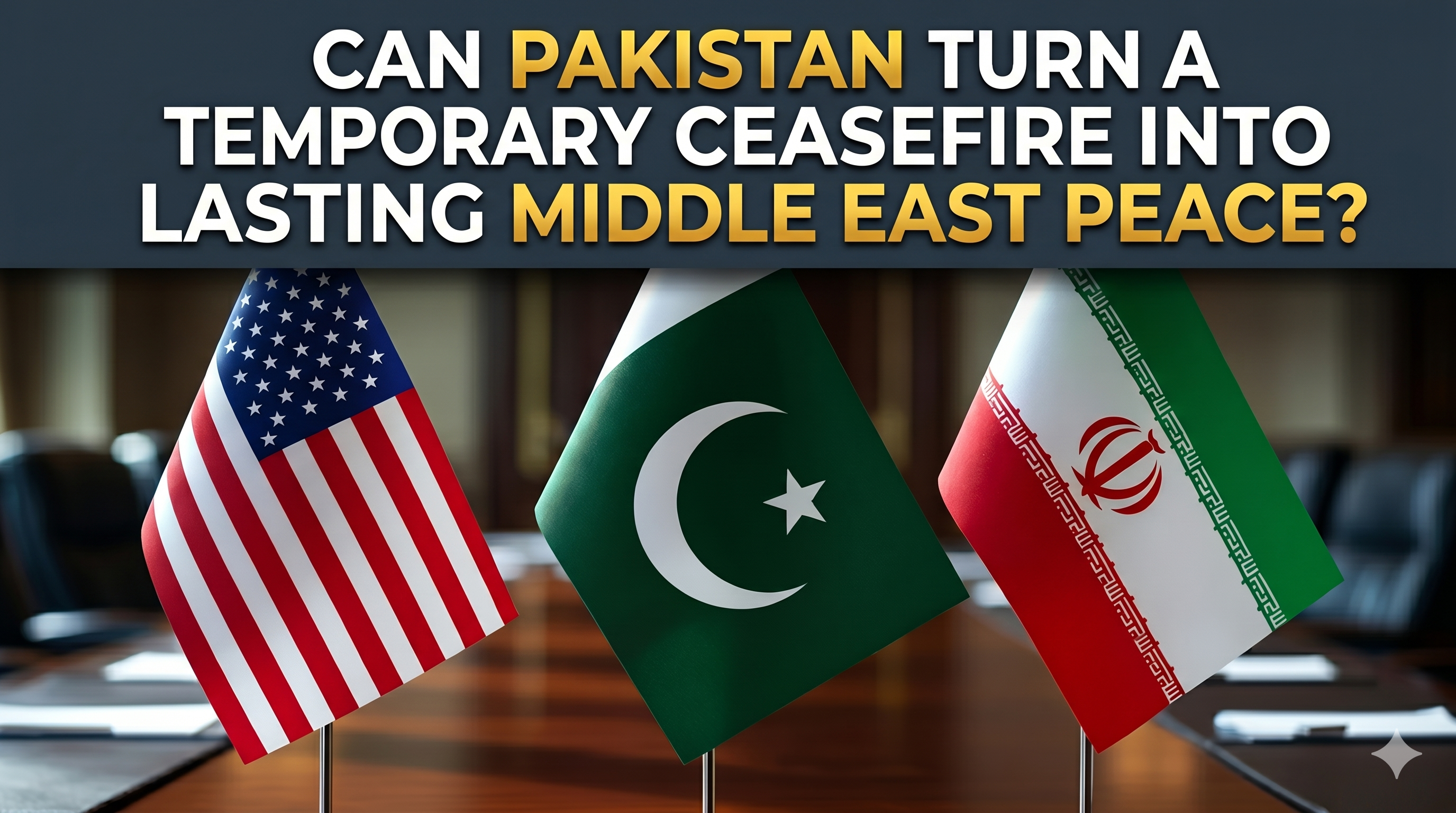
The Middle East has suffered, and continues to suffer, from ongoing tensions between the US and Iran. As it is the strategic region for global powers, US-Iran tensions affected oil routes, regional alliances and global security balances. In a recent official statement U.S. officials have warned that the ceasefire is fragile and that any violation could restart escalation, maintaining a strict but cautious diplomatic stance toward Iran. Pakistan is a country that both sides trust; that is why both agreed to hold peace talks in the capital of Pakistan on Saturday, April 11, 2026, local time in Islamabad. Many mediators only provide platform diplomacy, but actual success depends on follow up diplomacy not just hosting talks. This is a diplomatic opportunity for Pakistan, and its role is very crucial as it requires strong legal and political commitment along with neutrality. Just as the United Nations promotes peace between nations, Pakistan is trying to do the same to maintain long-term stability. Here, a question arises: Pakistan’s mediation efforts converted the war between the US and Iran into a two-week fragile peace, but will this temporary ceasefire turn into permanent peace?

Pakistan, acting as a facilitator, is providing legal grounds for sustainable peace between states. However, peace cannot be enforced upon other nations. In its public messaging, Pakistan has publicly positioned itself as a neutral diplomatic platform aimed at facilitating dialogue rather than imposing outcomes, reinforcing its role as a bridge between competing geopolitical interests. According to Article 33 of the UN Charter, part of Chapter VI, parties to any serious dispute must first seek peaceful solutions through negotiation, mediation, arbitration, or judicial settlement. Pakistan is trying its best to follow the United Nations approach in this sensitive situation. The country is taking advantage of its relations with different blocs, i.e., Middle Eastern countries and Western powers by acting as a bridge between conflicting sides to achieve durable peace.

A ceasefire is the first legal step towards peace and a temporary halt in fighting, which was facilitated by Pakistan. It is often fragile; however, if proper facilitation is provided, this temporary calm can turn into long-term harmony as it guides and encourages reasonable and voluntary solutions. Durable peace requires formal agreements under international law, and it becomes easier if the efforts of a third party are carried out correctly. As we have seen in many examples, ceasefires have broken down because assistance was not handled properly. For instance, in the Sri Lankan civil war, the ceasefire mediated by Norway between the LTTE (Liberation Tigers of Tamil Eelam) and the Government of Sri Lanka collapsed because the mediator did not complete its role effectively, and the root causes remained unresolved. To ensure peace, it is the facilitator’s job to address the root causes that escalate conflict and resolve them by bringing both parties into an agreement that is acceptable to both sides.

We should also keep in mind that success depends entirely on the consent of the conflicting parties, as international law is consent-based, not coercive. Mediation can create dialogue but cannot guarantee peace outcomes. Iran and the United States are sovereign states, and according to the principle of non-intervention, Pakistan can mediate but cannot impose agreements or pressure parties into legal obligations. Iranian officials have emphasized that any agreement must fully respect national sovereignty and long-term security interests, indicating that while dialogue is possible, imposed conditions will not be accepted.

Pakistan can promote dialogue, trust-building, and continuous diplomacy, but it cannot guarantee peace. True peace depends on the political will of states, not just mediation efforts. We must accept that this temporary ceasefire facilitated by Pakistan is also of great importance in reducing tensions in the Middle East, as short pauses reduce human suffering, military escalation, and regional instability. The success of any mediation effort is not determined in Islamabad alone; it depends on whether the conflicting parties accept mutual constraints and commit to binding agreements. In this scenario, the significance of Pakistan’s role continues to lie in its ability to facilitate dialogue between two deeply hostile rival parties. However, the relationship between the United States and Iran has long been marked by mistrust, security concerns, and regional power politics; therefore, it is not possible to achieve a lasting solution through a single round of talks but such engagements can pave the way for a durable settlement.
Disclaimer: The views expressed in this article are solely those of the author and do not necessarily reflect the position of ICEP.