Top Stories
Building Bridges Through Words Understanding Militant Ideologies in Modern Contexts Security: Beyond Walls and Weapons Upcoming Events: Connecting Ideas and People Previous Milestones: Reflecting on Our Journey Fatwas: Reclaiming the Spirit of Ethical Guidance Role of NATO in Conflict Resolution Washington Peace Deal Between Congo and Rwanda Social Justice and Equality in the Qur’ān: Implications for Global Peace The Qurʾānic Concept of Human Equality: An Analysis against Racism and Ethnic Discrimination in Contemporary Societies Reinterpreting Dhimmitude: A Reconsideration of Its Social and Political Functions in the Modern Context How China Is Playing the Long Economic War Ukraine Peace Efforts Advance Cautiously Despite Partial Alignment Among Parties How Pakistan-Libya Military Relations Strategic Outreach, Economic Stakes and Geopolitical Implications Aleppo Clashes as Syria and Kurdish-Led SDF Agree to Ceasefire Across the Border, Pakistani Ulema Stand Against Afghan Girls\' Education Ban Pakistan announce 500 fully-funded scholarships for Bangladeshi students in 8 programs How theTaliban regime threat for reginal peace Women Left Behind in Khyber Pakhtunkhwa’s Education System Sudan’s Civil War: Anatomy of the World’s Largest Humanitarian Crisis Changing Security Architecture in Central Asia Pakistan Leads India on Economic and Peace Indicators in 2026 : Gallup Survey Submerged Classrooms, Long-Term Learning Loss Pakistan Security Report 2025: Terrorism Trends and the Peace Deficit HEC’s MAKTAB Initiative Signals a New Era for Higher Education Southern Yemen Faces Tensions and Urgent Need for Peace IUT Strengthens Education Integrity in Bangladesh Pakistan’s Arms Sales Contracts (2024–25) and the Peace Dimension Pakistan\'s Contribution to UN Peacekeeping Operations for Global Peace Pakistan Enhances Educational Cooperation with Sri Lanka through Scholarship The Growing Defense and Economic Nexus of the Muslim World Charter of Trump’s Board of Peace Pakistan & Myanmar Prioritize Education Strategic Saudi defense agreements are redefining the Middle East\'s security architecture What would be the consequences of the U.S.–Iran Conflict on Pakistan? How Indian Cricket Politics Affect Regional Peace The Kashmir issue remains a central peace and stability in South Asia American Weapons in Afghanistan Are Destabilizing Pakistan Global Education Coalition sixth annual meeting A New Chapter for Pakistan’s Universities: Leadership, Stability, and Vision under the New HEC Chairman The Evolution of the IMCTC into a Global Security Pillar Reintegration Initiative: Analyzing the 2026 IMCTC Engagement in Pakistan Psychosocial Warfare and the IMCTC Peace Journalists Initiative (2026) The Concept of ‘Ummah’ in the Qurʾān: Transcending Race, Tribe, and Ethnicity HEC Reforms Regulation, Defends Academic Freedom Pakistan’s Evolving Role in Fostering Peace and Security on the African Continent Recontextualizing Pakistan’s Role in the Board of Peace War in the Middle East: Measuring the Cost The Silent Bridge: Pakistan’s Strategic Neutrality and the Quest for Middle Eastern Stability The Geography of Escalation: Living in an Age of Permanent Crisis Mapping the Educational Crisis in the Middle East Conflict The Blind Alley of “Epic Fury”; A War with no End game A Pakistani Voice Against Digital Islamophobia: A Landmark Academic Contribution World Eye on Pakistan for Middle East Peace Leading with Truth, ICEP’s Analysis Outlasted the Skeptics on Middle East Crisis World Powers Push for Deal U.S. Presents 15-Point Plan and Iran Responds with 5 Conditions

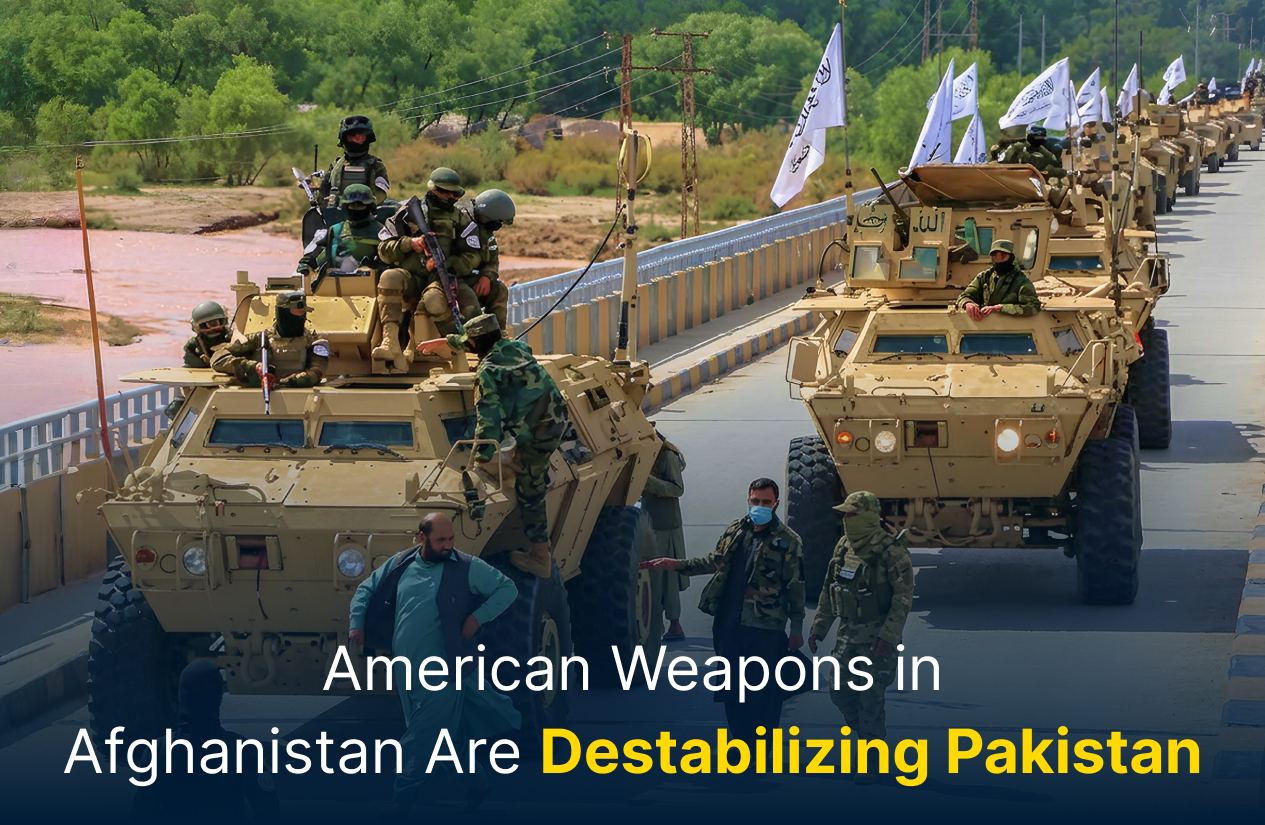
American Weapons in Afghanistan Are Destabilizing Pakistan

The security environment across South Asia has evolved further since the U.S. withdrawal from Afghanistan in 2021, which left large quantities of advanced military equipment behind. Since then, security experts and regional governments have repeatedly cautioned that the uncontrolled circulation of these weapons risks strengthening militant networks with cross-border reach. Pakistan, which shares a long and porous border with Afghanistan, has in recent years become increasingly vocal about concerns that the inflow of modern arms is intensifying terrorism and internal instability.

Pakistan’s political and security leadership has consistently highlighted the growing use of American-made weapons by militant groups operating along the Pakistan–Afghanistan border. Officials argue that the sudden collapse of the former Afghan government and the rapid Taliban takeover created a security vacuum, allowing weapons to seep into black markets and militant supply chains. From Islamabad’s perspective, this development has significantly enhanced the operational effectiveness of terrorist organizations, particularly those targeting civilians and security forces in sensitive border regions.

Developments on the ground have reinforced these fears. Recent counterterrorism operations in Balochistan and Khyber Pakhtunkhwa revealed that militants involved in attacks were equipped with advanced night-vision devices, modern assault rifles, and upgraded communication systems, believed to have originated from abandoned stockpiles in Afghanistan. Pakistani security officials state that access to such equipment has made attacks more coordinated, more lethal, and increasingly difficult to counter, forcing the state to expand counterterrorism operations and strengthen border security.

Islamabad has repeatedly urged the international community to recognize the broader security implications of the Afghan withdrawal and to take collective action to prevent the proliferation of these weapons. Pakistan maintains that the issue is not confined to its borders but represents a wider regional and global threat, as the spread of advanced arms could empower transnational extremist networks and destabilize South and Central Asia. Through diplomatic channels, Pakistan has called for stronger monitoring mechanisms, intelligence sharing, and coordinated efforts to trace and recover illicit weapons.

The government emphasizes that Pakistan remains committed to combating terrorism through intelligence-driven operations, improved border management, and regional cooperation. However, officials stress that long-term stability will depend on shared international responsibility and sustained cooperation to ensure militant groups do not exploit the security vacuum left in Afghanistan.

The Islamabad Center for Peace and Education (ICEP) views the post-withdrawal proliferation of sophisticated weaponry as one of the most serious security challenges confronting the region. The Center argues that Pakistan’s concerns are grounded in genuine security realities, as the availability of advanced arms increases the risk of cross-border militancy and regional destabilization. It underscores that durable peace in South Asia will require stronger international cooperation, responsible arms control, and renewed diplomatic engagement to prevent Afghanistan from becoming a hub for weapons trafficking and extremist resurgence.