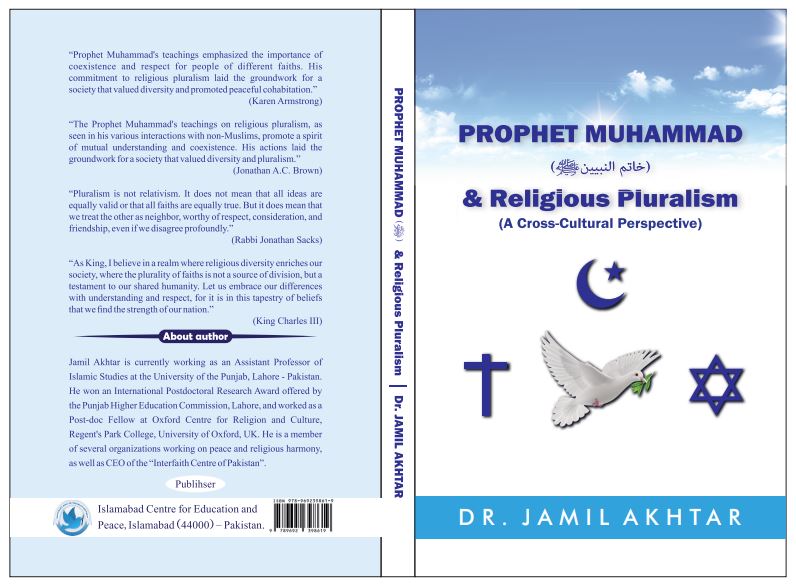
In the ever-evolving tapestry of human history, Prophet Muḥammad (ﷺ) has done something as a guiding force in shaping religious interfaces and transforming determined cultures’ ethos. The book at hand, “Prophet Muḥammad (ﷺ) and Religious Pluralism (A Cross-Cultural Perspective),” ventures on an elaborate investigation of the Prophet’s encounters with Christians and Jews, unfolding the intricate dimensions of his relationships to understand something about religious pluralism along with instructive angles that apply to current struggles. It is my pleasure to welcome the readers as we navigate through the historical landscape of Prophet Muḥammad (ﷺ)’s life. As a scholar who is deeply involved in analyzing interfaith relations, the aim has been to elucidate the Prophet Muḥammad (ﷺ)’s more complex interactions with Christians and Jews. The introduction sets out a personal view of why this exploration is historically important and pertinent to our current global context.
The introductory chapter provides a brief background
of Prophet Muḥammad (ﷺ)’s
life to establish the broader historical context. This book purposefully makes
the broader context, highlighting the importance of studying the Prophet’s
relationship with different religious communities. Embarking on this scholarly
voyage, it becomes apparent that the subtleties of interfaith politics in
Prophet Muḥammad (ﷺ)’s time are central
to our globally connected world.
The second chapter presents how the Prophet interacted with Jewish
communities during both Mecca and Madīnah times. The Constitution of Madīnah
formation is considered a demonstration that
the Prophet was dedicated to peaceful co- existence. The expulsion of Jewish
tribes from Madīnah as an act to achieve peace is investigated, and the Treaty of Ḥudaybiyyah illustrated how diplomatic attempts
to achieve harmony were carried out. The chapter also points out that Prophet
Muḥammad (ﷺ)
was engaging with Jewish scholars and how Jews converted to Islām.
Following this, the third chapter reveals the
relations of Prophet Muḥammad
(ﷺ)
with Christians from his early age to diplomatic relationships with Christian
communities. The Constitution of Madīnah is
considered a landmark document that sheds light on the Prophet’s vision for a pluralistic society where people
can live and cooperate peacefully. This chapter continues to delve into Prophet
Muḥammad (ﷺ)’s
meetings with Christian delegations and the narratives
of people who decided to follow Islām highlighting inclusivity in his message.
In the fourth chapter, the author draws timeless lessons from the Prophet’s
life. It discusses his principles applied in addressing modern issues and
challenges; it promotes communication between people of different cultures to achieve mutual understanding. The
historical instances of religious pluralism during Islāmic rule in Andalusian
Spain and the Ottoman Empire are analyzed, and examples from contemporary cases
within modern Islāmic states are discussed. This
chapter also
encourages opening up on religious plurality and fosters an inclusive
atmosphere.
The fifth chapter tackles obstacles and misconceptions
regarding Prophet Muḥammad
(ﷺ)
and religious pluralism. It demolishes widely held myths, such as charges of
enforced conversions and misunderstandings in the past. It deals with modern
issues, in which it critically discusses Islāmophobia and its repercussions on
interfaith connections providing ways to encourage understanding and tolerance.
Globalization, interconnectedness, and the rise of extremism have cornered
religious pluralism today; thus an overall outlook into the issues associated
with it is sounded out in terms of challenges. The sixth chapter examines how
the teachings of the Prophet Muḥammad
(ﷺ)
are contemporary in promoting religious harmony. It explores the role of
academics and religious leaders in advancing pluralism, highlighting joint
efforts to promote understanding and campaigns to combat extremism and advance
tolerance. These initiatives’ effects on world peace and co-existence are
carefully considered.
Through the pages of this book, readers are invited to travel back
in time and follow the Prophet Muḥammad
(ﷺ)
as he makes his way through the difficult terrain of religious pluralism. The
stories throughout these chapters aim to reveal the wisdom in the Prophet’s interactions and provide
insightful guidance for promoting harmony in the modern world. It will set the
stage for an interesting and illuminating investigation of the Prophet
Muḥammad
(ﷺ)’s
legacy and its lasting influence on navigating diversity in various historical
periods and geographical spaces. In short, this research book aims to
contribute to the current discussion on religious pluralism by providing a
thorough analysis of Prophet Muḥammad (ﷺ)’s interactions with
Jews and Christians. It aims to identify timeless lessons, tackle current
issues, and show the way toward a world that is more tolerant and understanding
by using a cross- cultural lens.
07-January-2024